Morocco’s experience in urban renewal was presented in Fuzhou, China, during the World Cities Day 2026 programme. The participation gave Morocco an international setting in which to explain the principles guiding its work on urban areas and buildings threatening collapse. It also placed that institutional experience within broader discussions about improving housing conditions and regenerating cities through approaches that respond to both physical risks and the needs of established communities.
The event unfolded in two distinct stages. The principal global observance took place on October 31, 2026, followed by thematic forums on November 1. The edition was organized under the theme “Regenerating the City: Adequate Housing for All.” This sequence connected the central observance with more focused discussions covering housing, urban planning, governance and practical delivery, while preserving the separate dates of the main celebration and the subsequent forum sessions.
Moving from response to risk prevention
Azhar Ktitou, director general of Morocco’s National Agency for Urban Renewal and the Rehabilitation of Buildings Threatening Collapse, was listed among the speakers in the forum on urban planning, governance and delivery for adequate housing. According to the account carried by MAP, her contribution addressed Morocco’s approach to urban renewal and the rehabilitation of unsafe buildings, presenting these areas as parts of an integrated model rather than separate fields of public intervention.
The approach presented in Fuzhou reflects a shift away from a mainly curative response and toward earlier action. It emphasizes identifying risks before they become more acute, then planning securing and rehabilitation operations accordingly. Under this framework, urban renewal can be understood as a coordinated process combining prevention, planned intervention and improvement of living conditions, rather than as a series of isolated measures taken only after serious deterioration has already become apparent.
A legal framework and an institutional coordinator
This model is supported by Law 94-12, which establishes rules concerning buildings threatening collapse, urban renewal operations and the national agency responsible for the field. Article 22 states that an urban renewal plan is intended to enhance urban space and improve living and housing conditions. The law identifies rehabilitation of the built fabric, along with architectural and urban heritage, among the means through which those objectives may be pursued.
Within this framework, ANRUR has been described as coordinating institutional and territorial stakeholders while assisting local authorities with urban renewal projects. That support is intended to help projects reflect the characteristics of the places in which they are implemented. The agency’s role therefore connects the national legal structure, local responsibilities and conditions on the ground, supporting differentiated responses instead of treating varied urban settings as though they presented identical needs and constraints.
Bringing residents into project development
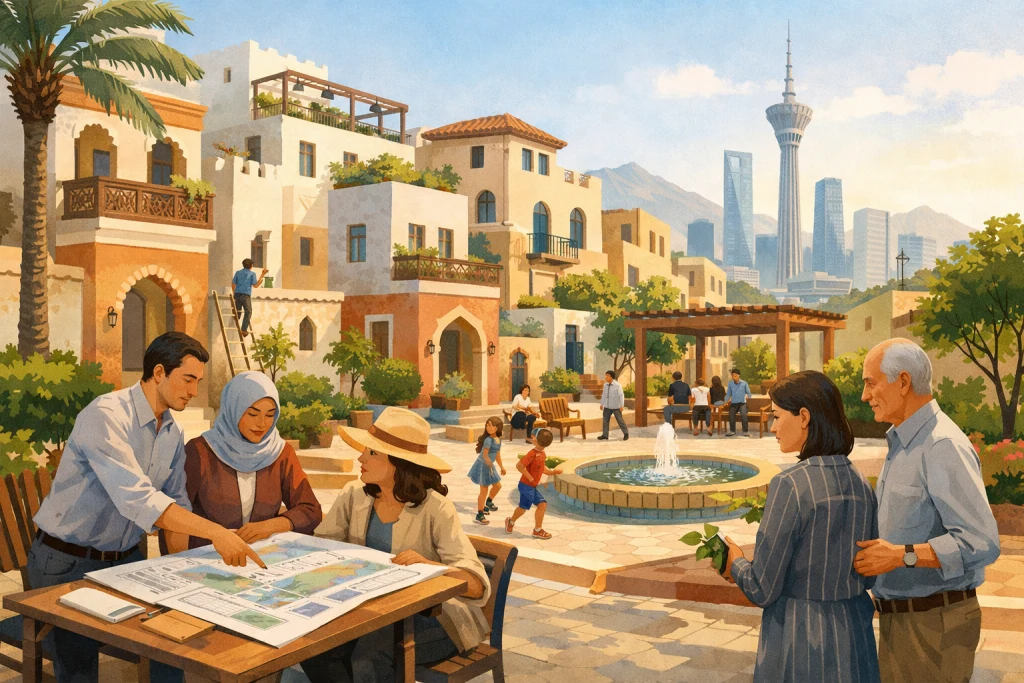
The Moroccan presentation also stressed the involvement of residents and civil society organizations from the diagnostic and project-design stages. This participation is accompanied by an emphasis on social support mechanisms for affected populations. The approach therefore treats residents as participants in the renewal process, not merely as recipients of technical decisions, and links the physical rehabilitation of buildings and neighbourhoods with attention to the circumstances of the people directly concerned by planned interventions.
Such participation is particularly relevant because implementation can face several interconnected constraints. The challenges identified include complex land-tenure situations, multiple property owners and institutional participants, relocation requirements and the financial capacity of households. These conditions make standardized responses difficult to apply. They also support the case for differentiated solutions that reflect local characteristics and combine technical planning with suitable arrangements for the residents and communities affected by an urban renewal project.
Connecting with international priorities
Morocco’s contribution aligned with the broader direction established by UN-Habitat for the Fuzhou gathering. The organization framed the event around people-centred regeneration, adequate and affordable housing, protection of established communities and safeguards against displacement. The emphasis in the Moroccan presentation on resident involvement and social support fits within this international discussion, while its preventive approach adds an institutional perspective on managing risks linked to vulnerable buildings and ageing urban fabric.
The gathering brought together officials working in housing, urban development and public works. Its discussions addressed planning, governance, financing and implementation of the New Urban Agenda. In that setting, the Moroccan presentation offered an example centred on early risk identification, rehabilitation of the built environment, coordination among stakeholders and adjustment to territorial conditions. These elements connected Morocco’s national framework with the event’s wider focus on delivering adequate housing through practical and people-centred urban regeneration.
The precise scope of Morocco’s presentation
The available evidence documents the presentation of an existing Moroccan approach based on Law 94-12, ANRUR’s coordinating role and a transition toward earlier intervention. It does not establish the launch of a new programme, a new funding commitment, a bilateral agreement or a regulatory change. The immediate significance of Morocco’s participation therefore lies in sharing an institutional framework at an international forum focused on urban regeneration, governance and adequate housing for all.
The message presented in Fuzhou brought together several complementary components: risk prevention, planned rehabilitation, institutional coordination, resident participation and adaptation to local circumstances. In the approach described, urban renewal is intended to improve living conditions and strengthen urban resilience. Morocco’s participation consequently illustrated how a national legal and institutional framework can contribute to international exchanges about regeneration that protects communities, addresses vulnerable buildings and responds to the distinct characteristics of each territory.