
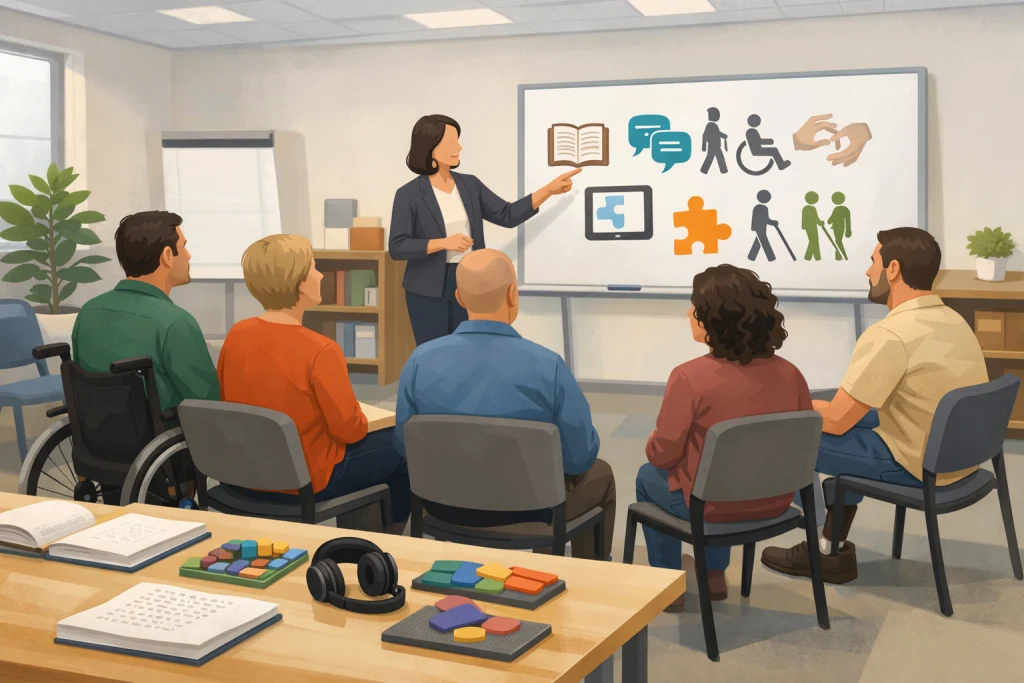
A specialized session on educational support for children with autism spectrum disorder concluded in Ifrane on Sunday, November 8, 2026. Held over three days, from November 6 through November 8, the training combined knowledge-building with work on improving support practices. This structure was intended to provide participants with foundations connected to the educational situations they may encounter while supporting children or young people with autism.
The session involved 30 participants from a range of backgrounds. They included young adults, mothers, higher-education students and representatives of associations active in autism support. Association Mosaïque deputy president Samir Ayadi said the participants came more broadly from associative and educational environments, including teachers and special-education specialists. The group therefore brought together family, academic, professional and civil-society perspectives within the same training program.
Combining knowledge with practical methods
The program combined theoretical presentations with practical workshops. Its content covered the characteristics of autism, communication and attention to individual needs. By addressing those areas within one session, the training connected an understanding of autism with methods of educational support. The available reporting confirms that these subjects were taught, but it does not establish that the training has already produced measurable changes in services or outcomes for participating children.
The workshops also addressed adapting activities, managing behavior, supporting autonomy and encouraging participation. These areas complemented the work on communication, individual needs and educational support. The documented immediate purpose was to improve the preparation of people expected to provide supervision and assistance. No completed impact evaluation has yet shown whether the skills covered during the session have improved children’s experiences, participation or access to effective support.
Preparing teams for inclusive settings
The training is intended to prepare educational support teams for inclusive camps and inclusive residences serving children or young people with autism. It therefore represents a preparatory step for adults who may work within those settings. The verified information concerns the completed Ifrane session and the competencies included in its program. It does not confirm that additional places, residences, camps or support services have already become operational as a result.
For families and associations, the immediate documented development is the additional preparation received by potential support personnel. No measured outcome for children, completed assessment of service quality or quantified expansion of provision had been reported at publication time. Keeping this distinction clear acknowledges the value of professional preparation without presenting it as proof of results that have not yet been evaluated or of services that have not yet been confirmed.
Cooperation between institutions and civil society
The initiative was organized through a partnership involving Association Mosaïque and government departments responsible for family or social development and social inclusion. Reports use slightly different wording for the official portfolios concerned, so their titles should not be merged into a single unverified designation. What is consistently established is cooperation between public institutions and civil society around training people expected to support children or young people with autism.
Minister Delegate for Social Inclusion Rachid Hamouni visited the training and met its participants. During the visit, he emphasized training, institutional cooperation and partnership with civil society. His presence highlighted coordination among the organizations involved in preparing support teams. It did not, however, constitute an evaluation of the session’s eventual effects on children, young people, families or the inclusive settings in which trained participants may later become involved.
Participants from varied backgrounds
The composition of the group reflected several forms of involvement in autism support. Association representatives were joined by mothers, students, teachers, young adults and special-education specialists. According to the organizer’s account, this brought people from educational, family and civil-society backgrounds into a shared program. Their work covered both fundamental knowledge and practical approaches related to communication, individualized needs, adapted activities, autonomy, participation and behavior management.
The figure of 30 participants provides a clear measure of attendance at this session, but it does not by itself demonstrate a wider reach. Published information does not specify how many participants will later support children or identify the particular settings in which each person might work. The confirmed result is therefore the completion of a collective training session involving varied profiles, rather than the deployment of a new support network.
A guide and further training remain prospective
Organizers said the project provides for a practical guide intended to harmonize support methods and strengthen supervising teams. The guide remains a planned deliverable rather than a completed or distributed result. The available information does not confirm its final contents, completion date or future conditions of use. Any assessment of its contribution will consequently need to wait until the document is finalized and applied within the relevant support arrangements.
Another training session was also announced in preparation for the next summer season, but its precise date and delivery remain unconfirmed. Plans concerning future inclusive camps, residences and a broader beneficiary reach must likewise be treated as prospective. By contrast, the session held from November 6 through November 8 is documented as completed. This separates the initiative’s accomplished training stage from the additional steps that organizers still intend to pursue.
Progress whose effects remain to be assessed
The Ifrane session provides a foundation of preparation for people who may participate in educational support for children and young people with autism. Its subjects covered several practical dimensions, ranging from communication and activity adaptation to autonomy, participation and behavior management. The delivery of this educational content is established, while its future application will depend on the support actually provided within planned camps, residences or other inclusive settings.
The next observable steps will include the possible delivery of the additional session, the announced completion of the practical guide and the effective involvement of trained teams. Later evaluation would be needed to determine any effects on support quality or on the experiences of the children and young people concerned. For now, the verifiable outcome is a completed training session backed by institutional and civil-society cooperation, with several extensions still at the planning stage.