Fès is scheduled to host the sixth Regional Forum on Sustainable Agriculture on Wednesday, November 11, 2026. Information available on the event date still describes it as a planned gathering. Its announced location, theme, organizers and program can therefore be presented, but the available evidence does not establish that the forum has already taken place or that any conclusions, commitments or outcomes have resulted from its discussions.
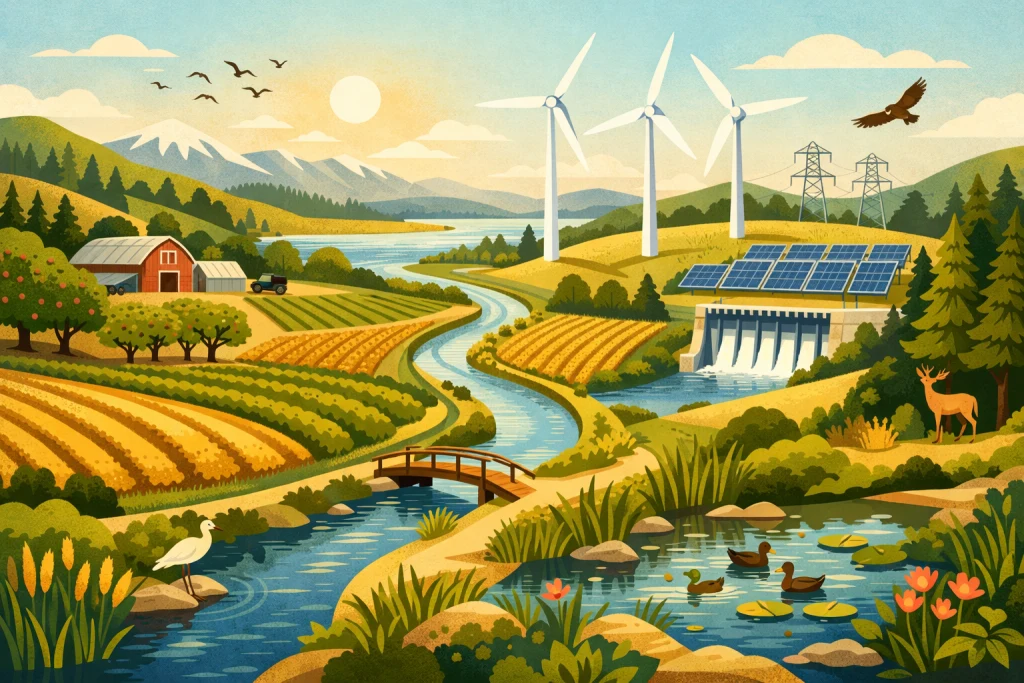
This edition focuses on the Water–Energy–Food–Ecosystems nexus and its relationship with sustainable and resilient agricultural systems. Instead of treating each resource and need separately, the approach considers how they interact. Morocco’s Economic, Social and Environmental Council defines the WEFE nexus as a systemic approach addressing the interactions and interdependencies among water, energy, food and ecosystems, providing clear context for the theme selected by the forum’s organizers.
Academic and agricultural partners
The forum is organized by the Faculty of Sciences Dhar El Mahraz at Sidi Mohamed Ben Abdellah University, together with the Fès-Meknès Regional Chamber of Agriculture. For the first time, the sixth edition is due to be held at the university, specifically at the CURI Centre in its Innovation City. The announced setting places the gathering at a meeting point between academic work, institutional involvement and the agricultural profession.
Expected participants include representatives of public institutions, researchers, training establishments, agricultural professionals and innovative companies. The stated objective is to connect these groups around approaches combining agricultural production, efficient water and energy use, and the preservation of natural resources. This is an intended purpose attributed to the organizers. It should not be interpreted as evidence that cooperation agreements have already been concluded or that measurable resource savings have been achieved.
A three-panel program
The announced program is structured around three thematic panels. Together, they are intended to cover regional strategies and public policy, scientific and technological approaches, and field experiences and initiatives. This sequence gives the forum a framework connecting institutional direction, academic contributions and agricultural practice. Across those areas, the central subject remains the relationship between production, efficient use of water and energy, and the preservation of natural resources and ecosystems.
The first panel concerns regional strategies and public policies for water, energy and agriculture. Announced participants include the Agriculture Ministry, the Sebou Basin Agency and MASEN. Their participation appears in the planned program, but currently available information does not confirm who will ultimately attend or speak. It also provides no basis for reporting recommendations, policy decisions or institutional commitments as outcomes of a panel that was still being presented in advance.
Science, technology and field initiatives
The second panel will examine scientific and technological approaches intended to raise agricultural productivity while reducing water and energy consumption. Any productivity gains or resource savings remain subjects for discussion, rather than results validated by the forum. Maintaining that distinction is essential because the evidence describes the event’s planned agenda. The presentations delivered, methods assessed and conclusions reached will require confirmation through information released after the gathering has taken place.
Announced participants in the second panel include the Moroccan Agency for Energy Efficiency, Sidi Mohamed Ben Abdellah University, the National School of Agriculture in Meknès and Cadi Ayyad University in Marrakech. Their scheduled involvement reflects the panel’s academic and technological orientation. However, the available information identifies no resulting joint project, implementation timetable or funding commitment, and it does not confirm the content that each institution will ultimately present.
The third panel is due to address conservation agriculture, smart irrigation management and energy solutions through field experiences and initiatives. Announced participants include the Moroccan Association of Conservation Agriculture, Tourba, ARWA Solutions and Thephsol. These details establish the intended scope and contributor list, but they do not demonstrate the effectiveness or suitability of any solution. Nor do they confirm that a particular practice will be adopted or expanded following the discussion.
Considering the Fès-Meknès context
An exchange with attendees is intended to consider whether the solutions presented could be expanded while accounting for the agricultural and environmental characteristics of Fès-Meknès. This planned discussion introduces an important question of local suitability: initiatives cannot be assumed to transfer automatically from one setting to another. Their possible expansion is to be examined in a regional context, without presuming that the forum will approve implementation, financing or an operational schedule.
The forum’s anticipated value therefore lies in connecting institutional, academic and professional actors around more integrated consideration of agricultural production and natural resources. This interpretation follows the organizers’ stated objective. It does not mean that the approaches under discussion have already generated verified outcomes, or that the expected participants have agreed on a common roadmap covering water management, energy use, food production and the protection of ecosystems.
National context and points to confirm
The subject also fits within an established area of national reflection in Morocco. At its general assembly on July 25, 2024, the Economic, Social and Environmental Council adopted its opinion on applying the Water–Energy–Food–Ecosystems nexus in the country. That opinion provides institutional context for the systemic approach selected as the forum’s theme, while offering no confirmation of the specific presentations, exchanges or conclusions expected from the gathering in Fès.
The next useful update should confirm whether the forum occurred as scheduled, which announced organizations actually participated and what the presentations contained. Subsequent proceedings, presentation materials, photographs or statements could clarify any lessons, decisions or follow-up. Until such evidence is available, the event is best described as a planned cooperation initiative linking research, public institutions and agricultural professionals through three panels and an exchange attentive to the characteristics of Fès-Meknès.