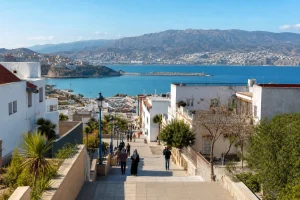
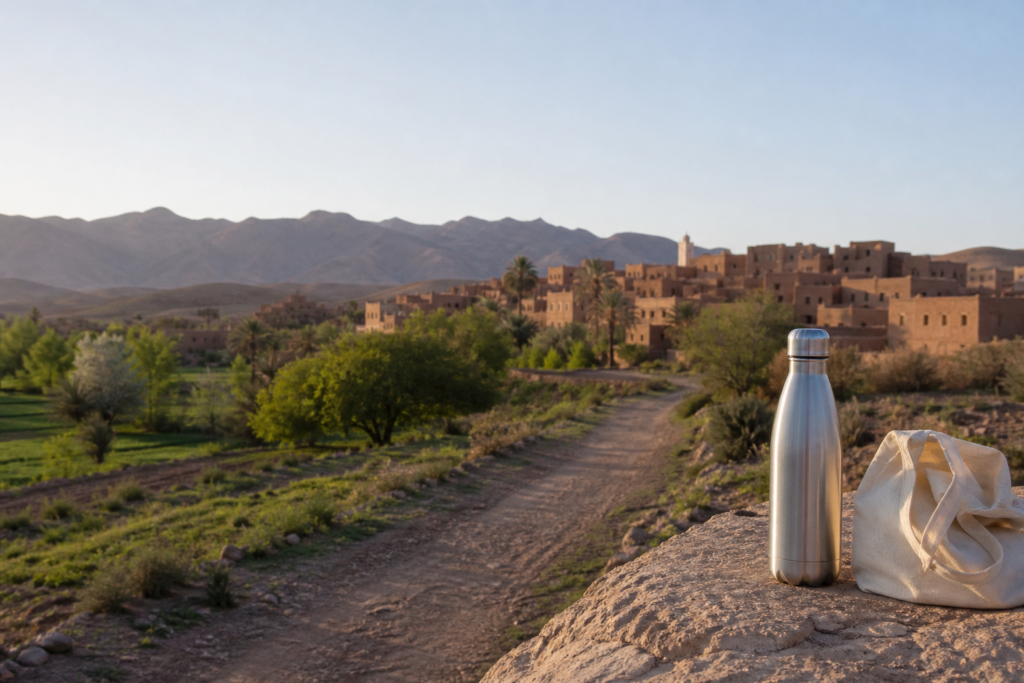
Travelling responsibly does not mean seeking a supposedly “impact-free” stay. Every journey consumes resources and changes the places visited. The useful objective is more concrete: understand local pressures, avoid easily preventable damage and make choices whose benefits remain within the local area to a greater extent.
In Morocco, this approach particularly concerns water, waste, natural areas, built heritage and relationships with local people. It requires neither perfection nor guilt. A few decisions made before departure, then repeated during the stay, matter more than a vague marketing promise.
Start with a less scattered itinerary
Visiting many far-apart cities increases hours on the road, connections and fatigue. Choosing two or three bases allows you to explore each region more thoroughly and reduce unnecessary travel. An extra night in a city often offers more than a rushed return trip to somewhere photographed for a few minutes.
Compare trains, coaches and shared transfers before automatically renting a car. The guide train, coach, taxi or car helps you choose according to the actual route. For a rural area without regular transport, group the stages together rather than returning to the same distant point every evening.
The season also matters. A destination that is overcrowded during a festival or summer peak may be more pleasant at another time. However, ask whether services, trails and accommodation remain open: travelling out of season should not mean arriving without a local option.
Treat water as a local resource
Morocco faces structural water stress and is developing dams, interconnections, desalination and reuse. These investments do not make water unlimited. At accommodation, taking a shorter shower, keeping a towel for several days and promptly reporting a leak are simple actions.
A swimming pool, golf course or heavily watered garden does not have the same context depending on the region, season and source used. Rather than believing a “green” label, ask how the establishment reduces consumption, measures its use and potentially reuses treated water.
Respect local restrictions, even if they appear temporary. A visitor should not demand different treatment from that requested of local residents. When hiking, carry enough water without taking it from a source whose safety and community use have not been established.
Use a reusable bottle without taking health risks
A reusable bottle reduces the use of small bottles only if it can be filled with safe water. Depending on the accommodation, this may come from a maintained filtered-water dispenser, a large sealed container or water declared safe to drink by the operator. Ask how the system is monitored.
If the quality is not guaranteed, prioritise health and use packaged water. In that case, choose one large container to share rather than several small bottles, when practical, and keep the caps with the bottles to make sorting easier.
A filter or tablet is not a universal solution: each process works on certain contaminants and has conditions of use. Read its instructions and do not present a piece of travel equipment as certification of the available water.
Reduce waste at the source
The best waste is what never enters the bag. Refuse extra cutlery, straws and bags when they are not needed. Bring a small reusable bag, a lightweight container and refillable toiletries, subject to air travel rules.
Waste sorting is not organised uniformly. Ask the accommodation which categories are actually collected. Putting packaging in a coloured bin does not guarantee its recycling if there is no subsequent recycling system.
In the mountains, on a beach or in the desert, take back everything you brought, including tissues, cigarette butts and so-called biodegradable waste. Discarded fruit peel attracts animals and remains visible for a long time in an arid environment.
Respect trails, dunes and protected areas
Staying on existing tracks limits erosion and disturbance. In the dunes, avoid chasing wildlife, uprooting plants or driving off authorised tracks. On the coast, do not walk through nesting areas and keep your distance from birds and marine mammals.
A motorised activity may be legal but poorly located. Ask where it takes place, how many vehicles leave together and which rules protect residents, animals and the ground. A reputable operator describes its limits as clearly as its programme.
Do not collect fossils, architectural fragments or stones from a protected site. Photography and observation leave the material in place and avoid supporting a trade that is difficult to trace.
Photograph people with their consent
A medina, market or village is not a setting without residents. Ask permission before photographing an identifiable person, especially a child, a craftsperson at work or a religious scene. A smile or clear gesture prevents many misunderstandings.
Payment for a staged photo should be agreed in advance. Conversely, buying an item does not automatically give you the right to publish the seller’s face. Drone rules are strict: do not bring one without checking the applicable Moroccan authorisations.
When sharing the location of a fragile natural site, ask yourself whether precise geolocation encourages a level of footfall that the place can absorb. A regional description may be enough.
Buy local without creating false authenticity
A product sold in a souk is not necessarily made in the neighbourhood. Ask questions about the material, workshop, production time and origin. An identifiable cooperative or craftsperson can explain their work without reciting the same sales pitch for every item.
Bargaining may be part of the exchange, but forcing a price below reasonable remuneration is not a responsible achievement. Compare, set your budget and be prepared to walk away. For an expensive piece, ask for an invoice and the shipping terms.
When dining, alternate between established venues and small establishments where hygiene appears sound. Choosing seasonal produce sometimes reduces long supply chains, but no dish is sustainable simply because someone claims it is: origin, waste and working conditions also matter.
Choose accommodation based on evidence
A credible certification, an audit or measured data are worth more than a green leaf on a brochure. Ask for three specific details: how water and energy are monitored, what happens to waste, and what proportion of the team is recruited and trained locally.
An establishment may be modest and make progress without having an expensive label. A transparent answer about its limitations is preferable to a “100% environmentally friendly” promise. Also consider its integration into the neighbourhood: noise disturbance, pressure on property and respect for neighbours are part of its impact.
Before cancelling a daily service, check that this saving does not simply result in a reduction in paid work. Responsibility concerns both resources and people.
Observe animals without forcing them
Refuse an activity involving an animal that is injured, visibly restrained, overloaded or deprived of rest and water. For a trek with an equine or dromedary, observe its general condition, how the equipment fits and how the guide responds to a problem.
Do not feed macaques or other wild animals. Feeding changes their behaviour, increases conflict and can transmit diseases. Keep food and waste sealed.
Shows involving animals should be assessed with the same critical eye. A tradition cited by a seller does not remove the need to consider the animal’s welfare and the regulations.
Carry out a simple review when you return
Keep the contact details of reputable places and share a factual review: practices observed, accessibility, water management or quality of supervision. Avoid turning a one-off impression into a general accusation.
Calculate travel distances approximately, but do not reduce the journey to an isolated carbon score. The length of the stay, mode of transport, local spending and repeated choices provide a more useful picture. Financial offsetting does not replace reduction when reduction is possible.
Finally, note what actually worked. An unusable reusable bottle, a lack of sorting or a successful shared journey are concrete pieces of information for preparing the next stay and advising other travellers.
Responsible checklist before booking
- Group stages together and compare public transport options.
- Ask for evidence about water, energy, waste and local employment.
- Plan for a reusable bottle, reusable bag and safe refilling option.
- Check the rules for parks, heritage sites and drones.
- Refuse wildlife feeding, overloading or handling.
- Ask permission before photographing someone.
- Buy based on origin and quality, not a vague label.
- Keep your waste until you reach an actual collection point.
Sources consulted
- Moroccan National Tourist Office, “Morocco at a glance – Sustainable Morocco” brochure: https://www.visitmorocco.com/sites/default/files/atoms/files/maroc_durable_0810_pbi251101-en_1.pdf
- Official Maroc.ma portal, policy on dams, desalination and reuse: https://www.maroc.ma/fr/actualites/la-politique-des-barrages-levier-strategique-de-la-resilience-hydrique-et-de-la-justice-territoriale-m
- Official Maroc.ma portal, desalination capacity announced in May 2026: https://www.maroc.ma/fr/actualites/dessalement-une-capacite-de-production-annuelle-de-420-millions-m3
- World Tourism Organization, recommendations on sustainable tourism: https://www.unwto.org/sustainable-development