
Morocco is responding to water stress through several types of solutions: dams, interconnections between basins, seawater desalination, wastewater treatment, groundwater protection and demand reduction. None is sufficient on its own, and their timelines differ.
The figures change with rainfall and as facilities enter service. This article is based on official announcements available as of 22 August 2026; a target capacity is not production that has already been delivered.
A deficit that has become structural
Successive droughts, rainfall variability, increasing demand and the overexploitation of some aquifers are reducing the system’s margin. The World Bank has documented six years of drought between 2018 and 2024, with below-average rainfall.
A spell of rain can fill some dams without erasing the long-term deficit. The national rate aggregates very different basins and does not describe the situation of each city or use.
It is therefore necessary to distinguish between weather, available reserves, transfer infrastructure and consumption. A region may receive rain while still being constrained by its network.
Dams remain a backbone
For decades, Morocco has pursued a policy of constructing large and small dams. They store drinking and irrigation water, mitigate some flooding and can generate electricity.
Their effectiveness depends on inflows. A large-capacity reservoir does not create water when a basin experiences several dry seasons. Silting, evaporation and geographical distribution also reduce the amount that can actually be mobilised.
New structures strengthen resilience, but their assessment must compare announced capacity, impoundment date, fill level and distribution network.
Interconnections move the resource
Transfers between basins seek to use temporary surpluses from one area to support another. The Sebou–Bouregreg link has illustrated this strategy, and other connections have been announced.
In May 2026, the Minister of Equipment and Water referred to future links capable of transferring between 1 and 1.2 billion cubic metres per year to provinces facing shortages. This volume remains a target linked to construction projects.
A transfer requires pumping, canals, energy and allocation rules. It replaces neither the protection of the donor basin nor water conservation in the receiving basin.
Desalination capacity is increasing rapidly
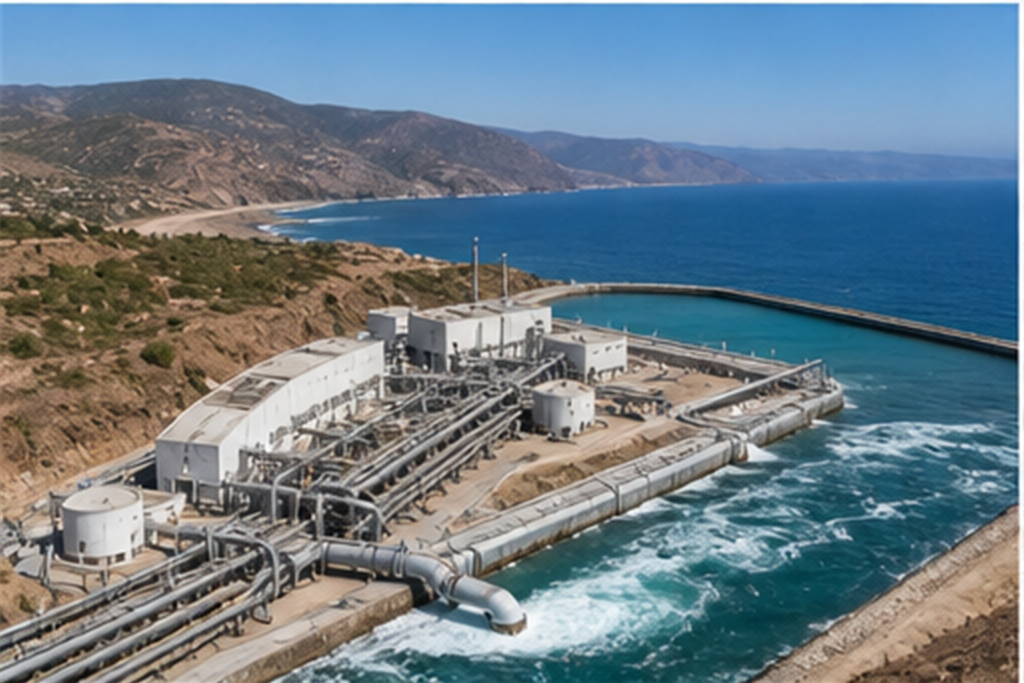
According to an official announcement on 6 May 2026, Morocco’s annual desalinated water capacity had reached 420 million cubic metres, with an ambition of 1.7 billion in the longer term. The figure covers different facilities and uses.
Jorf Lasfar supplies water for industrial and urban uses; other projects concern Casablanca, Agadir, Safi, Dakhla or future areas. A distinction must be made between nominal capacity, actual production and the share reserved for irrigation.
Desalination secures a resource that is independent of rainfall, but requires investment, energy, networks and brine management. Its environmental value depends in particular on the electricity used and discharge into the sea.
Casablanca is moving to a new scale
The future Casablanca plant is presented as a major project under the National Drinking Water Supply and Irrigation Programme. It is intended to support a densely populated and agricultural region.
A capacity announcement does not mean that the water will reach taps immediately. Construction, connection, testing and ramp-up are separate stages.
To track the project, the following should be recorded at each date: progress, capacity of the operational phase, energy, beneficiaries and distribution between the city and agriculture.
Reusing treated wastewater
Reuse is intended in particular for watering green spaces and sports grounds or for certain industrial uses, so that drinking water can be reserved for needs that require it.
In April 2025, the ministry announced a target reuse capacity of 100 million cubic metres in 2027 and 350 million in 2035. These timelines must be monitored facility by facility.
Treatment, health quality, the separate network and user acceptance determine the outcome. “Reused” water is not automatically suitable for every crop or human contact.
Agriculture is central to the efficiency challenge
Irrigation accounts for a major share of demand. Drip irrigation, crop choices, watering schedules and pricing can save water, but a technical gain does not always reduce total abstraction if cultivated areas increase.
Public policy must therefore measure the volume actually saved across the basin, not merely the number of hectares equipped.
Desalination intended for agriculture can protect an aquifer, but its cost and energy requirements necessitate trade-offs regarding crops and beneficiaries.
Protecting groundwater
Aquifers serve as reserves during dry years, but pumping that exceeds recharge lowers their level and can degrade quality. On the coast, saltwater intrusion poses a risk.
Meters, permits, aquifer agreements and action against illegal boreholes are less visible than a large plant, but essential. Restoring an aquifer often takes longer than overexploiting it.
A coherent policy connects surface water, groundwater and reuse. Shifting an abstraction without measuring the whole system may simply shift the problem.
What travellers can actually do
Taking a shorter shower, reusing a towel and reporting a leak are useful actions, without placing responsibility for the crisis solely on visitors. Choices of accommodation and activities also have an effect.
Ask how the swimming pool, garden and laundry are managed. An “eco-friendly” claim must be accompanied by measures, monitoring and a clearly identified water source.
Our guide to responsible travel in Morocco turns these principles into practical decisions without guilt.
How to read future announcements
- Distinguish between capacity, production and actual distribution.
- Note the date and author of the figure.
- Separate drinking water, irrigation and industry.
- Check the energy source and brine treatment.
- Compare targets with facilities that have entered service.
- Examine demand-side savings, not just supply.
- Read data by basin rather than relying on an isolated national rate.
- Do not present rainfall as the end of structural water stress.
Sources consulted
- Maroc.ma, desalination capacity as of 6 May 2026: https://www.maroc.ma/fr/actualites/dessalement-une-capacite-de-production-annuelle-de-420-millions-m3
- Maroc.ma, policy on dams, transfers and reuse: https://www.maroc.ma/fr/actualites/la-politique-des-barrages-levier-strategique-de-la-resilience-hydrique-et-de-la-justice-territoriale-m
- Maroc.ma, National Programme and reuse: https://www.maroc.ma/fr/actualites/le-taux-de-remplissage-des-barrages-lechelle-nationale-porte-4944
- World Bank, desalination and droughts in Morocco: https://documents1.worldbank.org/curated/en/099120325085522367/pdf/P510972-95cd0c55-9926-4bca-a6fe-422af95faaff.pdf
- Ministry of Equipment and Water: https://www.equipement.gov.ma/