Chefchaouen is built on a mountainside in the Rif, in northern Morocco. Its blue façades have become famous around the world, but the city is more than a colour or a photographic backdrop. Its inhabited medina, kasbah, crafts, springs and surrounding landscapes tell a deeper story.
A successful visit therefore begins with a simple distinction: Chefchaouen is a living city, while Akchour and Talassemtane National Park are separate nature excursions. Combining them in the same stay is possible, provided that distances, hiking conditions and residents’ daily lives are respected.
A city clinging to the Rif
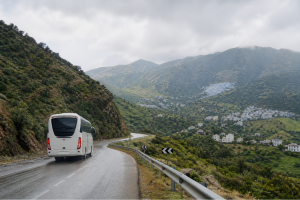
Chefchaouen rises in tiers along the slopes of the Rif. This location explains its sloping lanes, stairways, viewpoints and the presence of water in its urban history. It also calls for a different pace from that of the major imperial cities: here, getting around on foot requires good shoes and a little time.
The city was founded in the late 15th century. Its development was shaped by the region’s populations and by the arrival of Muslim and Jewish families from al-Andalus amid the upheavals on the Iberian Peninsula. This Mediterranean heritage can be seen in certain architectural forms, culinary practices and skills, without making Chefchaouen a copy of an Andalusian city.
Today, the city is at once a provincial centre, a place where people live and an international tourist destination. These functions intersect within a relatively compact area.
The medina, an inhabited neighbourhood
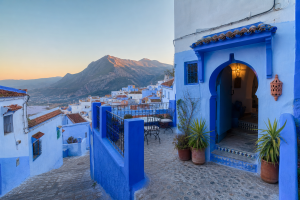
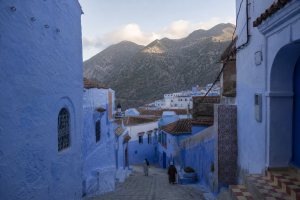
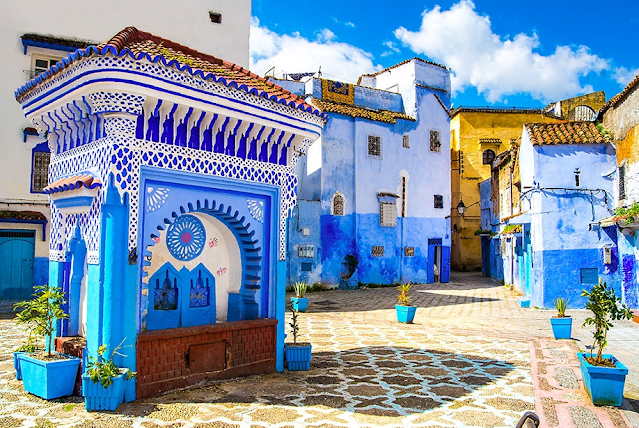
The medina is smaller than those of Fez or Marrakesh. Its narrow streets connect homes, shops, ovens, workshops, places of worship and small squares. The whitewashed or blue-painted walls create a strong visual unity, but each street retains its own uses.
Resist the temptation to treat doorways and stairways as a freely accessible studio. A beautiful façade may be the entrance to someone’s home. Asking permission before photographing a person, not blocking a passage and avoiding noise early in the morning or late at night are simple gestures.
The medina is best explored without an overly rigid itinerary. The climbs, changing light and scenes of daily life shape the experience more than a list of “spots” to reproduce.
Why are the walls blue?
Several accounts circulate about the origin of Chefchaouen’s blue colour. Some associate it with Jewish traditions, others with coolness, protection from insects, water or more recent efforts to enhance its tourist appeal. No single explanation can definitively sum up a practice that has evolved over time.
The most honest wording is therefore to describe it as a tradition whose origins are debated. The shades are not uniform either: pale blue, indigo, turquoise and white vary according to the pigments, maintenance campaigns and light.
This caution does nothing to diminish the city’s character. It simply avoids turning a complex history into a definitive legend and then repeating it as an established fact.
Outa el-Hammam and the kasbah
Outa el-Hammam Square is one of the medina’s main landmarks. Cafés, passageways and historic buildings concentrate some of the tourist activity here. It offers insight into the relationship between public space, commerce and heritage.
The kasbah stands in the heart of the old quarter. The Moroccan National Tourist Office highlights its gardens and museum, which notably houses old weapons, photographs and textiles. The collections, opening hours and accessible areas may change; it is best to check official or local information on the day of the visit.
The neighbouring Grand Mosque forms part of the square’s landscape. As with other active places of worship, visitor access depends on the rules in force and must be approached respectfully.
Ras El Maa, water and the city
East of the medina, Ras El Maa recalls the role of water in Chefchaouen’s location and daily life. The path running along this area connects the dense city with a more open landscape, offering views over the rooftops and slopes.
The site is not merely a beautiful backdrop. The springs and streams long supported domestic needs, craft activities and nearby crops. In a region subject to seasonal variations, water remains a resource that must be conserved.
Flow levels and the appearance of the site change with the season and rainfall. Visitors should therefore not be promised a spectacular waterfall or an identical experience throughout the year.
A living Mediterranean culture
Chefchaouen is one of the emblematic communities associated with the Mediterranean diet inscribed by UNESCO on the Representative List of the Intangible Cultural Heritage of Humanity. This recognition does not refer to a fixed menu or a weight-loss diet.
It concerns a set of skills, knowledge, agricultural practices, preservation methods, cooking, transmission and sharing meals. UNESCO also emphasises the role of markets and women in passing on this knowledge.
In Chefchaouen, this dimension connects local products, seasonality, agricultural landscapes and social interaction. Discovering it requires more than ordering a dish presented as “typical”: markets, producers and ways of sharing matter just as much as the recipe.
Crafts: look at the work behind the object
Wood, wool, weaving and leatherwork are among the activities highlighted by the Moroccan National Tourist Office. Shops sell rugs, blankets, clothing, wooden objects and contemporary products inspired by regional motifs.
Not all products sold in the medina are necessarily made in Chefchaouen. To better understand what you are buying, it is useful to ask where the object was made, what material it is made from and which workshop produced it. A precise answer is better than a vague “handmade” label.
Bargaining can be part of the exchange, but it does not need to become a confrontation. Comparing calmly, acknowledging the work involved and politely declining when a purchase is not suitable help create a fairer relationship.
Talassemtane is not in the medina
Talassemtane National Park protects mountainous landscapes in the Rif and is among the main excursions associated with Chefchaouen. It also appears on Morocco’s Tentative List at the UNESCO World Heritage Centre, which does not mean that it is inscribed as a World Heritage Site.
Its terrain, forests and valleys require genuine preparation. The difficulty varies depending on the route, weather, trail conditions and chosen duration. A route described as easy on social media can become slippery or demanding after rain or in hot weather.
Bring water, sun protection, suitable shoes and everything needed to descend before nightfall. For a long or poorly marked route, a clearly identified local guide is preferable.
Akchour, an excursion to organise separately
The waterfalls and the Akchour area lie outside Chefchaouen. They are not an urban walk that can be added spontaneously at the end of the day. Transport, walking time, water levels and weather conditions must be assessed separately.
Online images often show the pools at their best. In reality, the flow varies, some sections can be slippery and visitor numbers increase sharply at certain times. Swimming must never be presented as risk-free.
Staying on authorised routes, taking your rubbish away and avoiding products that contaminate the water help protect the site. Vendors and small services along the route are no substitute for basic preparation.
Photography and tourism pressure
Chefchaouen’s visibility on social media generates income, but it also concentrates visitors in a few lanes. Photography queues, outfit changes and prolonged staged shoots can inconvenience residents and reduce the city to a repeated image.
A more respectful approach involves varying routes, visiting outside the busiest hours and spending time in museums, workshops and landscapes. Buying from an artisan or using a clearly identified local guide makes a more direct contribution than taking a photograph in front of a private doorway.
Drones are subject to specific regulations in Morocco and must not be used merely on the basis of habits acquired elsewhere. Any authorisation must be checked before travelling.
When and how to organise your stay
Spring and autumn are often sought out for their more moderate temperatures, but no season guarantees stable weather. Winter can be cold and wet; summer can make climbs and hikes demanding during the hottest hours.
From Tangier, Tetouan or Fez, journey times vary according to the route, stops and conditions. Staying for at least one night makes it possible to see the medina after day visitors have left and avoids a rushed visit.
Within the city, walking remains the most natural way to get around. For excursions, clarify the departure point, return arrangements, what is included and the identity of the carrier or guide in advance.
Understanding Chefchaouen beyond the blue
Chefchaouen is immediately appealing for its colours, but its value lies in the relationship between the city, mountains, water and Mediterranean cultures. The kasbah, medina, workshops and Rif landscapes are not interchangeable elements of the same postcard.
Taking the time to distinguish between them enriches the journey. It also makes it possible to respect the places more fully: the medina as an inhabited neighbourhood, Talassemtane as a fragile natural area and Akchour as an excursion where conditions change.
The “blue city” then becomes a gateway to a living region, rather than merely a photographic stop.
Institutional sources
- Moroccan National Tourist Office, Chefchaouen destination: https://www.visitmorocco.com/fr/voyage/chefchaouen
- Moroccan National Tourist Office, Chefchaouen medina: https://www.visitmorocco.com/fr/voyage/chefchaouen%2C-la-belle-bleue/medina
- UNESCO, “The Mediterranean diet”: https://ich.unesco.org/fr/RL/la-diete-mediterraneenne-00884
- UNESCO, document on the Chefchaouen community and the Mediterranean diet: https://ich.unesco.org/doc/src/19703-FR.pdf
- UNESCO World Heritage Centre, Morocco’s Tentative List: https://whc.unesco.org/fr/etatsparties/ma