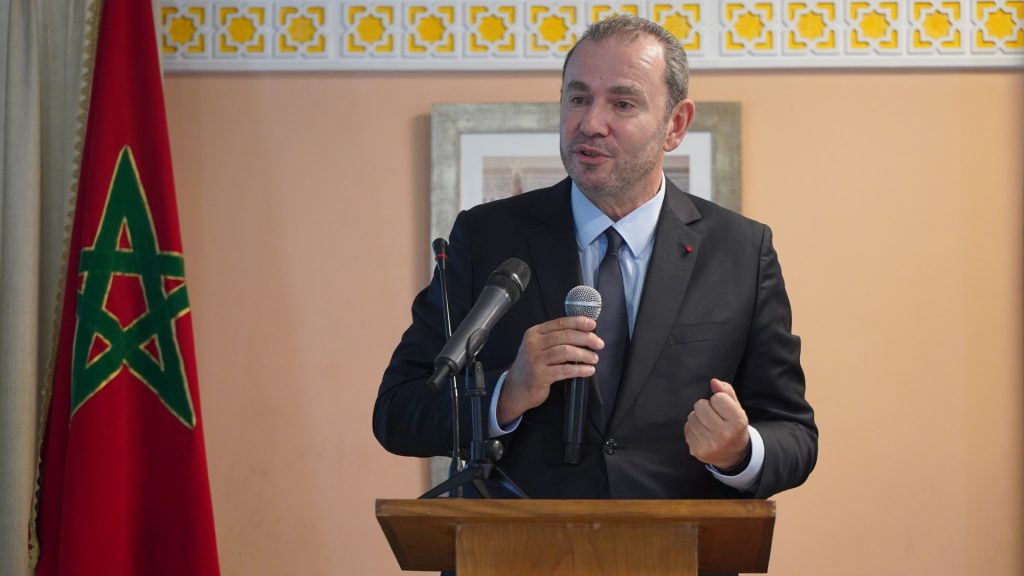
From 11 to 13 November 2024, the French Ambassador to Morocco, Christophe Lecourtier, visited Laayoune and then Dakhla with institutional and business representatives. This public visit by a French ambassador to the territory sent a strong diplomatic signal a few months after the shift in France’s position on Western Sahara.
However, it would be inaccurate to present this visit as universal recognition or as a resolution of the dispute. It reflects France’s official policy and a rapprochement between France and Morocco. The political process conducted under the auspices of the United Nations remains open.
What happened in November 2024
The tour lasted three days. It took the delegation to Laayoune and Dakhla, where the ambassador met local authorities, business stakeholders and project leaders.
At the same time, the French Chamber of Commerce and Industry of Morocco organised Morocco–France Economic Days. According to its report, nearly 50 decision-makers and business leaders took part in this mission focused on investment and partnership opportunities in the Laayoune-Sakia El Hamra and Dakhla-Oued Eddahab regions.
The CFCIM had already been established in Laayoune since 2017 and in Dakhla since 2019. The 2024 visit therefore strengthened an existing economic presence rather than creating it from scratch.
A visit following on from the state visit
The visit took place shortly after Emmanuel Macron’s trip to Morocco, from 28 to 30 October 2024. During this state visit, the two countries reaffirmed their intention to relaunch their political and economic partnership.
On 30 July 2024, the French president had set out the new wording of France’s position in a letter to King Mohammed VI. France Diplomatie now states that, for Paris, the present and future of Western Sahara fall within the framework of Moroccan sovereignty and that the autonomy plan proposed by Morocco is the basis adopted by France for seeking a political solution.
The ambassador’s trip gave concrete expression to this shift through an official presence, local meetings and a review of projects that could involve French stakeholders.
The projects and sectors examined
The delegation focused on several aspects of regional development: port infrastructure, desalination, energy, training, services and investment. Dakhla Atlantic Port and projects related to water and energy were among the subjects regularly mentioned in connection with the mission.
A site visit must be distinguished from a definitive financial commitment. The presence of a diplomat or a company guarantees neither a contract, nor a timetable, nor the completion of a project. Announcements must be followed up through documents issued by the relevant contracting authorities and companies.
The main purpose of the visit was to identify areas of cooperation and connect public- and private-sector decision-makers. Its economic impact therefore cannot be measured solely by the number of participants.
A tangible educational dimension
Christophe Lecourtier also visited schools in the OSUI–Mission laïque française network in Laayoune and Dakhla. Mission laïque française confirmed the presence of its delegation during the tour from 11 to 13 November 2024.
These schools, which have been open for more than ten years in both cities, were already welcoming pupils before the visit. The visit notably highlighted efforts to enable French examinations to be organised locally, in order to avoid some journeys north.
This educational dimension provides a more nuanced picture than that of a mission focused solely on major projects. Cooperation also concerns services provided to families, training and school networks.
What the French position means
France had supported Morocco’s autonomy plan since 2007. The presidential letter of July 2024 went further in its wording by explicitly linking, from the French perspective, the territory’s present and future to Moroccan sovereignty.
This is the position of one state. It carries diplomatic weight, but by itself it does not change the territory’s international status or the United Nations framework. Other countries use different wording, ranging from support for the autonomy plan to recognition of Moroccan sovereignty, while some maintain a distinct position.
A rigorous article must therefore attribute each statement to its author: “France considers”, “Morocco states”, “the UN designates”. Presenting a national position as a universal legal conclusion creates confusion.
The United Nations framework remains separate
The United Nations uses the name “Western Sahara” and continues to seek a political solution. MINURSO, established in 1991, remains deployed as a mechanism for conflict prevention and monitoring the situation.
The mission’s reference page notes that Morocco administers a large part of the territory and that the Polisario Front contests this situation. It traces a settlement process that did not lead to the referendum initially envisaged.
This reality does not negate the bilateral significance of the French visit. It simply requires three levels to be kept separate: Morocco’s position, the policy adopted by France and the multilateral process conducted under the auspices of the UN.
Why the visit marked a milestone in French-Moroccan relations
The political value of the tour lies in its visibility. After a period of tension between Paris and Rabat, a French ambassador publicly visited two cities at the heart of the dispute, accompanied by business stakeholders.
The gesture signalled that France’s new position was to be reflected in administrative, educational and commercial relations. It also gave local authorities and businesses direct access to French contacts.
Describing it as a “step” is therefore justified. Describing it as a definitive outcome or “unwavering” support would be more debatable: partnerships are measured over time through decisions, contracts, services and projects actually implemented.
What to watch next
Since 2024, several indicators have made it possible to assess whether this direction is continuing: visits by public agencies, consular or educational arrangements, funding, company establishments and the implementation of announced projects.
Each development must be documented separately. A mobile visa application collection service, an economic mission or a memorandum of understanding does not have the same significance as a permanent establishment or an investment that has been carried out.
Follow-up must also specify dates. A project described as “future” in November 2024 may have progressed, had its timetable changed or been resized. Repeating the initial announcement without an update would undermine the article’s informative purpose.
A factual reading rather than a victory narrative
Christophe Lecourtier’s visit to Laayoune and Dakhla was indeed an important diplomatic event in French-Moroccan relations. It combined a political dimension, an economic mission and educational and regional meetings.
Its precise significance is bilateral: it gives tangible form to France’s choice to support Morocco’s position and draw practical consequences from it. The dispute continues to exist within the United Nations framework.
This dual reading makes it possible to understand the event without minimising it or turning it into proof of a settlement that has not taken place.
Institutional sources
- France Diplomatie, overview of Morocco and the French position on Western Sahara: https://www.diplomatie.gouv.fr/fr/information-par-pays/maroc/presentation-du-maroc
- Élysée, state visit to Morocco from 28 to 30 October 2024: https://www.elysee.fr/emmanuel-macron/2024/10/29/visite-detat-au-maroc-deuxieme-journee
- Mission laïque française, Christophe Lecourtier’s visit to OSUI schools: https://www.mlfmonde.org/visite-officielle-maroc/
- MINURSO, history and framework of the United Nations mission: https://minurso.unmissions.org/en/background
- CFCIM, report on the Morocco–France Economic Days in Laayoune and Dakhla: https://fr.linkedin.com/posts/cfcim_journ%C3%A9es%C3%A9conomiquesmarocfrancela%C3%A2younedakhla-activity-7394060056608231424-elLs