
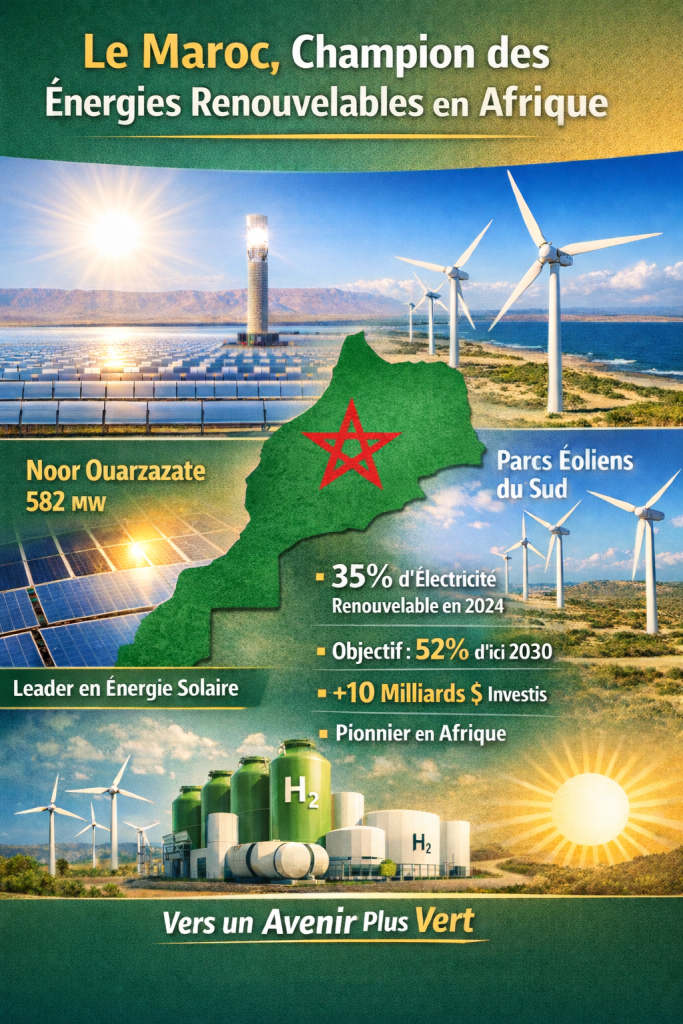
Morocco has built an ambitious energy strategy around solar, wind and, more recently, green hydrogen. Its official objective remains to increase the share of renewables to more than 52% of installed electrical capacity by 2030. This objective is often wrongly turned into a claim that more than half of the electricity consumed is already renewable.
To understand the real situation, it is necessary to distinguish between power plant capacity, actual generation and final consumption. The Kingdom has reached important milestones, but the transition still depends on the grid, storage, investment and the ability to commission projects on schedule.
What the 52% target means
The Ministry of Energy Transition and Sustainable Development has set an ambition of more than 52% renewables in installed electrical capacity by 2030. Installed capacity measures the theoretical maximum capacity of the available equipment, expressed in megawatts.
It does not correspond to the amount of electricity actually generated during a year. A solar power plant does not generate electricity at night, and a wind turbine depends on the wind. Two countries with the same proportion of renewable capacity may therefore achieve different levels of generation depending on their resources, grids and flexibility resources.
The correct interpretation is as follows: Morocco wants more than half of its electricity generation fleet to consist of renewable capacity in 2030. This does not make it possible to claim today that 52% of every kilowatt-hour consumed is green.
Wind capacity continues to grow
Indicators published by the ministry report approximately 2,433 MW of installed wind capacity for the 2024-2025 period. They also list more than 2,600 MW of wind projects under development. These figures show a significant portfolio, but projects under development must not be added to operational power plants as though they were already generating electricity.
Wind is a major asset along the Atlantic coast and in several southern regions. The wind farms in Tarfaya, Tangier, Midelt and Boujdour illustrate the sector’s geographical diversity. Private projects intended for industrial companies have also taken on a growing role since the gradual opening of the market.
The next step is to connect this capacity at the right pace. Without sufficient transmission lines, an abundant resource may remain underused or require temporary generation restrictions.
Solar power: flagship plants and new programmes
The Noor Ouarzazate complex has raised the profile of Morocco’s solar strategy by combining concentrated solar power and photovoltaic plants. It remains a technological showcase, but it does not represent the entire national solar fleet.
The Noor Midelt, Noor Atlas and Noor PV Multisites programmes are intended to complement this foundation. They use different technologies and arrangements, with more photovoltaic power and, depending on the projects, storage solutions. In January 2026, the authorities referred to 12 GW of additional renewable capacity to be commissioned nationwide by 2030.
This announcement describes an investment pathway, not capacity that is already available. For each project, the financing, construction, connection and commissioning dates remain the decisive milestones.
Why the grid is becoming the central undertaking
A power plant only has value for the electricity system if its energy can be transported to where it is consumed. The official investment programme for the transmission grid for 2025-2030 totals 27 billion dirhams, excluding the South-Central electrical link.
This funding is intended to strengthen substations, lines and the capacity to accommodate new installations. The link between the southern regions, which are rich in solar and wind potential, and the major centres of demand is particularly important.
The grid must also manage more variable and decentralised generation. This requires weather forecasting, automated systems, reserves, regional exchanges and transparent access rules.
Opening the market to private producers
Laws No. 13-09, 48-15 and 82-21 have gradually expanded the opportunities to generate and sell renewable electricity. Access to the medium-voltage grid notably allows industrial companies and developers to enter into contracts suited to their needs.
For 2025-2029, the published cumulative hosting capacity for distribution grids totals 1,324 MW. This capacity is neither guaranteed generation nor an automatically allocated quota: it indicates the announced technical room for connecting new projects, subject to the applicable procedures.
The National Electricity Regulatory Authority is playing a growing role in tariffs, grid access and transparency. Predictable regulation is essential to attract capital while protecting the stability of the system.
Storage and flexibility are becoming essential
As solar and wind power grow, the system must compensate for rapid variations in their generation. Pumped-storage hydropower plants, batteries, interconnections and dispatchable resources can provide this flexibility.
Storage shifts electricity from a period of surplus to a period of high demand. It does not create energy and itself causes losses. Its value therefore depends on its location, duration, cost and the services it provides to the grid.
Demand management also matters: some industrial uses can be scheduled when renewable electricity is abundant. This coordination reduces peaks and improves the integration of new power plants.
A transition linked to industry and exports
Renewable energy can reduce exposure to imported fuels and improve the carbon footprint of export sectors such as automotive manufacturing, fertilisers and materials. It is therefore becoming a factor in competitiveness as much as a climate objective.
European companies are increasingly requesting data on emissions embedded in products. More decarbonised electricity can help Moroccan manufacturers, but only if the origin of the energy is measured and certified using credible methods.
Interconnection or export projects must not overshadow the domestic market. The operational priority remains a reliable, accessible supply capable of supporting the electrification of the Moroccan economy.
The limitations that prevent this from being called a victory
The pace of projects can be affected by financing, calls for tenders, land, permits, imported equipment and connection works. Droughts also reduce hydropower generation and increase pressure on water use.
The cost of a technology is not limited to the stated price per megawatt-hour. The system must finance lines, flexibility, reserves and balancing. Success is therefore measured by the full cost and quality of service, not solely by the number of megawatts announced.
Finally, official figures are not all published on the same date or according to the same definition. Comparing capacity from 2024 with a portfolio planned for 2030 produces a misleading picture.
Indicators to monitor until 2030
The first indicator is capacity actually commissioned, technology by technology. The second is annual renewable generation and its share of the electricity fed into the grid. The third concerns grid upgrades that have actually been completed.
Connection times, volumes curtailed due to grid constraints, storage capacity and changes in dependence on energy imports must also be monitored. The prices paid by households and businesses make it possible to verify whether investments are genuinely improving service.
The regular publication of comparable data would make the debate more precise. It would make it possible to distinguish between an announcement, a construction project, a commissioned power plant and measured generation.
Leadership to be demonstrated through results
Morocco has natural resources, experience with major projects and a coherent strategy. It holds a prominent position in Africa in solar and wind power, but the title of “champion” cannot rest on a single power plant or on future objectives.
The transition will be convincing if the announced capacity is commissioned, if the grid absorbs its generation and if electricity becomes safer, more competitive and less carbon-intensive. The 2030 deadline therefore remains a demanding target, not a result that has already been achieved.
Official sources
- Ministry of Energy Transition and Sustainable Development, renewable energy and sector indicators: https://www.mem.gov.ma/Pages/secteur6659.html?e=2
- Ministry of Energy Transition and Sustainable Development, access to the medium-voltage grid and hosting capacity for 2025-2029: https://www.mem.gov.ma/Pages/secteur4492.html?e=1&sprj=17
- Ministry of Energy Transition and Sustainable Development, transmission grid and investment programme for 2025-2030: https://mem.gov.ma/pages/secteur0a89.html?e=1
- Ministry of Energy Transition and Sustainable Development, regulation of the electricity sector: https://www.mem.gov.ma/Pages/secteur4909.html?e=1&sprj=16
- Maroc.ma, energy transition and MASEN programmes, 26 January 2026: https://www.maroc.ma/fr/actualites/la-transition-energetique-au-maroc-un-veritable-levier-de-developpement-et-de-renforcement-de-la