Morocco’s automotive industry has grown significantly. The country is no longer limited to assembling a few models for the domestic market: it hosts manufacturers’ factories, a network of equipment suppliers, engineering activities and a logistics chain largely geared towards exports. This progress is real, but it deserves to be described using dated figures and without confusing theoretical capacity, actual production and export value.
As of 22 August 2026, the available public data show that the sector has become central to Morocco’s industrial economy. They also highlight the challenges of the next stage: strengthening local integration, supporting electrification, reducing the carbon footprint of production and maintaining competitiveness in an unstable global market.
What the latest figures show
Morocco’s Ministry of Industry and Trade states that the automotive sector generated export revenue of 157 billion dirhams in 2024. The National Industry Barometer published in October 2025 also presents the automotive industry as the Kingdom’s leading export sector, with nearly 196 billion dirhams in industrial revenue and more than 250,000 direct jobs in 2024.
These indicators do not measure the same thing. Industrial revenue covers the sector’s activity in Morocco, while export revenue concerns sales destined for foreign markets. They should therefore not be added together.
For 2026, the data remain provisional. The Foreign Exchange Office states that at the end of June 2026, automotive sector exports had reached 93.7 billion dirhams, up 17.4% compared with the same period in 2025. This half-year result does not automatically predict the total for the year: volumes, prices, delivery schedules and economic conditions in Europe may still affect the final result.
Renault: two sites and production mostly exported
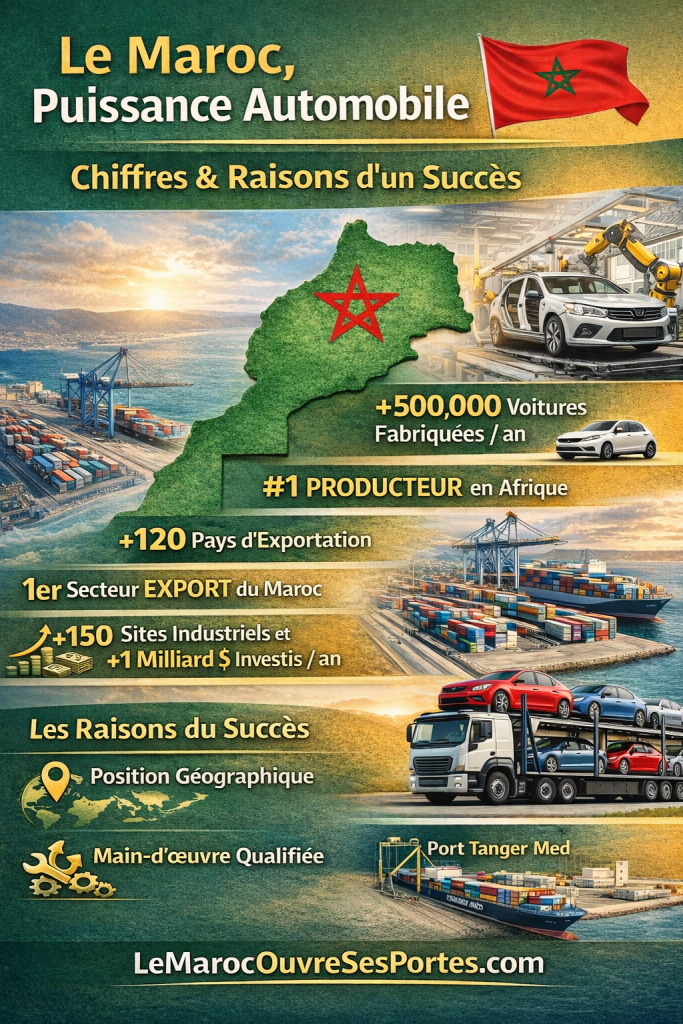
Renault is one of the longstanding players in this transformation. The group notably operates the Tangier factory and the Somaca site in Casablanca. According to Renault Group, its Moroccan industrial operations produced more than 394,000 vehicles in 2025. The manufacturer states that 82% of production from Tangier and Casablanca was exported to 63 destinations.
In Tangier, the group’s detailed 2025 production approached 300,000 units. It mainly included the Dacia Sandero, Dacia Jogger and Renault Express, along with small volumes of Duo and Bento mobility vehicles. The launch of the hybrid Jogger in Tangier in 2024 illustrates the site’s gradual shift towards electrified powertrains.
These data concern Renault Group and do not represent Morocco’s entire automotive production. They nevertheless make it possible to measure Tangier’s role in the manufacturer’s industrial operations and the importance of foreign markets.
Stellantis strengthens the Kenitra hub
The Stellantis factory in Kenitra is the other major production hub. In July 2025, Stellantis and the Moroccan government inaugurated an extension to the site and announced new projects. The group’s press release states that annual engine production in Kenitra has reached 350,000 units. An initial phase of mild hybrid engine assembly began in May 2025, while a machining phase is announced for November 2026.
The same press release reports that following this extension, installed automotive capacity in Morocco exceeds one million vehicles per year. This is an announced maximum capacity, not the number of vehicles actually produced during a year. Actual production depends on demand, model launches, component supplies and the rate at which factories are used.
Kenitra also produces urban mobility vehicles and is set to host new activities. This diversification may strengthen the site, provided that the announced volumes translate sustainably into production, skills and local added value.
Tanger Med, a crucial logistics link
An export-oriented factory does not operate alone. The proximity between industrial sites in the north, suppliers and the Tanger Med port complex reduces the time between vehicles leaving the factory and being shipped to foreign markets. This organisation contributes to Morocco’s attractiveness for manufacturers and equipment suppliers.
The country’s geographical position facilitates trade with Europe, but it does not explain everything. The development of industrial zones, port and rail infrastructure, vocational training and subcontracting networks has created an ecosystem that extends beyond final assembly.
However, this logistics advantage makes the sector sensitive to economic conditions in its export markets. A European slowdown, maritime disruption or rapid change in automotive standards may affect Moroccan orders.
The challenge of local integration
The number of vehicles produced is a visible indicator, but the share of value created in Morocco is equally important. Local integration advances when more components, engineering services, tooling and logistics services are produced or provided within the country.
Morocco already hosts activities related to wiring, seats, metal parts, interior systems and other components. In 2025 and 2026, further investments by equipment suppliers were announced, particularly around Kenitra. Their impact will need to be assessed over time through the jobs created, the skills transferred and the share actually produced locally.
The objective is therefore not only to increase assembly capacity. It is also to consolidate a network of suppliers capable of withstanding changes in models and technologies.
Electrification and decarbonisation: a transition yet to be demonstrated
The global automotive industry is gradually shifting towards hybrid and electric vehicles and new environmental requirements. Morocco has begun to host electrified vehicle production, but it would be premature to present the transition as complete.
Future competitiveness will depend in particular on access to lower-carbon energy, component traceability, recycling, the availability of technical skills and the ability to attract projects related to batteries or power electronics. European rules on carbon footprints and product origin will also affect supply chains geared towards the European Union.
To measure progress, it will be necessary to monitor the share of electrified vehicles actually produced, the origin of strategic components and the emissions associated with each site, rather than focusing only on investment announcements.
The main risks to monitor
The sector’s growth does not eliminate its vulnerabilities. Heavy dependence on exports exposes Morocco to foreign economic cycles. Competition from other industrial platforms remains intense, while manufacturers regularly reorganise their ranges and sites.
The sector must also prevent capacity growth from persistently exceeding actual orders. The distinction between capacity and production will therefore remain essential. Finally, training must keep pace with changes in professions: embedded software, automation, maintenance of electrified systems and quality control require skills different from those used in traditional assembly.
What will need to be checked in future updates
Three indicators will make it possible to track the sector’s trajectory: the actual annual production of each site, the value of automotive exports published by the Foreign Exchange Office and the level of local integration documented by the authorities and manufacturers.
Morocco now has a major automotive base on the African continent. The next stage is not simply about producing more. It involves creating more local value, successfully completing the technological transition and maintaining diversified markets in a rapidly changing global sector.
Primary sources
- Ministry of Industry and Trade, “Automotive industry: inauguration of the 8th edition of Automotive Meetings Tangier,” 16 April 2025: https://mcinet.gov.ma/fr/actualites/industrie-automobile-inauguration-de-la-8eme-edition-de-lautomotive-meetings-tangier
- Ministry of Industry and Trade, “National Industry Barometer,” 29 October 2025: https://mcinet.gov.ma/fr/actualites/barometre-de-lindustrie-nationale-lindustrie-marocaine-franchit-un-nouveau-cap-en-2024
- Foreign Exchange Office, foreign trade indicators at the end of June 2026: https://www.oc.gov.ma/fr/publications
- Renault Group, Tangier factory, 2025 production: https://www.renaultgroup.com/groupe/implantations/usine-tanger/
- Renault Group, Moroccan industrial and logistics platform, 29 June 2026: https://www.renaultgroup.com/en/magazine/our-group-news/tangier-factory-the-industrial-and-logistics-hub-where-everything-comes-together/
- Stellantis, extension of the Kenitra factory and new projects, 18 July 2025: https://www.media.stellantis.com/me-fr/corporate/press/maroc-stellantis-et-le-gouvernement-marocain-consolident-leur-partenariat-industriel-a-kenitra-inauguration-de-l-extension-de-l-usine-de-kenitra-et-lancement-de-nouveaux-projets