
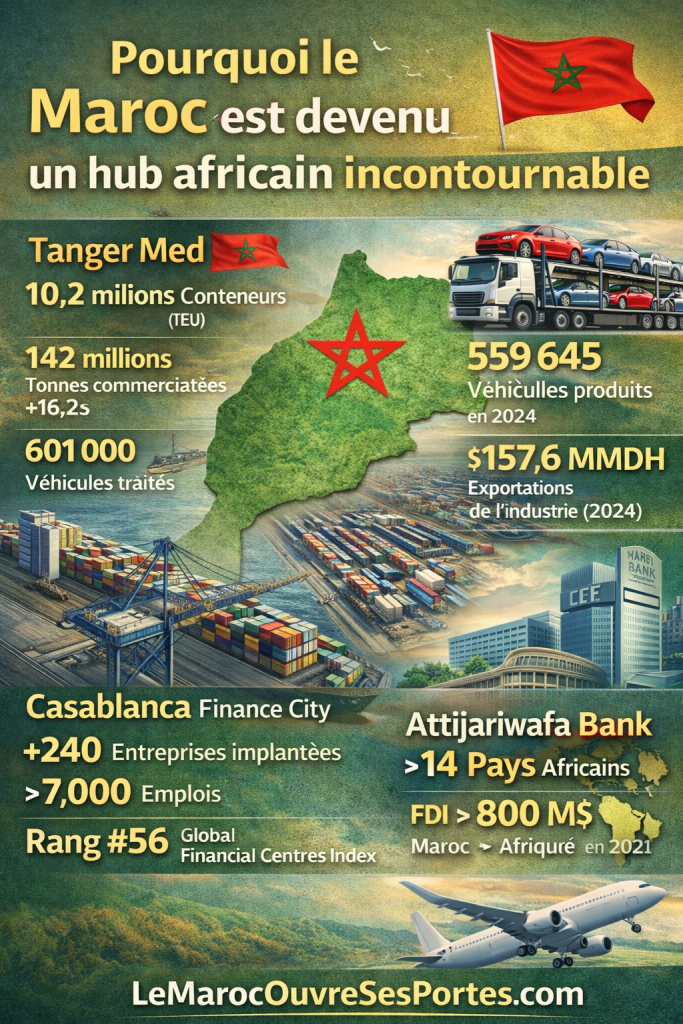
Morocco is regularly presented as a hub between Europe, West Africa, the Sahel and the Mediterranean. In June 2026, the African Development Bank described it as a strategic industrial, logistics and financial centre for regional integration. This position rests on tangible assets: Tanger Med, a developed motorway and rail network, air connections, banks operating in Africa and export industries.
However, the word “hub” does not mean that all the continent’s trade passes through the Kingdom or that it dominates every African sector. It describes an interconnection function that Morocco must continually strengthen through competitive services, reliable corridors and balanced relationships with its partners.
Favourable geography, but not enough
The Strait of Gibraltar places northern Morocco in close proximity to Europe. The Atlantic coast opens onto West Africa and the Americas, while land and sea routes can connect the Mediterranean to the Sahel.
This location reduces certain distances but does not guarantee any flows. Companies choose a corridor based on total cost, transit time, regularity, customs procedures and regulatory stability.
Geography therefore becomes an advantage only when accompanied by ports, roads, logistics data and financial services capable of working together.
Tanger Med, the main logistics engine
The Tanger Med complex handled 11,106,164 TEU containers in 2025, up 8.4% year on year. It also handled 161 million tonnes of goods and more than 535,000 international TIR trucks.
These volumes place the platform among the world’s major container ports and at the forefront in Africa and the Mediterranean. Its strength comes from connections with numerous shipping lines, the productivity of its terminals and its proximity to industrial zones.
A significant share of the containers is transhipped from one vessel to another. This traffic demonstrates maritime connectivity, but it should not be confused with goods produced or consumed entirely in Morocco.
Industrial zones connected to global supply chains
Around Tangier, automotive, aeronautics, textile and logistics activities benefit from the port’s proximity. Export factories can receive components and ship finished products within short timeframes.
This integration has helped make the automotive industry a major export sector. It shows that a hub is not limited to the movement of goods: it creates more value when design, processing, maintenance and services are located on site.
The challenge is to increase the share of Moroccan suppliers, workforce skills and research capacity, so that competitiveness does not rely solely on cost or proximity.
Casablanca, a regional financial platform
Moroccan banks and insurance companies have developed subsidiaries in several West and Central African countries. At the same time, Casablanca Finance City seeks to attract headquarters, consultancies and services aimed at African markets.
This presence facilitates trade finance and support for companies operating across several jurisdictions. It also exposes Moroccan groups to the economic, monetary and regulatory risks of the markets where they operate.
The depth of the financial hub is therefore measured by the quality of financing, risk management and usefulness to partner economies, not solely by the number of subsidiaries.
The role of Royal Air Maroc and airports
Casablanca functions as an air hub connecting African cities with Europe, the Middle East and the Americas. For certain journeys, a connection in Morocco avoids a detour through another continent.
The network’s value depends on frequency, punctuality, baggage handling and ease of connections. Airport investments planned before 2030 must accommodate a significant increase in traffic.
A dense network can also support tourism, business travel and high-value freight. It must remain affordable and sufficiently resilient when disruptions affect a central hub.
African corridors beyond the ports
The African Development Bank emphasises transport corridors and regional value chains. The route to Mauritania is an important land link with West Africa, but its transit times depend on borders, security and infrastructure outside Morocco.
The development of the Atlantic Initiative for Sahel countries aims to improve their access to the ocean. To produce results, this vision will need to be translated into agreements, investments and procedures that carriers can actually use.
A corridor is only efficient if its slowest link improves. Coordination between states matters as much as the quality of a national port.
The AfCFTA as a test of integration
The African Continental Free Trade Area seeks to reduce barriers to trade between African countries. For Morocco, it can open up markets for industries and services while facilitating the arrival of suppliers from the continent.
Customs duties are only part of the problem. Rules of origin, standards, payments, insurance, health inspections and digital formalities determine the actual fluidity of trade.
Hub status will be more credible if African companies can access Moroccan infrastructure through clear procedures and if value chains are built across several countries rather than captured by a single centre.
Digital technology and professional services
Service centres, engineering, telecommunications and digital platforms complement physical infrastructure. Morocco has a pool of French- and Arabic-speaking talent, time zones close to Europe and international connections that support outsourcing.
Competition is strong, however. The quality of training, cybersecurity, data protection and the availability of advanced skills determine the ability to move from standardised services to higher-value activities.
A modern hub must circulate data and knowledge as efficiently as containers.
The limits of Morocco’s ambition
Urban congestion, water stress, skills gaps and the cost of certain services can reduce attractiveness. Major projects concentrated in a few centres also risk exacerbating regional imbalances.
At the regional level, political tensions and the closure of certain borders limit Maghreb integration. Transcontinental corridors also require significant financing and lasting cooperation between government departments.
Lastly, an intermediary position may face competition from other African ports and platforms. Morocco must therefore continually improve its reliability rather than regard its lead as secure.
How to measure a genuine hub
Port and air traffic volumes are useful, but they must be supplemented by transit times, logistics costs, investments made and the share of local added value. A diversity of destinations also protects against dependence on a few routes.
Intra-African trade, joint projects, skilled jobs and SME participation must be monitored. A hub that benefits only transit has less impact than a platform capable of helping its partners grow.
The African Development Bank is preparing an integration strategy for North Africa. Projects financed within this framework will make it possible to assess whether ambitions become operational corridors and value chains.
A function to consolidate rather than an acquired title
Morocco today possesses a rare combination of port, industrial, air and financial infrastructure. It justifies describing the country as a developing regional hub and explains the interest of companies focused on several continents.
However, the outcome will depend on the quality of connections with the rest of Africa, the creation of shared value and the ability to reduce administrative barriers. The hub is not a trophy: it is a service that travellers, carriers and investors must be able to experience every day.
Official sources
- African Development Bank, consultations on the regional integration strategy for North Africa, June 2026: https://www.afdb.org/en/news-and-events/press-releases/morocco-african-development-bank-group-kicks-consultations-its-north-africa-regional-integration-strategy-94834
- Tanger Med, financial communication and 2025 results: https://www.tangermed.ma/wp-content/uploads/documentations/2026/Communication-financiere.pdf
- Maroc.ma, Morocco’s presidency of the Group of Transport Ministers of the Western Mediterranean 2026–2028: https://www.maroc.ma/fr/actualites/le-maroc-prend-officiellement-la-presidence-du-gtmo-55-pour-la-periode-2026-2028
- Tanger Med, official review of the Marhaba 2025 campaign: https://www.tangermed.ma/fr/1-776-942-passagers-et-463-321-vehicules-ont-transite-par-le-port-tanger-med-durant-la-campagne-marhaba-2025/