
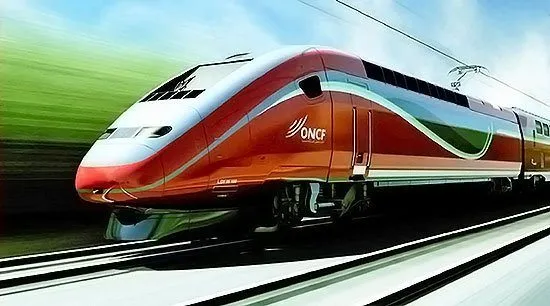
Morocco is building a new high-speed line between Kenitra and Marrakech. Officially launched on 24 April 2025, the project extends the Al Boraq route beyond Kenitra, serves Rabat and Casablanca, and then reaches Marrakech. It is part of a 96-billion-dirham national rail programme.
The project is often described simply as an immediate extension of the high-speed rail network to numerous cities. Documents from the National Railway Office provide a more precise picture: the high-speed line under construction covers the Kenitra–Marrakech route. Services to Fez, Oujda or Agadir are part of other ambitions and must not be presented as stations on this line that is already under construction.
The confirmed scope of the new high-speed line
ONCF describes approximately 430 kilometres of new double track dedicated to high-speed rail between Kenitra and Marrakech. This infrastructure extends the existing Tangier–Kenitra network and creates a major north-south route linking Tangier, Rabat, Casablanca and Marrakech.
The route is intended to bypass or cross the major urban areas using suitable structures. It includes connections with conventional networks so that the time savings can benefit other rail services.
In April 2026, ONCF stated that the work had reached cruising speed, one year after its official launch. This wording confirms the progress of the project; it does not mean that the line is open to passengers.
The cities directly concerned
Kenitra serves as the junction with the high-speed line from Tangier. Rabat and Casablanca lie at the heart of the extension, while Benguerir and Marrakech appear in the service plan published by ONCF.
The programme also includes rail connections with Rabat-Salé and Casablanca Mohammed V airports, as well as with new sports facilities. The objective therefore goes beyond a simple journey between two city centres.
For passengers, the exact service will depend on the commercial services selected: not all trains will necessarily stop at every station. The final timetables and frequencies will need to be checked when the line opens.
What the 53 billion dirhams will fund
Of the 96 billion dirhams allocated to the overall rail programme, 53 billion are assigned to the infrastructure and equipment of the Kenitra–Marrakech high-speed line. This amount must not be presented as the cost of all the country’s rail projects.
The overall programme also includes the renewal of rolling stock, improvements to the conventional network and the development of metropolitan services. These components are intended to absorb traffic growth and improve daily travel.
A high-speed line requires tracks, earthworks, bridges, viaducts, signalling, electrical power supply, telecommunications, maintenance bases and station adaptations. The cost therefore covers a complete system, not just rails.
The expected time savings
The extension is expected to significantly reduce journey times between Tangier, Rabat, Casablanca and Marrakech. The estimates announced during the launch are service targets that will need to be confirmed by commercial timetables and operational testing.
The time saved will also depend on the number of stops and connections. A direct train may have a very different journey time from a service calling at more cities. It is therefore prudent to avoid promising a single journey time before the official timetable is published.
For passengers arriving from the north, eliminating a change or a slower journey south of Kenitra should be one of the main benefits.
Why the airports are part of the project
The rail connections to the airports are intended to facilitate transfers between aircraft, trains and urban centres. Casablanca Mohammed V accounts for a major share of international traffic, while Rabat-Salé supports the capital’s growth.
A good airport connection does not depend solely on maximum speed. It requires extended service frequencies, clear information, space for luggage and coordination with flight times.
Visitors will therefore need to distinguish between the presence of infrastructure and the quality of the daily service. The latter will be assessed based on timetables, fares, reliability and connections.
Construction work is already disrupting some services
The construction of the high-speed line and the transformation of existing facilities require temporary adjustments. ONCF publishes construction information that may result in changes to timetables, routes or connections.
These disruptions do not necessarily constitute a project delay. They are common when new structures must be connected to a rail network that remains in operation.
Before travelling, it is advisable to check that day’s timetable through official channels, especially during major phases of work around Casablanca, Rabat or Kenitra.
Fez and Oujda are not on the high-speed line under construction
Morocco has presented a broader vision for its high-speed rail network, with an Atlantic route and a Maghreb route. Fez and Oujda are included in this long-term planning, but they are not stations on the Kenitra–Marrakech project.
They may benefit indirectly from investments in the conventional network, rolling stock and better connections. This does not turn these improvements into a new high-speed line that is already funded and under construction.
To announce a future extension, a timetable, funding and an official launch specific to the project concerned will need to be identified.
Agadir remains a separate ambition
The rail extension to Agadir is regularly mentioned in national plans. However, the city is not currently connected to the rail network and is not part of the Kenitra–Marrakech scope described in the progress documents consulted.
An extension south of Marrakech would involve a new project, studies, route decisions and specific funding. The terrain and distance make this project different from the extension currently under way.
Presenting Agadir as a confirmed future station with a firm date would therefore be premature until a complete official timetable is published.
The expected effect on the conventional network
The new infrastructure could free up capacity on certain conventional tracks by separating some high-speed trains from regional and freight services. This capacity will only improve daily travel if it is reused with a suitable service offering.
The programme specifically provides for local services and the acquisition of new trains. The challenge is to make the high-speed network a backbone connected to the rest of the rail system, rather than an isolated service between a few major cities.
Interchange stations, accessibility and integration with urban transport will be decisive for passengers who do not live in the immediate vicinity of the high-speed line.
What to monitor before the opening
The main milestones are the completion of structures, track laying and equipment installation, electrification, static and then dynamic testing, and operating authorisation. A reliable commercial opening date requires these stages to be completed.
Frequencies, fares, journey times, stations served and luggage rules will then need to be checked. The actual environmental impact will depend on train occupancy and the shift from cars or aircraft.
As of 22 August 2026, the central fact is therefore simple: the Kenitra–Marrakech project is progressing, but the line is not yet a service open to the public.
A transformative project that should be described without anticipating developments
The Kenitra–Marrakech high-speed line will transform the Atlantic rail route and bring four major tourism and economic centres closer together. Its integration with airports and metropolitan networks could amplify this effect.
Nevertheless, precision remains essential. The confirmed programme links Kenitra with Marrakech and extends Al Boraq from Tangier. Fez, Oujda and Agadir belong to other development horizons. Distinguishing between these levels does not diminish the project’s ambition: it makes it possible to track its actual results.
Official sources
- ONCF, review of the rail programme one year after its launch, 24 April 2026: https://www.oncf.ma/fr/Actualites/Programme-ferroviaire-historique-l-oncf-marque-une-annee-d-avancees-concretes-au-service-d-une-vision-strategique
- ONCF, progress of the Kenitra–Marrakech high-speed line: https://www.oncf.ma/fr/Actualites/Les-travaux-du-projet-de-la-lgv-kenitra-marrakech-atteignent-leur-vitesse-de-croisiere
- ONCF, 2024 annual financial report and presentation of the Kenitra–Marrakech project: https://www.oncf.ma/fr/content/download/112865/2632761/file/RFA%202024%20-%20VF.pdf
- ONCF, passenger information relating to construction work: https://www.oncf.ma/fr/Voyageurs/Nouveautes/Info-travaux