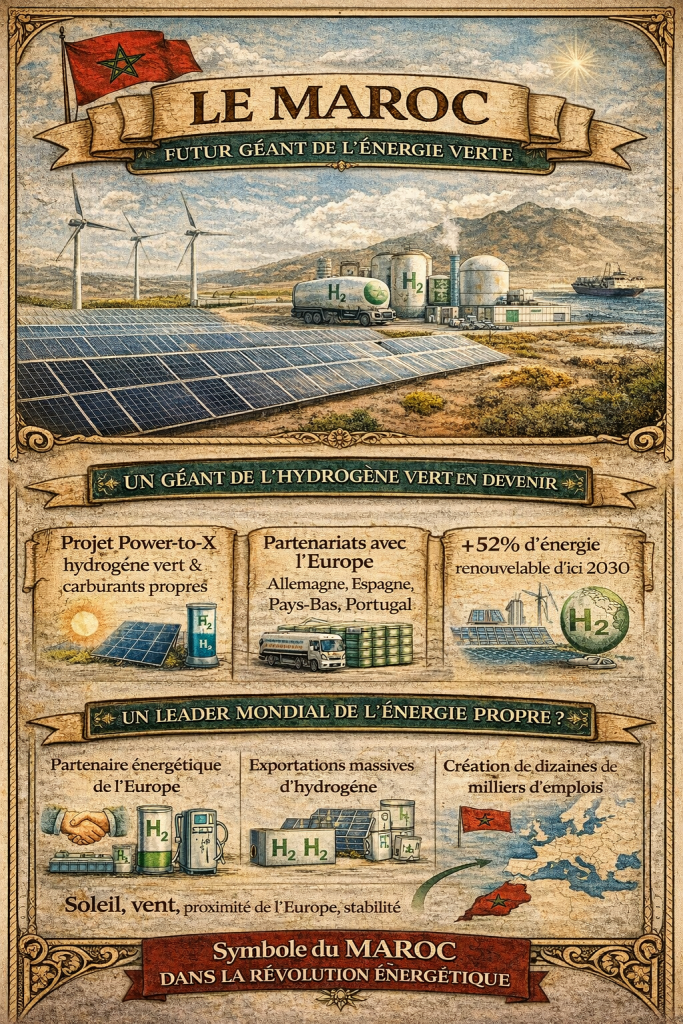
Morocco wants to use its solar and wind potential to produce green hydrogen and derivatives such as ammonia, synthetic fuels and methanol. The “Morocco Offer” has structured access to land and the selection of investors. In January 2026, the authorities stated that seven integrated projects had been selected in the southern regions.
This is an important step, but it does not yet make the Kingdom a production “superpower”. A selected project must still finalise its financing, secure its customers, and build its renewable power plants, electrolyser, water networks and port facilities before delivering its first tonne.
What green hydrogen actually is
Hydrogen is produced by separating molecules, particularly water molecules. When an electrolyser runs on renewable electricity and lifecycle emissions are controlled, the product can be classified as green under the applicable rules.
This gas is not a primary energy source comparable to the sun or wind. It is an energy carrier: electricity must first be produced, that energy converted into hydrogen, and then potentially compressed, liquefied or transformed.
Each conversion results in losses. Hydrogen is therefore mainly envisaged for uses that are difficult to electrify directly, rather than as a replacement for electricity in every situation.
Why Morocco is positioning itself early
The country has complementary solar and wind resources, an extensive coastline and port infrastructure connected to Europe. Its phosphate industry also consumes ammonia, which is currently largely imported, creating a potential outlet in the domestic market.
Proximity to the European Union can reduce certain transport distances. Trade agreements, MASEN’s experience and industrial capabilities also provide developers with an institutional foundation.
These advantages do not guarantee a competitive final cost. They must be converted into abundant electricity, grid capacity, treated water and long-term contracts.
The Morocco Offer organises the projects
The royal speech of 29 July 2023 called for the rapid, high-quality implementation of the Morocco Offer for green hydrogen. The government subsequently established a steering committee and a framework to accommodate investors.
The approach covers integrated projects, from renewable production to derivatives and their export or local use. Public land made available in the southern regions is to be allocated progressively according to investment commitments.
This organisation seeks to prevent a proliferation of isolated projects without a grid, port or customer. It will also need to preserve competition and ensure transparency in the selection and monitoring criteria.
Seven selected projects are not seven operating plants
In January 2026, Maroc.ma stated that seven integrated projects had been selected. They bring together Moroccan and international investors and target different hydrogen derivatives.
Selection opens a development phase. Technical and environmental studies, permits, land agreements, purchase contracts and financing must still come together.
It is therefore incorrect to add their announced capacity to existing national production. The accurate wording is that Morocco has a portfolio of selected projects whose implementation remains to be monitored.
Renewable electricity is the first bottleneck
Producing large quantities of hydrogen requires a great deal of electricity. The projects will need to develop additional solar and wind capacity so as not to divert energy already needed by households and businesses.
The grid can support certain uses, but a large-scale export project must demonstrate the origin of its electricity and its additionality. European rules on renewable fuels notably impose traceability criteria.
The complementary nature of Morocco’s sun and wind can increase electrolyser utilisation rates. It eliminates neither variability nor the need for storage and balancing.
The water issue must be addressed openly
Electrolysis consumes pure water, while Morocco faces structural water stress. Major coastal projects are therefore considering desalination, with treatment and transport to the facilities.
The amount of water directly incorporated into hydrogen is only one part of the equation. Cooling, cleaning, desalination losses and the needs of processing industries must also be taken into account.
Each project must publish a water study, avoid competing with drinking or agricultural water, and properly manage brine discharges. A “green” label alone is not enough to guarantee an acceptable local impact.
Ammonia could be an initial market
Converting hydrogen into ammonia makes it easier to store and transport. Morocco already uses ammonia in fertiliser production, creating a domestic market that could reduce certain imports.
This outlet could be more tangible than exporting pure hydrogen over long distances. It brings the producer closer to an industrial consumer and allows an existing supply chain to be progressively decarbonised.
Ammonia nevertheless remains toxic and requires strict safety rules. Its climate impact depends on the electricity used and the control of emissions throughout the entire supply chain.
European exports are not guaranteed
Europe is seeking low-carbon fuels for industry, aviation and maritime transport. Several countries are therefore positioning themselves as future suppliers, creating competition over prices and contracts.
A Moroccan project must comply with the standards of its target market, obtain certification and find a buyer willing to pay the additional cost. European import infrastructure and support mechanisms also influence demand.
Without a long-term purchase contract, banks may hesitate to finance facilities costing several billion. Exporting is an opportunity, not an automatic outlet.
Jobs, local industry and regions
Construction sites can create many temporary jobs, while highly automated operations generally create fewer. Technical training, maintenance and component manufacturing determine how much value is retained in Morocco.
Host regions must benefit from infrastructure, services and sustainable economic activities. Land and natural resources cannot be the only local contributions.
Publishing indicators on employment, purchases from Moroccan companies and regional benefits will make it possible to verify the promises.
Milestones to monitor for each project
A credible project must announce a definitive land agreement, an approved environmental study, a purchase contract, a final investment decision and completed financing. Construction, testing and commissioning then follow.
The dedicated renewable capacity, water volume, final product, port used and timetable must also be known. Vague announcements of billions and gigawatts are no substitute for these details.
As of 22 August 2026, the selection of seven projects represents the most important official starting point. Final investment decisions will mark the real transition from ambition to industry.
Major potential, without premature superlatives
Morocco has a structured strategy, resources and industrial outlets that could make it an important green hydrogen player. Its lead currently lies in preparing the framework and project portfolio.
Leadership will later be measured in tonnes produced, emissions avoided, costs, contracts and local benefits. Talking about a “superpower” before the first plants are operational obscures this reality. The challenge now is to deliver without sacrificing water, the grid or transparency.
Official sources
- Maroc.ma, royal speech on the Morocco Offer for green hydrogen, 29 July 2023: https://www.maroc.ma/fr/discours-messages-royaux/discours-royaux/discours-de-sm-le-roi-la-nation-loccasion-du-24eme-anniversaire-de-la-fete-du-trone
- Head of Government, steering committee for the Morocco Offer for green hydrogen: https://www.cg.gov.ma/en/node/12241
- Maroc.ma, energy transition, MASEN oversight and seven selected projects, 26 January 2026: https://www.maroc.ma/fr/actualites/la-transition-energetique-au-maroc-un-veritable-levier-de-developpement-et-de-renforcement-de-la
- Ministry of Energy Transition and Sustainable Development, renewable energy strategy: https://www.mem.gov.ma/Pages/secteur6659.html?e=2