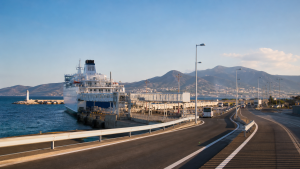
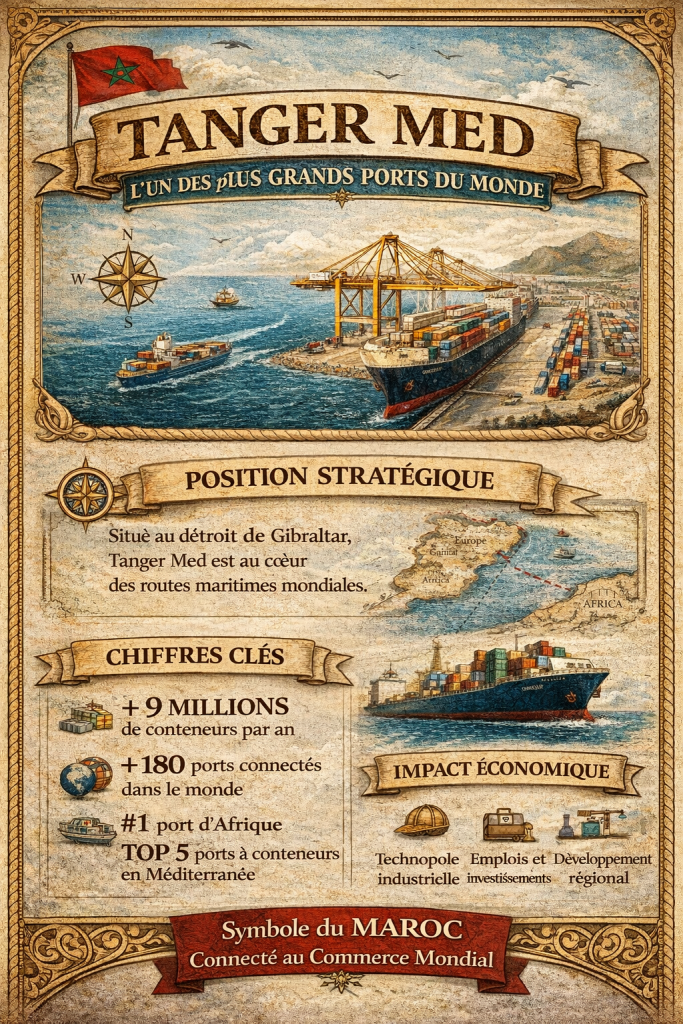
In 2025, Tanger Med surpassed the threshold of 11 million TEU containers. The complex handled exactly 11,106,164 TEUs, 8.4% more than in 2024, and 161 million tonnes of goods. These results confirm its position as Africa’s and the Mediterranean’s leading container port platform.
This success does not come from a single terminal or a recent decision. It is the result of a strategic location, gradual investment, concessions to international operators, industrial zones and a logistics organisation built over more than two decades.
A port located on a major shipping route
The Strait of Gibraltar is a focal point for ships travelling between the Atlantic and the Mediterranean. Tanger Med is located close to this route without requiring container ships to make a long detour.
This geography facilitates transshipment: a large ship unloads containers that continue to other destinations on different vessels. The quality of the connections thus makes it possible to serve numerous ports from the same platform.
Location alone is not enough. Shipping companies require productive terminals, suitable depths, available equipment and reliable port calls.
Construction completed in stages
The first port complex was supplemented by Tanger Med 2 and new container terminals. This gradual expansion made it possible to increase capacity as volumes and ship sizes grew.
The concessions granted to different operators brought commercial networks, equipment and international expertise. The port authority retains its role as the developer and coordinator of the entire complex.
This structure explains why the complex can handle containers, trucks, new vehicles, bulk cargo and passengers at the same time without mixing their flows.
The official results for 2025
In addition to the 11,106,164 TEUs, Tanger Med handled 161 million tonnes, an increase of 13.3%. TIR truck traffic reached 535,203 units, representing growth of 3.6%.
The vehicle terminal handled 526,862 vehicles, a figure down 12% year on year. This decrease is a reminder that a port can set an overall record while experiencing different trends across its activities.
The data must be read by year and category. A ranking published in 2024 or 2025 does not become an unchanging global position.
Why TEUs do not tell the whole story
The TEU, or twenty-foot equivalent unit, standardises container measurement. A forty-foot container generally counts as two TEUs. This figure facilitates comparisons between ports but measures neither the value nor the origin of the goods.
A container in transshipment may pass through Tanger without entering the Moroccan economy. Conversely, an industrial truck or an exported vehicle creates a direct link with a factory located in the country.
To assess the economic impact, TEUs must therefore be supplemented by jobs, logistics added value, exports and activity in industrial zones.
The link with the automotive industry
Factories in Tangier and Kenitra use the port to receive parts and export vehicles. Dedicated terminals, railways and motorways reduce the time between the assembly line and the ship.
This organisation has helped Morocco integrate into European automotive supply chains. It also benefits suppliers based in nearby industrial zones.
However, the decrease in the number of vehicles handled in 2025 shows that volumes depend on production cycles, demand and manufacturers’ logistics choices.
TIR trucks and trade with Europe
Roll-on/roll-off connections allow trailers and trucks to cross the strait quickly. Agricultural, textile and industrial products can reach Europe within time frames suited to sensitive goods.
Handling more than 535,000 TIR trucks in 2025 requires coordinated customs, health and security checks. Congestion at the port entrance can cancel out some of the time gained at sea.
The digitalisation of formalities and the predictability of crossings are therefore as important as the quays.
Marhaba: a different but essential function
During the 2025 Marhaba campaign, 1,776,942 passengers and 463,321 vehicles passed through Tanger Med. The flows are concentrated over a few weeks and require specific organisation.
Passenger areas, waiting zones and border checks do not face the same constraints as container terminals. Their quality directly influences the experience of Moroccans living abroad and visitors.
Annual passenger figures should therefore not be combined with goods figures to produce a single ranking.
Business zones extend the port
Tanger Med manages a network of industrial, logistics and commercial zones. Their proximity allows companies to organise supply, storage, production and shipping within the same ecosystem.
This integration creates more value than transshipment alone. It attracts investment, jobs, and maintenance, transport and engineering services.
The challenge is to increase the share of domestic suppliers and local skills while limiting pressure on land, travel and environmental impacts.
Security, fluidity and the environment
A major port must control access, track cargo and comply with international security standards. It must also protect its digital systems, which have become essential to container movements.
Traffic growth increases emissions from ships, trucks and handling equipment. Electrifying equipment, improving energy efficiency, using rail and adopting lower-carbon fuels can reduce this impact.
Future performance will therefore be measured as much by fluidity and emissions as by the gross volume handled.
A global ranking that must be precisely dated
Tanger Med’s 2024 annual report mentioned 17th place worldwide according to the Alphaliner ranking available at the time. Rankings subsequently change with the results of other ports and the methods used.
Saying that Tanger Med is “one of the world’s largest ports” is justified by its volumes. Assigning it a fixed rank without a year or source would be imprecise.
The indisputable position in the 2025 data is its African and Mediterranean leadership in containers, as presented in the official communication.
The next indicators to monitor
TEU growth will need to be compared with available capacity, waiting times and terminal productivity. Rail freight volumes will show whether some pressure can be taken off the roads.
The value of exports, employment, training and the carbon footprint will also need to be monitored. A resilient platform must diversify its customers and maintain service despite global disruptions.
Tanger Med has already transformed the scale of logistics in Morocco. Its next challenge is to convert its records into sustainable efficiency for the country’s industry and trade.
Official sources
- Tanger Med, 2025 financial communication and activity results: https://www.tangermed.ma/wp-content/uploads/documentations/2026/Communication-financiere.pdf
- Tanger Med, 2024 annual financial report: https://www.tangermed.ma/wp-content/uploads/documentations/2025/rapport-financier-2024-V-WEB.pdf
- Tanger Med, review of the 2025 Marhaba campaign: https://www.tangermed.ma/fr/1-776-942-passagers-et-463-321-vehicules-ont-transite-par-le-port-tanger-med-durant-la-campagne-marhaba-2025/