Morocco’s consumer price index fell by 1% in July 2026 compared with June, according to the High Commission for Planning, or HCP. Food and fuel made the largest contributions. The result does not mean that every price fell or that each household gained exactly 1% in purchasing power.
CPI tracks the average cost of a representative basket. A family’s actual basket depends on income, location, travel needs and food choices, so the national result is a guide to a trend rather than an individual bill.
The headline figure and its comparison period
HCP first compares July with June 2026. The overall index is down 1% month on month. Food products fall by 1.9%, while non-food products fall by 0.3%.
This is a short-term movement. It is different from the twelve-month comparison: July 2026 CPI is 0.6% below July 2025. The monthly and annual figures answer separate questions, and should not be merged into a single claim about inflation.
The food categories behind the fall
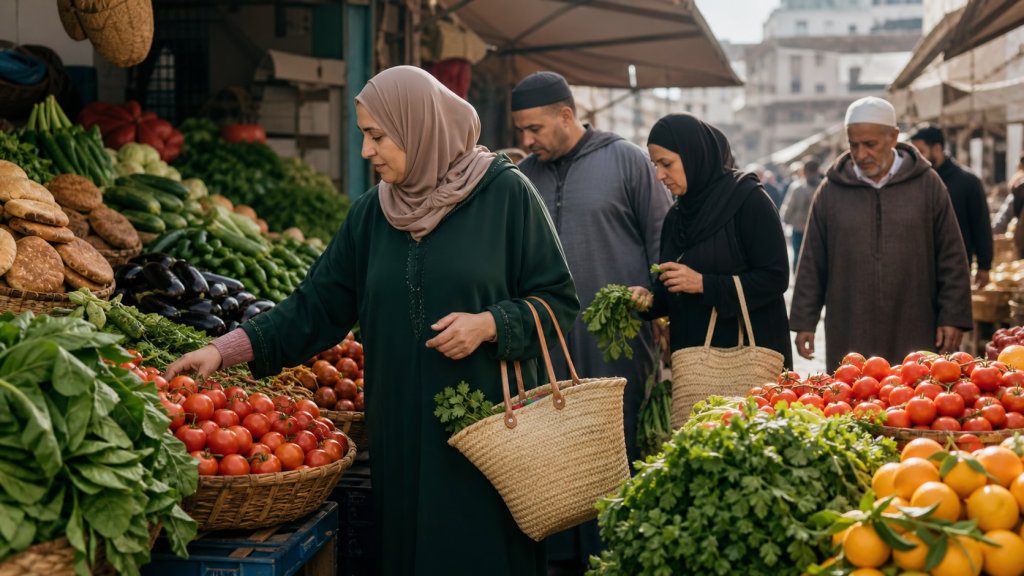
Compared with June, HCP reports declines of 7.6% for vegetables, 3.9% for fish and seafood, 3.7% for fruit and 1.2% for meat. Milk, cheese and eggs fall by 0.3%.
Other items move in the opposite direction. Mineral water, soft drinks and juices rise by 0.3%, while coffee, tea and cocoa increase by 0.2%. A falling food average can therefore coexist with visible increases in particular aisles.
Fuel also affected the monthly index
Fuel prices fall by 4.9% in the non-food group. This helps lower the overall index, but households experience the change differently.
A daily car user is more exposed to pump prices than someone who mainly walks or uses public transport. A fuel decline also does not immediately reduce every transport cost already embedded in goods and services.
The movement varied between cities
HCP records the largest monthly decline in Marrakech, at 1.7%, followed by Safi at 1.4% and Guelmim at 1.3%. Tangier falls by 1.1%, while Casablanca, Rabat and Meknes each record a 1% decline.
The changes are smaller in Agadir, Settat and Beni Mellal, at 0.9%, then Fez and Oujda, at 0.8%. Results are also published for Tetouan, Al Hoceima, Dakhla and Errachidia. These figures do not create a permanent ranking of the cost of living; they measure how local baskets moved between two months.
What the twelve-month comparison shows
Between July 2025 and July 2026, food prices fall by 3.7%, while non-food prices rise by 1.9%. Within the non-food group, annual changes range from -0.2% for communication to +4.1% for transport.
This mix helps explain why a lower overall index may not match an individual household’s perception. A family spending a large share on transport, housing or a rising service has a different basket from the statistical average.
Core inflation offers a second view
HCP also calculates core inflation, excluding volatile prices and products with public tariffs. It falls by 0.1% month on month and by 0.1% year on year in July.
The measure is designed to show a trend less affected by a temporary shock in vegetables or fuel. It does not replace headline CPI: households still buy volatile products even when analysts exclude them from the core measure.
CPI is not purchasing power
Purchasing power depends on both prices and disposable income. An average price decline cannot guarantee an improvement if household income falls, an unexpected expense occurs or essential items move faster than the index.
CPI also does not show the absolute level of prices, product quality, differences between shops or the exact cost of an individual lifestyle. It measures average change under a published method.
A practical reading checklist
- Compare like with like: month on month or year on year.
- Look at product groups, not only the headline index.
- Check the city when HCP provides a territorial result.
- Relate price changes to a household’s real income.
- Do not turn one monthly movement into a forecast.
The next release may confirm, soften or reverse July’s movement. The value of the indicator lies in following a consistent series over time.
Economic context without a commercial pitch
This article is intended to explain contemporary Morocco and does not justify a travel or affiliate offer. The data were published on 19 August 2026. Personal budgeting should rely on actual household spending and future official releases.
Sources consulted
- High Commission for Planning, “Consumer Price Index for July 2026”, 19 August 2026: https://m.hcp.ma/L-Indice-des-prix-a-la-consommation-IPC-du-mois-de-Juillet-2026_a4344.html
- High Commission for Planning, Consumer Price Index resources, accessed 23 August 2026: https://www.hcp.ma/Actualite-Indices-des-prix-a-la-consommation-IPC_r349.html