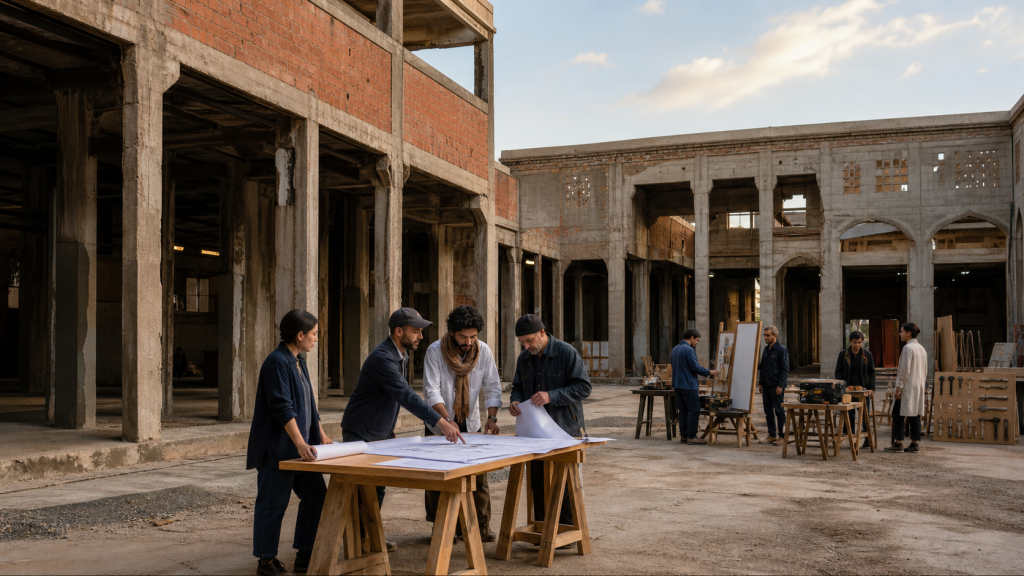
Casablanca’s municipality plans to rehabilitate the former slaughterhouses in Hay Mohammadi as a cultural institution focused on urban art, live performance, street arts and circus. Its 2023-2028 Action Plan gives an estimated budget of 150 million dirhams. These facts document a public project; they do not prove that a renovated venue is already open.
That distinction matters. Financial programming, a council decision and a completed building are separate stages.
Industrial heritage that became a creative space
Hay Mohammadi’s official heritage page links the complex to Casablanca’s industrial and popular history. It dates the site to 1922 and notes that the former slaughterhouses have occasionally hosted performances, conferences and workshops.
The place is often known as the Cultural Factory. Its value is not a generic industrial backdrop. It comes from the neighbourhood, the scale of its architecture and the artistic uses that developed there.
What the municipal Action Plan says
Casablanca’s 2023-2028 Action Plan includes a project sheet for restructuring the Cultural Factory. It says access for artists ended after the agreement with Casa-Mémoire expired in 2016 and sets the objective of making the heritage site a fully established institution.
Proposed actions include cleaning, painting, sanitation, lighting, renovation, an events programme and a management agreement. The document also envisages selecting an operator and evaluating performance through defined indicators.
A planned budget, not a final cost
The project sheet gives an estimated budget of MAD 150 million under a public-private partnership. Its forecast allocation is MAD 50 million in 2024, MAD 50 million in 2025 and MAD 50 million in 2026.
This is programming inside a plan. Without an implementation report, awarded contracts and documented acceptance of work, it is not possible to claim that all funds were committed or spent, or that construction followed that exact timetable.
The November 2024 council decision
At an extraordinary session in November 2024, the municipal council adopted several projects intended to strengthen Casablanca’s tourism, cultural and sports offer. Restoration and rehabilitation of the former slaughterhouses was on the list.
The decision confirms a policy direction. By itself, it does not provide an opening date, a confirmed programme or the final manager’s identity. Any visitor information requires a newer operational announcement.
The stated cultural goals
The Action Plan aims to revive a place of creation and accommodate street art, performing arts, street performance and circus. It lists target indicators of 20 events a year, 150,000 visitors a year and 10 activities.
These are intended results, not observed attendance. Reporting them as achievements would misstate the project’s status. Their value is that they could make future management measurable if the venue begins operating.
Governance will shape the outcome
The municipality and local development company Casa Events et Animation are identified among the project leads. The youth and culture ministry and the regional council appear among the proposed partners.
Success will depend on the management agreement, financial model, artist access, maintenance and relationship with residents. Renovating a building alone does not create a lasting cultural institution.
Do not confuse two different sites
The former Hay Mohammadi slaughterhouses associated with the cultural project are not Casablanca’s active municipal slaughterhouses in Sidi Othmane. The latter have a separate sanitary and economic function.
This distinction prevents a common search and mapping error. Anyone looking for the cultural venue should use “Cultural Factory of the former slaughterhouses” and verify both the address and opening status.
What the project could change
A careful rehabilitation could preserve twentieth-century heritage, provide workspace for artists and broaden culture beyond Casablanca’s best-known circuits. It could also help visitors understand Hay Mohammadi rather than treating the metropolis only as a city-centre stop.
Tourism value should remain secondary to local value: resident access, regular programming, conditions for creative work and the site’s memory. Those are the measures by which the project can ultimately be assessed.
Can visitors plan a trip now?
As of 23 August 2026, the public documents reviewed establish the project and its goals but do not provide a recent operational schedule that allows MOP to announce a permanent opening. Tickets, times and activities must not be invented.
MOP’s Casablanca destination hub provides broader context. There is no affiliate offer or promise of access here. Before travelling, look for a dated announcement from the municipality or the future operator.
Sources consulted
- Casablanca Municipality, 2023-2028 Action Plan, project sheet on restructuring the former slaughterhouses Cultural Factory: https://www.casablancacity.ma/storage/photos/48/PAC%20Casablanca%202023-2028%20%5Bversion%20franc%CC%A7aise%20comple%CC%80te%5D1.pdf
- Casablanca Municipality, projects adopted at the extraordinary session, 28 November 2024: https://www.casablancacity.ma/fr/actualite/1828/le-conseil-communal-de-casablanca-a-adopte-des-projets-visant-a-renforcer-loffre-touristique
- Hay Mohammadi district, heritage page, accessed 23 August 2026: https://haymohammadi.casablancacity.ma/fr/article/1214/hay-mohammadi-un-lieu-de-memoire