Casablanca is a large metropolis. An address that works for one transit night may be inefficient for an architecture visit, business meeting or coastal stay. The choice should begin with the railway station, airport or district actually used, then account for daily journeys.
This guide compares urban bases without publishing a hotel ranking. MOP separates editorial analysis from Expedia offers and reproduces no price or availability data.
City centre and Art Deco heritage
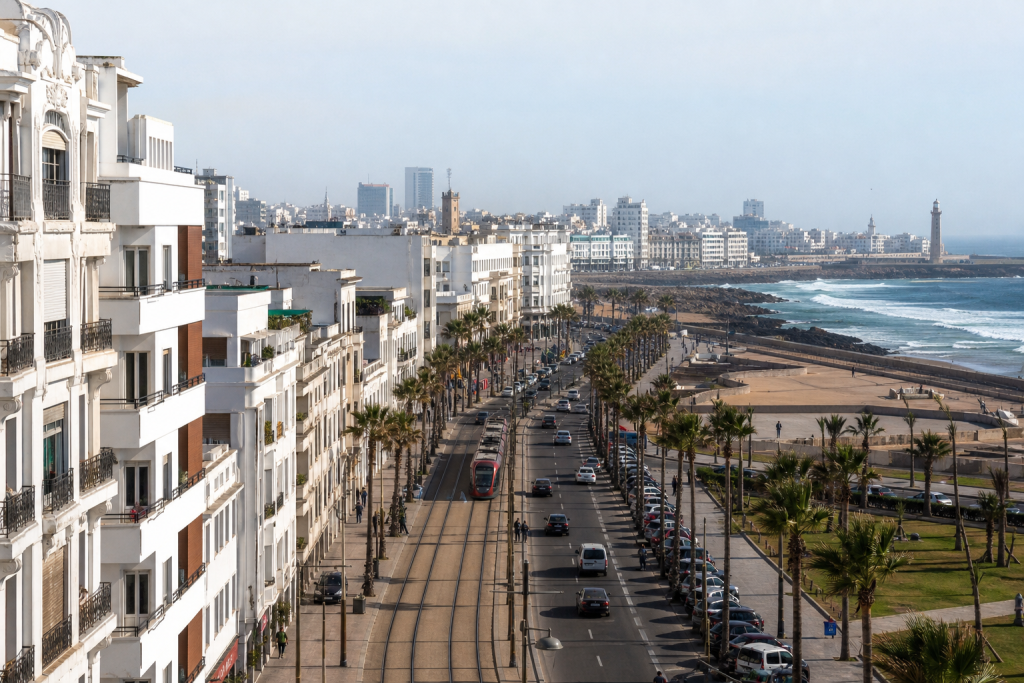
The centre suits travellers who want to observe twentieth-century architecture, reach shops, use the tramway and connect with several urban routes. Morocco’s National Tourist Office presents Casablanca as a modern city with varied transport and infrastructure.
The quality of a stay still depends on the street. Check traffic, noise, the building entrance, distance to a useful station and the route after dark. A remarkable facade says nothing about room soundproofing.
Around Casa-Port: trains and a short city stay
A base near Casa-Port can simplify some rail journeys and access to the centre. It suits a short stop when the real itinerary uses this station.
Casablanca has several stations, so check the ticket before booking. “Near the station” is not useful if the train departs from Casa-Voyageurs. Also ask about the walking route with luggage and options early or late in the day.
Around Casa-Voyageurs: put connections first
This area may be logical for a departure or railway connection. It is not automatically the best base for every visitor walk. Group visits and use urban transport rather than taking repeated taxis across distant districts.
For one night before a train, transfer simplicity may be decisive. For several days of exploration, compare the time cost of journeys to the centre, Habous and waterfront.
Habous and nearby districts: heritage and a residential pace
Habous presents another side of Casablanca, with a street pattern and shops distinct from the Art Deco centre. An address here can suit a stay focused on architecture, markets and a more residential setting.
Measure the distance to transport, evening meals and other visits. Being close to a monument or market does not create a direct connection to the corniche or railway stations.
Maarif and business districts: services and appointments
Maarif and other contemporary sectors may suit travellers with appointments, those looking for many services or anyone considering an apartment for a longer stay.
Traffic changes by the hour. A short map route may take much longer on the road. Prefer an address near a transport axis that you will genuinely use rather than an area chosen only for its reputation.
Corniche and Ain Diab: make the coast central
A corniche base works when Atlantic walks, waterfront restaurants and a coastal pace are part of the stay. It creates more distance from some stations, central heritage and business meetings.
Check traffic, nighttime noise and transport access. “Sea view” guarantees neither a straightforward walk nor suitable swimming. Ocean conditions and supervision must be checked on the day.
Mohammed V Airport: distinguish transit from a city visit
The airport lies outside central Casablanca. A nearby night can make sense before an early departure or during a long connection, but is inefficient for daily city visits.
Confirm transfer arrangements, price, frequency and the margin required. Never assume that a shuttle runs all night. For an urban stay, a base connected to the real itinerary is usually more useful.
Families, accessibility and noise
With children, check bedding, windows, access to simple food and travel time. A large city makes every outing tiring when the district was selected without reference to the programme.
For reduced mobility, request details of the route between pavement, reception, lift and room. A nearby station is useful only when the route and vehicle meet the actual need.
Apartment or hotel: verify services
An apartment may suit a longer stay but requires checks on reception, cleaning, building security and inventory. A hotel generally offers a more structured reception, useful for transit or late arrival.
Compare taxes, breakfast, parking, transfers, cancellation and reception hours. For an important need, request a written answer rather than relying on an icon.
Compare on Expedia without losing context
Expedia presents offers for selected dates and party size. MOP makes no automatic recommendation from them. Verify the exact address, station used, tram access, recent reviews and cancellation terms.
A discount cannot compensate for hours of unnecessary travel during the stay. Compare the district first, then the services genuinely required.
Decide with five questions
- Which station, terminal or district actually shapes the stay?
- Is the address close to useful transport, not just a line on a map?
- How much time will daily journeys consume?
- Are noise and nighttime access covered by recent information?
- Are transfer and cancellation terms explicit?
Continue with the Casablanca destination guide and the MOP two-day Casablanca itinerary.
Sources consulted
- Moroccan National Tourist Office, Casablanca overview: https://www.visitmorocco.com/en/travel/casablanca
- Moroccan National Tourist Office, Casablanca medina and modern city: https://www.visitmorocco.com/en/travel/casablanca/medina