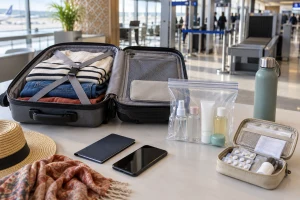
A SIM or eSIM makes travel easier, but connectivity should never be the only key to a ticket, address or payment. A less-covered area, empty battery, lost device or unavailable application can interrupt an otherwise well-designed journey.
This article complements MOP’s SIM, eSIM and Internet in Morocco. It recommends no operator: ANRT publishes sector indicators, while coverage, packages and compatibility must be checked with operators for the particular place and date.
Identify critical dependencies
List everything that currently requires a connection: ticket, boarding document, booking, address, driver message, bank authentication or translation. Mark the items whose absence would genuinely prevent the next step.
Download them in a format readable without a proprietary application when possible. A screenshot can help, but a complete PDF with reference and conditions is more reliable. Do not store full card details unnecessarily.
Prepare maps for each stage
Download every city and the route between terminal and accommodation. In a medina, add the correct gate, drop-off and a recognised landmark. For a remote road, save the next safe settlement instead of a lone pin on an unsurfaced track.
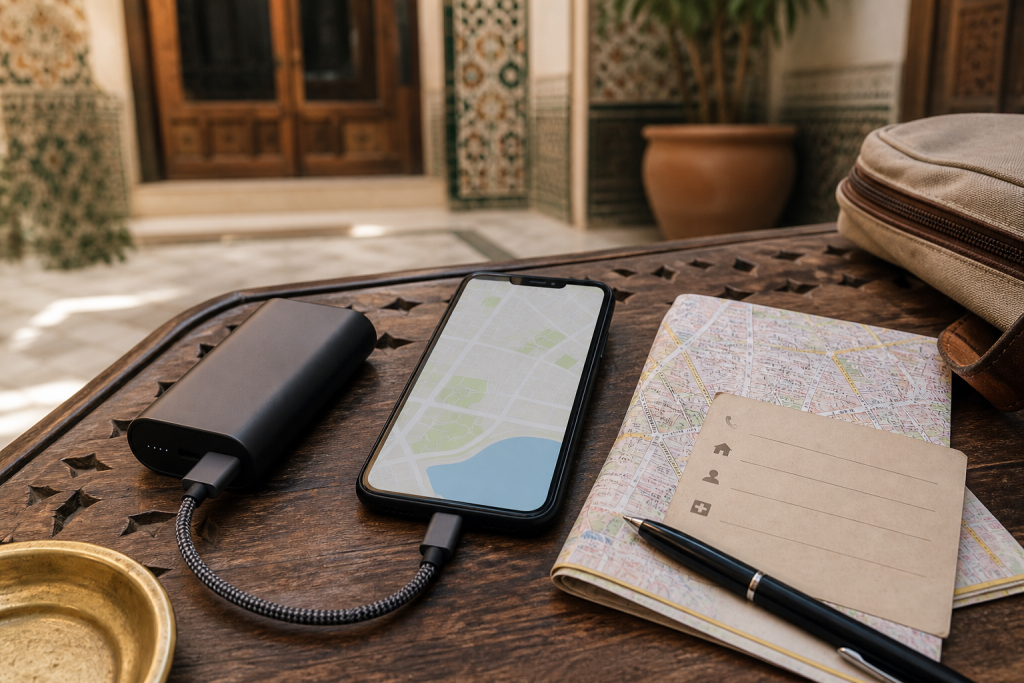
Test airplane mode before departure: open the map, find the address and confirm that the useful route remains visible. An offline map may not show a closure, diversion or weather condition, so recent local instructions still take priority.
Create a minimal contact sheet
Retain contacts for accommodation, carrier, insurer, one trusted person and applicable emergency services. Add the international prefix and a short phrase describing the address or need. A limited paper copy makes it possible to borrow a telephone without exposing the whole address book.
For a driver or guide, note the name, company, meeting point and agreement. A profile screenshot is not identity verification; confirm the provider through the booking channel or official reception.
Separate the main device and backup
Carry a charged power bank, compatible cable and, when the trip warrants it, a second route to essential references. A backup phone can remain switched off and separate. Enable a strong lock and location features before leaving.
Photographing every document is not a security plan. Limit copies, encrypt backups and avoid keeping the passport, telephone and only battery in one bag. A trusted person should be able to help without receiving all personal data.
Prepare payment authentication
Some bank approvals depend on a text message or application. Ask the bank how authentication works abroad and keep a second payment method separately. Never disclose a received code to someone claiming to solve a transaction block.
Keep proportionate cash for a journey or meal rather than the whole stay. Currency exchange should use authorised operators; MOP’s money guide explains the distinction between card, cash and exchange receipts.
Organise arrival without mobile data
Before a flight or sailing, open the ticket and address, then switch to airplane mode to confirm that both remain readable. Agree a meeting point that does not depend on a last-minute message. If transport changes, use an official desk or a contact already verified.
For accommodation, save the late-arrival procedure and booking name. Expedia or another platform provides access to the offer; the stored confirmation and property contact execute the arrival.
Review files during the journey
Delete old versions when a ticket or address changes. Add a checked date to dynamic information and refresh maps before entering another region. An archive full of duplicates can be less dependable than one short folder.
After returning, remove identity files from temporary devices and revoke unnecessary shared access. A strong offline plan protects both continuity and the amount of personal information carried.
Sources consulted
- ANRT, Morocco ICT Data and telecommunications indicators: https://www.anrt.ma/observatoires/morocco-ict-data
- ONDA, travel documents and storage recommendations: https://www.onda.ma/en/I-am-passenger/Formalities/Travel-documents
- ONDA, luggage and valuables guidance: https://www.onda.ma/en/I-am-passenger/Traveller-Guide/Luggage