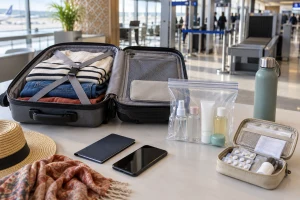
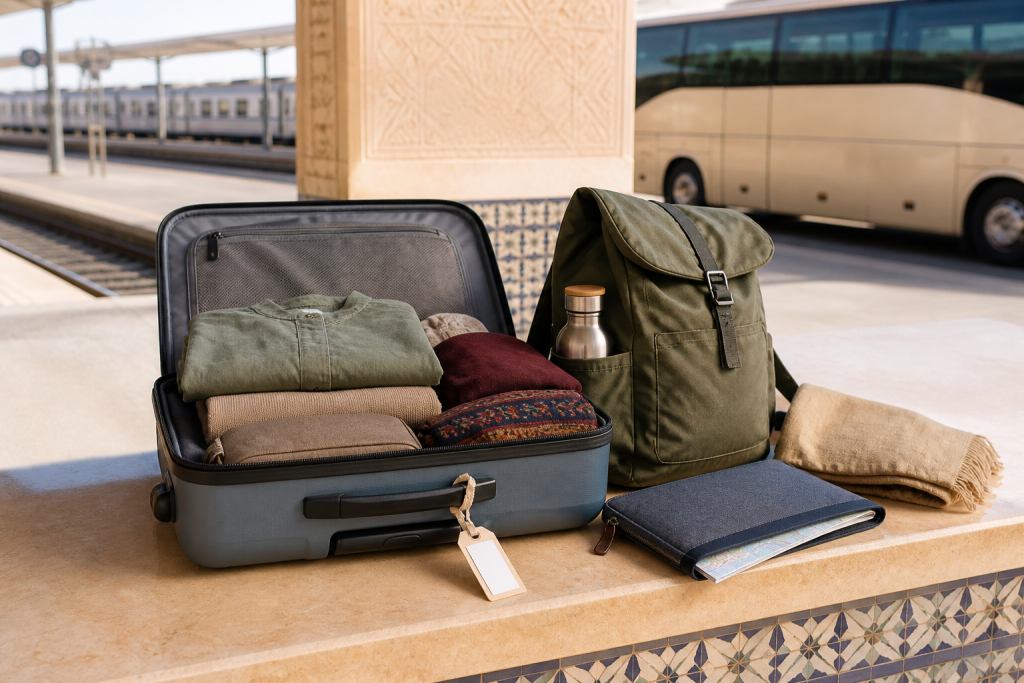
The same bag does not follow exactly the same rules on an ONCF train and a CTM coach. On a train, passengers keep their belongings with them and must be able to carry and place them safely. On a coach, some luggage may be registered for the hold under the operator’s conditions.
This guide summarises rules published as of 27 August 2026. They can change, so always consult the current official version when buying the ticket.
On trains, the luggage remains in your care
ONCF’s conditions allow personal objects and effects that are easy to carry, subject to requirements imposed by the authorities. Passengers must be able to place their own baggage in the designated spaces without blocking circulation or creating a risk for other travellers.
Even when a suitcase is in a luggage space, it remains in the passenger’s care. ONCF says that it is not responsible for belongings temporarily left in vestibules, waiting rooms, station courtyards or other transit spaces.
Dimensions published by ONCF
Suitcases, travel bags and backpacks accepted as hand luggage must not exceed 1.2 metres by 0.6 metres by 0.4 metres under the published conditions. Their closure, volume and weight must allow them to be carried and stored without difficulty.
One folded bicycle in a cover, skis, a folded pushchair, a board in a compliant cover or a folding wheelchair may be accepted per passenger under the detailed terms. Read the official text again before travelling with specialist equipment.
Items that are not accepted on trains
ONCF excludes objects whose transport amounts to a commercial operation, goods intended for sale, flammable or corrosive material, sharp or pointed objects and luggage that does not meet the carrying and storage conditions.
More specific safety instructions may apply to a particular item or situation. If uncertain, the customer service centre or station staff is a better source than an old forum comment.
On coaches, separate hold and hand luggage
CTM’s published terms allow two items in the hold, with a stated maximum of 20 kilograms per item and a total of the three dimensions not exceeding 170 centimetres. Hold transport is a paid service; its current charge and availability must be checked through the official channel for the journey.
Hand luggage inside the coach is limited to 40 × 50 × 16 centimetres according to the FAQ and conditions. It remains under the traveller’s supervision. A larger or heavier item may require an additional payment and depends on space actually being available.
Labels, receipts and claims
A bag placed in a CTM hold must carry the label provided by the operator. Keep the baggage receipt separately because it is used to collect the registered item. A photograph of the closed bag and label can help describe it but does not replace the required evidence.
CTM asks passengers to report loss or damage on arrival, before leaving the disembarkation point, to the driver and agency staff with the original receipt. Compensation limits and conditions should be read in the current contract.
Connections: assume nothing transfers automatically
During a coach change, CTM states that the traveller is responsible for transferring baggage. Do not leave a bag on board during a connection or stop when staff ask passengers to remove it.
A rail connection may also involve stairs, an underpass or a quick platform change. Travelling with a load that you can carry yourself reduces the risk of a fall or missed train.
Protect the essentials
A passport, essential medication, phone, payment methods and booking evidence should not go into a hold. Keep them in a small closed bag that remains with you, and do not hang it from a seat where it is out of sight.
Separate payment methods and keep protected copies of documents. An external tag can show a contact number, but there is no need to display a full home address or other sensitive information.
Pack lighter to make the journey easier
The best bag is not the one that reaches every maximum; it is the one you can manage in a station, on a platform and at arrival. A versatile layer, smaller containers and one compressible inner bag can replace several duplicate items.
Choose the transport mode before packing with MOP’s guide to train, coach, taxi or car travel in Morocco. The operator’s current ticket conditions remain decisive.
Before closing the suitcase
- Dimensions and weight measured for the operator actually used.
- Prohibited items removed and battery rules checked.
- Documents, medication and payment methods kept with you.
- Tag readable without excessive personal data.
- Hold receipt retained until the bag is collected.
- Every item counted at each vehicle change.
- Damage reported immediately when discovered.
Sources consulted
- ONCF Voyages, General Conditions of Sale and Use, section 3 “Luggage”, accessed 27 August 2026: official terms
- CTM, General Conditions of Sale, “Bagage” section, accessed 27 August 2026: official terms in French
- CTM, baggage help and FAQ, accessed 27 August 2026: official FAQ in French