Since 5 August 2026, UNESCO preparatory assistance has supported the documentation of knowledge and skills associated with Morocco’s khettaras. The project does more than celebrate an old technique: it is preparing a nomination to the List of Intangible Cultural Heritage in Need of Urgent Safeguarding.
This development matters to travellers. In an oasis, a channel, well or palm grove is not simply scenery. It belongs to a living system maintained by communities and made vulnerable by pressure on water, drought, flooding and the loss of transmission.
What a khettara is
A khettara collects groundwater from an aquifer and channels it to the surface through gently sloping horizontal galleries. Gravity moves the water. Vertical shafts are used to dig, ventilate and maintain the underground route.
The system can bring water to an oasis without permanent pumping. It is not only an underground structure, however. Its operation depends on knowledge of soil, gradient, flow, water allocation and collective maintenance.
Why urgent safeguarding is being prepared
UNESCO’s official record identifies several threats: depletion of groundwater reserves, declining transmission of skills, structural deterioration, and alternating periods of flooding and severe drought. The migration of people qualified to maintain the galleries adds further pressure.
Preparatory assistance does not mean that inscription has already happened. It supports work towards a possible nomination. This distinction is essential: MOP will not describe the khettara as already inscribed on the Urgent Safeguarding List.
What the project is expected to produce
The assistance is implemented by the Fondation Miftah Essaad pour le capital immatériel du Maroc. It will support a film about khettara techniques, especially digging and underground drainage. It should also facilitate documentation, an inventory update and preparation of the nomination file.
UNESCO gives an implementation period from 5 August 2026 to 30 April 2027. These dates describe the project calendar. They are not visiting dates and do not announce that a site has opened to the public.
Learning to read an oasis differently
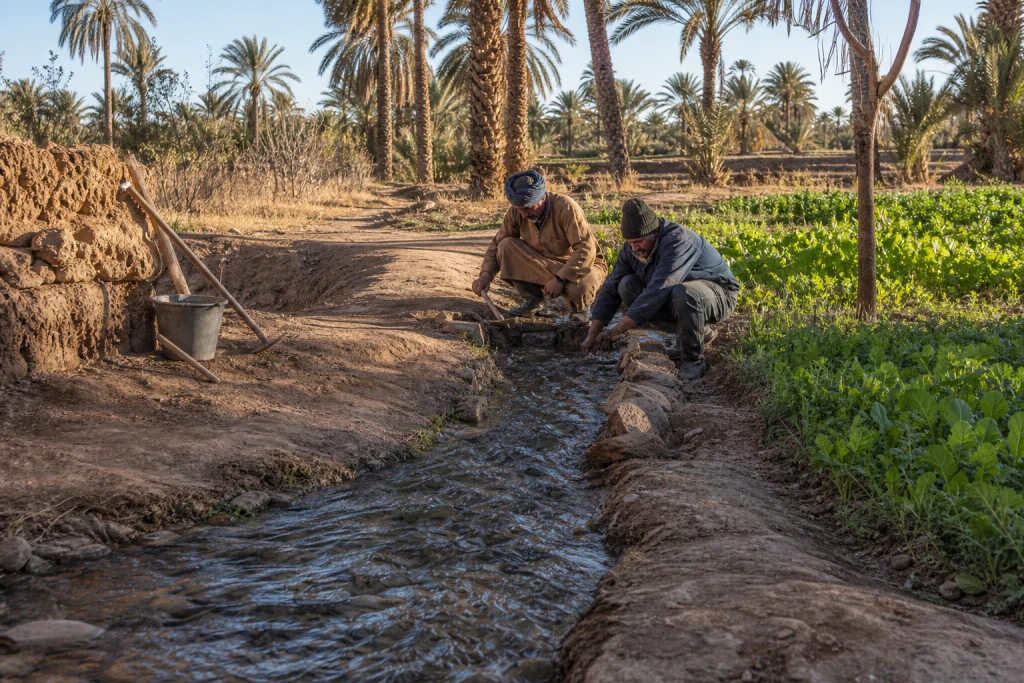
Understanding an oasis means following the relationship between gallery, water outlet, distribution channels, cultivated plots and palm grove. A photograph of one shaft cannot explain the movement of water or the rules that organise it.
A khettara also shows that heritage may be largely invisible. Its crucial structure lies underground, while its cultural value depends on gestures, vocabulary, agreements and responsibilities passed between generations.
Visiting without disturbing the system
A khettara shaft is not an attraction that visitors can enter freely. Galleries may be unstable, narrow or under maintenance. Stay on authorised access, follow local instructions and never move stones, block a channel or contaminate the water.
Where a guided visit exists, ask who organises it, how the community is involved and what the fee supports. Serious interpretation explains water sharing and current threats without turning residents into background characters.
What MOP will follow in 2026 and 2027
MOP will check progress through official UNESCO pages and keep three stages separate: preparatory assistance, any future submission of a nomination, and a later Committee decision. None should be announced before it occurs.
We will connect this update to oasis guides when it adds useful context. No commercial offer is attached to this article. The priority is to understand the system and the conditions required for its safeguarding.
Reader’s reference points
- The project began on 5 August 2026 and is scheduled to run until 30 April 2027.
- Assistance granted in 2026 is stated as US$10,000.
- A nomination is being prepared; inscription is not confirmed.
- Access, maintenance work and local conditions must be checked on site.
- Water, structures and community practices take priority over photography.