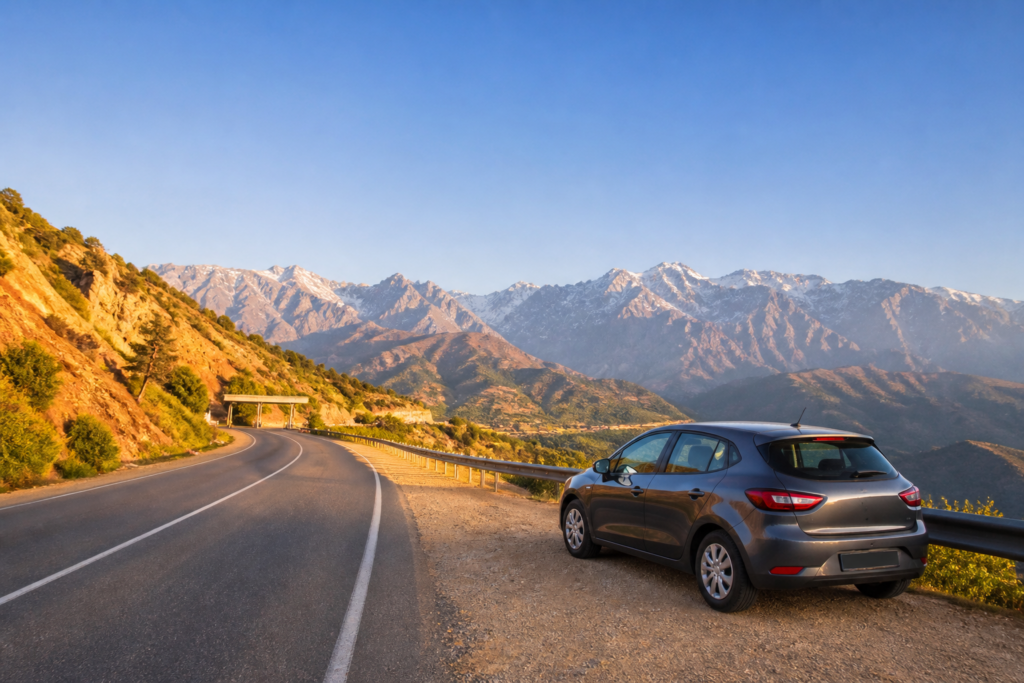
A car makes it possible to travel between villages, valleys, beaches and accommodation far from railway stations. It also adds responsibilities: the rental agreement, the condition of the vehicle, heavy traffic, speed limits, parking and fatigue. A successful road trip depends less on the number of kilometres than on the amount of leeway planned.
Rules and prices may change. This guide brings together the essential checks as of 22 August 2026; road signs, the agreement and instructions from the authorities always take precedence over general information.
Which licence to present
According to official information for travellers, a foreign national may drive with a valid national driving licence for a maximum period of one year from the start of their stay. An international driving permit is accepted for the duration of its validity, within the same limit, and makes the document easier to read.
The international driving permit is not valid on its own: keep the original national driving licence with it. A translation or digital document does not necessarily replace the document required during a check or by the rental company.
The rental company may impose additional conditions: a minimum age, a minimum period of holding a licence or a card in the driver’s name. Check these before paying, especially if the driver is young or if several people will be driving.
Choosing a rental company and understanding the total price
Compare the price including the deposit, excess, insurance, mileage, additional driver, child seat, return location and fuel. A very low offer may become more expensive when these items are added at the counter.
Ask how much will be blocked on the card and the expected release date. A debit card may be refused for the deposit even if it was used to make the booking. The cardholder’s name must generally match that of the main driver.
Identify the company that actually provides the vehicle when booking through an intermediary. In the event of a dispute, the platform’s terms and those of the rental company may not offer the same remedies.
Inspecting the vehicle before setting off
Walk around it in daylight if possible. Photograph the bodywork, wheels, windscreen, interior, dashboard and fuel level. Record every defect on the condition report, even if it appears minor.
Check the tyres, spare wheel or kit, lights, windscreen wipers, seat belts, air conditioning and the presence of the documents. Adjust the seat and mirrors before entering traffic. Ask how to contact roadside assistance.
For a mountain or desert leg, do not assume that a passenger car is suitable for a track. The agreement may exclude unpaved roads and invalidate the insurance.
Insurance: read the exclusions before an incident
Basic cover may leave a substantial excess. Tyres, windows, the underbody, roof, fuelling errors and keys are often handled separately. Insurance provided by a bank card may operate on a reimbursement basis and require you to decline certain options offered by the rental company.
In the event of an accident, secure the area, contact the authorities and the rental company, then follow the procedure in the agreement. Do not make an improvised arrangement without understanding its consequences. Take photographs and collect contact details and official documents.
If the vehicle is stolen or immobilised, roadside assistance must explain what happens next. For a personal car temporarily brought into Morocco, the customs situation must also be regularised before leaving the country.
Motorways, tolls and the Jawaz pass
The motorway network links several major routes. Official tolls are published by Autoroutes du Maroc and depend on the journey and vehicle class. Check the price list or ADM Trafic when setting off rather than relying on an old amount.
Jawaz lanes are intended for electronic toll payment. A rental vehicle may be equipped with a pass; ask how toll passages will be charged and whether administrative fees are added. Without a pass, use lanes that accept the payment method you have available.
Keep some spare cash and do not change lanes abruptly when approaching the toll plaza. On motorways and elsewhere, if you miss an exit, correct your route at the next interchange.
Fuel and range
Note the type of fuel specified by the rental company and check it on the fuel flap. A mistake can damage the engine and may be excluded from the insurance. Ask whether the vehicle must be returned with a full tank or at the same level.
Petrol stations are frequent on main routes, but less so in some regions. Do not let the fuel level fall to the reserve before taking an isolated road. Use a stop at a petrol station to check tyre pressure, water and the next stop.
Keep the receipt from the last fill-up if required by the agreement. When returning the vehicle, photograph the fuel gauge and mileage with the time visible.
Speed limits and checks
Obey the signs, which take precedence over a general limit. Speed limits change when entering built-up areas, in roadworks and on mountain roads. Speed checks are frequent on some routes.
Keep your passport or accepted supporting document, driving licence, agreement, insurance and vehicle documents accessible. If an offence is recorded, ask for the corresponding document and follow the official procedure.
Holding a phone while driving is distracting. Set the route before leaving or let the passenger handle navigation. Stop in a safe place to change the route.
Traffic that requires careful observation
Pedestrians, bicycles, scooters, carts, animals, lorries and taxis sometimes share a narrow road. A slow vehicle may conceal a pedestrian or obstacle. Keep enough distance to brake and do not overtake without full visibility.
At roundabouts, observe the signs and actual movements without assuming that all road users will apply the same interpretation. Use indicators, avoid sudden changes and let an aggressive driver pass.
In cities, scooters may filter through traffic. Check the blind spot before opening a door or changing direction.
Why you should avoid driving at night
France Diplomatie recommends taking particular care on Moroccan roads. At night, lighting may be limited, poorly visible road users may travel along the hard shoulder and an animal may appear suddenly. Fatigue after a visit or flight increases the risk.
Plan to arrive before nightfall. If a delay makes the leg unreasonable, stop in a known town rather than continuing just to keep to a schedule. Inform your accommodation.
In mountainous regions, weather and roadworks may alter the route. Ask for recent local information and do not take a track because an app presents it as a shortcut.
Parking without causing an obstruction or exposing yourself to risk
Choose a designated car park or follow a specific recommendation from your accommodation. Leave nothing visible, even for a few minutes. Lock the doors and keep documents, money, keys and devices with you.
In a medina, the riad may be accessible only on foot. Ask about the recommended car park, its price, opening hours and actual distance. An informal attendant should not keep the keys without clear agreement.
Avoid isolated areas, beaches and roadsides at night. For a motorhome, use authorised sites with recently verified information.
Children, seat belts and breaks
Request a restraint system suited to the child’s age and size, then check its installation. A simple reference to a “child seat” does not specify the standard, condition or category. Bringing your own seat may be preferable when practical.
All occupants must wear their seat belts. Plan regular breaks, water and sun protection. Never leave a child or animal in a closed vehicle, even for a brief stop.
Reduce the distance planned for a family day. Our guide https://www.lemarocouvresesportes.com/en/morocco-with-kids-transport-accommodation/ suggests a suitable pace.
Checklist before each major leg
- Original national driving licence and, if chosen, international driving permit.
- Agreement, insurance, roadside assistance and vehicle documents.
- Correct fuel and sufficient range.
- Tyres, lights, seat belts and warning lights checked.
- Route downloaded and arrival planned before nightfall.
- Motorway toll checked on ADM and payment method available.
- Water, charged phone and accommodation contact details.
- Break or fallback stop planned if fatigue increases.
Official sources consulted
- France Diplomatie, useful information and driving licences in Morocco, updated 7 August 2026: https://www.diplomatie.gouv.fr/fr/information-par-pays/maroc/conseils-aux-voyageurs-informations-utiles
- France Diplomatie, safety and road risks, updated 7 August 2026: https://www.diplomatie.gouv.fr/fr/information-par-pays/maroc/conseils-aux-voyageurs-securite
- Autoroutes du Maroc, official portal and ADM Trafic: https://www.adm.co.ma/fr
- Autoroutes du Maroc, toll price list: https://www.adm.co.ma/fr/grille-tarifaire-sur-le-reseau
- Autoroutes du Maroc, Jawaz pass: https://www.adm.co.ma/fr/le-pass-jawaz
- France Diplomatie, vehicle formalities: https://www.diplomatie.gouv.fr/fr/information-par-pays/maroc/conseils-aux-voyageurs-entree-sejour