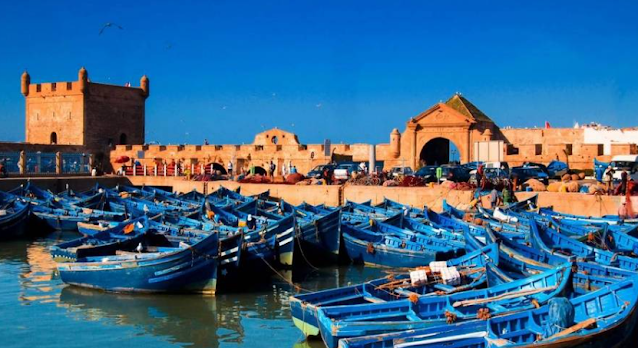
Essaouira, formerly Mogador, lies on Morocco’s Atlantic coast. Its walled medina, port, winds, workshops and musical traditions make it an immediately recognisable destination. Yet the city is richer than the image of a bohemian retreat where time has stood still.
Founded in its present form in the 18th century, Essaouira was designed as a port city open to international trade. Its inscription on the UNESCO World Heritage List is based on this urban and maritime history. To understand it, the ramparts must be linked to trade, the port to the city, and the heritage to the residents who keep it alive.
From Mogador to Essaouira
The site was occupied and involved in trade long before the present city existed. However, the urban layout visible today dates mainly from the reign of the Alaouite sultan Sidi Mohammed ben Abdallah in the second half of the 18th century.
The sovereign wanted to create a royal port capable of connecting Morocco with Europe and other trade routes. The city was designed with the involvement of a French architect influenced by the principles of European military architecture of the period, adapted to a North African context.
The name Mogador was long used for the city in European languages. Essaouira is its current name. Using both can help distinguish the periods, provided they are not imagined as two separate cities.
A UNESCO World Heritage medina
The medina of Essaouira has been inscribed on the UNESCO World Heritage List since 2001 under criteria (ii) and (iv). UNESCO describes it as an outstanding example of a late-18th-century fortified port town where European military principles were transposed to North Africa.
This recognition applies to an urban ensemble, not only to the most photographed ramparts. The street layout, fortifications, gates, civic buildings, neighbourhoods, port and relationship with the Mogador Archipelago all contribute to its value.
Its inscription does not mean that everything is frozen in time or perfectly preserved. UNESCO notes, in particular, issues involving the deterioration of buildings in the Mellah and the need to reconcile heritage conservation with residents’ living conditions.
A planned city, not an improvised maze
Contrary to the common image of a medina as necessarily labyrinthine, Essaouira has a relatively easy-to-follow layout. Major thoroughfares cross the city and connect gates, squares, markets and craft districts. The side streets introduce more variation, but finding your way remains manageable.
This layout reflects the city’s role as a port and defensive stronghold. It also makes exploring on foot easier: from Bab Marrakech or Bab Doukkala, visitors can reach the markets, squares and fortified seafront without having to follow a single route.
The medina remains a place where people live and work. Its houses, workshops and shops are not elements of a uniform backdrop. Photographing a doorway or a person always requires respect for private space.
Ramparts, Skala and monumental gates
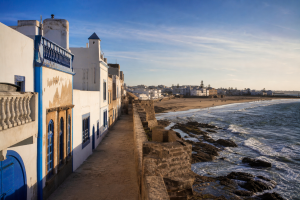
The fortifications give Essaouira much of its visual identity. The Moroccan National Tourist Office distinguishes, in particular, the Skala de la Kasbah and the Skala du Port, two structures associated with the defence of different areas.
The Skala de la Kasbah runs along the medina’s Atlantic frontage. Its cannons, stone walls and ocean views make the city’s military dimension clear. The Skala du Port stands on the other side, alongside maritime activities.
Access, works and circulation may change. Wind and sea spray make some surfaces slippery. Visitors must stay within areas open to the public and not climb on fragile structures to obtain a different view.
The port, a working area
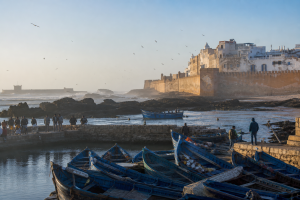
The fishing port is not a recreated attraction. Unloading, sales, repairs, ice, seagulls and the movement of workers set the pace of the area. The blue boats form a famous image, but they belong first and foremost to a maritime economy.
A visit requires remaining alert to moving vehicles, wet ground and work areas. Photographing fishermen up close without asking their permission can easily turn their work into a spectacle.
Landings and the species available depend on the season, the weather and trips out to sea. No guide can guarantee the same market every day. When eating fish, it is best to check the price, weight and preparation method clearly before ordering.
Atlantic trade and a multicultural city
Essaouira played the role of an international port connecting Morocco and its Saharan hinterland with Europe and other regions. This role encouraged the presence of Amazigh, Arab, African and European populations, as well as Muslim, Jewish and Christian communities.
UNESCO includes this multicultural dimension in the site’s value. It should not be reduced to an idealised coexistence without tensions or changes. Trade, protections granted by the authorities, social status and political transformations shaped different experiences.
The former consular houses and buildings associated with commerce recall that international openness was part of the city’s original purpose, long before tourism developed.
The Mellah and Moroccan Jewish memory
The Mellah represents an essential chapter in Essaouira’s history. The city was home to a significant Moroccan Jewish community involved in trade, craftsmanship, religious life and international exchange.
Synagogues, houses and memorial sites bear witness to this presence, but their status and opening hours vary. Some spaces have been restored, while others remain fragile or private. A well-documented guided tour helps avoid inaccurate accounts.
The condition of the buildings in the Mellah is among the conservation issues mentioned by UNESCO. Respecting building sites, not entering unsafe buildings and not presenting a ruin as a romantic backdrop are essential precautions.
Gnaoua, a living heritage
Gnaoua has been inscribed on UNESCO’s Representative List of the Intangible Cultural Heritage of Humanity since 2019. The term refers to a body of musical productions, brotherhood practices and rituals in which sacred and secular dimensions may come together.
UNESCO notes that this culture is linked to the history of groups descended from slavery and the slave trade, and that it is now one of the many facets of Moroccan cultural identity. Its instruments, rhythms, songs, costumes and transmission therefore cannot be reduced to a concert genre.
Essaouira has a strong connection with Gnaoua and hosts a recognised festival. However, the UNESCO inscription applies to the cultural practice in Morocco, not to the festival alone. Dates, programmes and access conditions must be checked for each edition.
Thuya wood, marquetry and responsibility
Essaouira’s craftspeople are known for working with thuya wood, often associated with marquetry. Boxes, trays, furniture and decorative objects combine the wood with various materials and patterns.
This expertise requires precision and experience. It also raises the issue of the resource: thuya grows slowly and its availability must be managed carefully. A responsible purchase involves asking where the wood came from and avoiding objects whose provenance remains completely opaque.
The medina is also home to weaving, metalwork, galleries and contemporary creation. Not every object is produced locally. Talking to the craftsperson and observing a workshop gives a purchase more meaning than a simple “Essaouira souvenir” label.
Wind, beach and water sports
The trade winds shape Essaouira’s reputation among surfers, windsurfers and kitesurfers. They also contribute to a sometimes misleading feeling of coolness: the sun remains intense even when the air feels cool.
The large urban beach offers a vast area for walking. Swimming conditions change with the swell, currents and wind. Flags, lifeguards’ instructions and advice from local schools must always take precedence over personal impressions.
For a first water-sports session, it is essential to choose a clearly identified provider, suitable equipment and instruction appropriate to your level. A windy bay is not automatically safe for a beginner.
Diabat and Sidi Kaouki are separate stops
Diabat lies south of Essaouira, near the mouth of the Ksob River. The village, dunes and remains associated with the former defensive system form a nearby excursion that is separate from the medina.
Sidi Kaouki lies farther along the coast. Its beach attracts water-sports enthusiasts and those who enjoy open landscapes. Wind, transport and available services vary by season; visitors should plan their return rather than rely on services always being available.
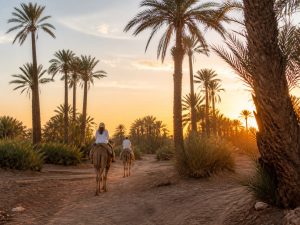
Horseback, camelback or vehicle excursions should be booked with responsible operators. Animal welfare, authorised routes, insurance and the impact on the dunes are more important criteria than a low price.
The Mogador Archipelago, a protected area
The islands visible from the ramparts and the coast belong to a sensitive natural environment. They are connected to the site’s ancient history and provide habitats for bird species.
Their presence completes the picture of Essaouira: the fortified city is not isolated but forms part of a bay, a dune system, an estuary and an archipelago. The World Heritage Centre highlights this relationship between natural assets and cultural properties.
Access to the islands is regulated and must never be assumed to be unrestricted. Observing them from authorised viewpoints protects nesting sites and prevents a reserve from being turned into an improvised excursion.
Planning a visit without rushing
One day is enough to explore the medina’s main thoroughfares, the ramparts and the port. Two or three days provide time to add museums, workshops, the beach and a coastal excursion without treating every place as a box to tick.
Walking is sufficient in the historic centre. The wind can make the perceived temperature fall considerably at the end of the day; an extra layer remains useful even when the interior of the country is hot.
For cultural sites, opening hours should be checked for the dates of the visit. For fish, crafts and excursions, asking about prices and conditions before making a commitment prevents most misunderstandings.
Preserving a living city
Tourism’s success supports many jobs, but it also increases pressure on property, waste production and the transformation of shops. Protecting the walls is not enough if everyday life disappears from the historic centre.
Staying in a registered establishment, choosing local guides and craftspeople, limiting plastic use and respecting residential areas contribute to more balanced tourism. Essaouira’s beauty depends on the continuous maintenance of its heritage and the vitality of its communities.
The city then reveals itself in all its complexity: an 18th-century Moroccan port, a UNESCO-recognised fortified medina, a centre of musical cultures and a contemporary Atlantic city.
Institutional sources
- UNESCO World Heritage Centre, “Medina of Essaouira (formerly Mogador)”: https://whc.unesco.org/fr/list/753
- UNESCO, “Gnaoua”: https://ich.unesco.org/fr/RL/gnaoua-01170
- Moroccan National Tourist Office, Essaouira-Mogador destination: https://www.visitmorocco.com/fr/voyage/essaouira-mogador
- Moroccan National Tourist Office, medina of Essaouira-Mogador: https://www.visitmorocco.com/fr/voyage/essaouira-mogador/medina