Le Carreau du Temple is devoting the tenth edition of Food Temple to Morocco from Friday 18 to Sunday 20 September 2026 in Paris. Its official programme combines food, transmission, a market, photography and music. The event is therefore neither a sequence of tastings alone nor a tourism showcase that reduces a country to a handful of dishes.
The festival is part of Saison Méditerranée 2026. That connection provides a cultural frame, but it does not remove the need to verify each activity with the organiser. MOP separates confirmed information from interpretation and last-minute promises.
Three days with different levels of access
The official page gives opening times of 6 p.m. to 11 p.m. on Friday, 11 a.m. to 8 p.m. on Saturday and 11 a.m. to 5.30 p.m. on Sunday. General admission is described as free, while the opening evening, meals and some workshops have their own conditions.
That distinction matters. “Free admission” does not mean that every table, workshop or meal is available without a booking. The organiser’s detailed programme and ticketing page remain the references before travelling, especially for a session with limited capacity.
Food presented as knowledge that is passed on
Food Temple announces pop-up restaurants, a tea room, workshops and masterclasses. The editorial interest lies less in a list of recipes than in the presence of people who cook, explain and pass on techniques.
A festival can make individual journeys and skills visible, but it cannot represent all Moroccan cooking. Practices differ among regions, families, seasons and migration histories. Each contribution is better understood as a situated proposal than as a final definition of Morocco.
A market where provenance still matters
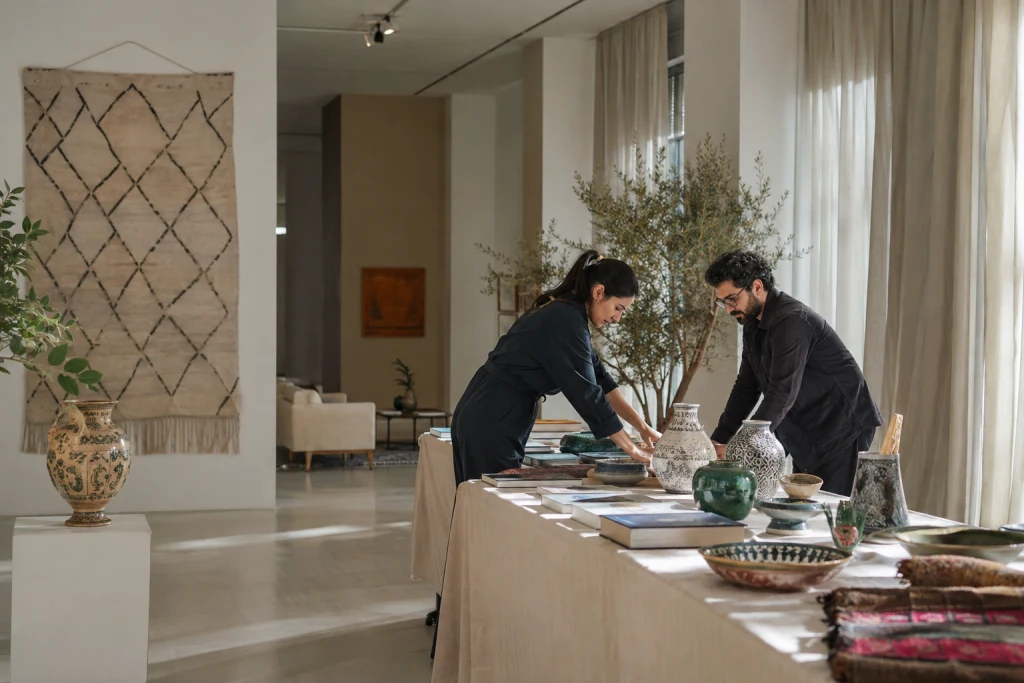
The programme includes a market bringing together food products, objects, illustrations and books. Visitors can ask who made an item, where it was produced, which materials were used and how its price rewards the work involved.
Presence at a cultural event is not automatically a certification of origin, quality or fair trade. For a substantial purchase, written information, a receipt and clear transport conditions are more useful than an appealing story that cannot be checked.
Photography and archives broaden the view
A photography exhibition and archive material are included in the programme. This dimension can show that food culture is also built through places, gestures, objects, movement and memory.
Images still need context. One photograph cannot describe an entire region or an unchanging practice. Its credit, date and display framework help the visitor understand who is showing what, and under which conditions.
A music programme between heritage and current creation
The official schedule combines concerts and DJ sets. Artists connected with jazz, Moroccan music, electronic music, new wave and post-punk appear in the announcements. The result is intended to present a contemporary, plural Morocco rather than one supposedly folkloric soundtrack.
Dialogue between older repertoires and current production should be described without confusing artistic fusion with ritual. A festival performance is a work programmed for a stage. It can draw on heritage without replacing the social or spiritual practice from which some elements originate.
What Saison Méditerranée confirms
The official Saison Méditerranée calendar repeats the dates of 18, 19 and 20 September, the venue and the multidisciplinary nature of Food Temple Morocco. This second institutional source supports the framework announced by Le Carreau du Temple.
It does not guarantee that every participant, exact time or capacity will remain unchanged until the event. A live programme can evolve. A final check on the organiser’s page is therefore necessary before booking transport or accommodation around a particular session.
Why this belongs in Morocco Today
The subject shows how Moroccan and Franco-Moroccan participants currently present food, creation and transmission in a French cultural venue. It also concerns the circulation of works, skills and audiences across the Mediterranean.
This visibility should be neither exaggerated nor dismissed. A three-day festival is not a complete measure of Moroccan cultural influence. It is a documented case with a programme, artists and formats that can be observed and discussed.
Preparing a visit without turning MOP into a ticket office
MOP sells no ticket for this event and adds no affiliate link. The official Carreau du Temple page should be used for booking and access conditions. Visitors travelling a long way need a margin if one specific activity is the reason for their journey.
It is sensible to confirm the accessibility of the chosen format, the dietary information provided by each stall and the photography rules during workshops. Entry to a public venue does not grant permission to publish a participant’s portrait without consent.
Checklist before 18 September
- Read the official programme again on the day of travel.
- Identify open sessions and those requiring a reservation.
- Do not confuse festival access with a guaranteed workshop place.
- Ask about provenance and use conditions before buying.
- Follow the photography instructions of exhibitors and participants.
- Keep the organiser’s confirmation when a booking is required.