
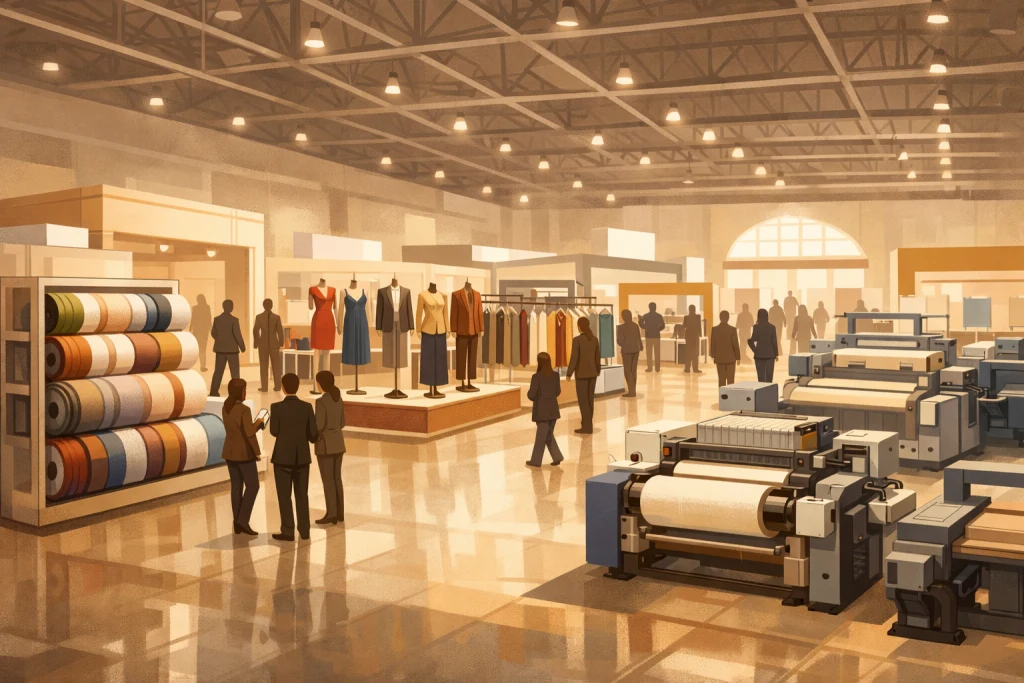
The 23rd edition of Maroc in Mode opened on November 3, 2026, at the Foire Internationale de Casablanca. Jointly organized by the Moroccan Association of Textile and Clothing Industries, AMITH, and CEMS-Global USA, the event continues through November 5. The schedule places Casablanca at the center of three days dedicated to the textile industry and its international commercial relationships.
According to information presented on the opening day, more than 200 exhibitors from 25 countries are taking part in this edition. The exhibition covers 8,000 square metres and is divided into seven thematic areas spanning apparel production, Moroccan brands, fabrics, machinery and innovation, chemicals, accessories and services. This structure provides a broad view of the different components supporting the textile value chain.
A platform for international connections
Maroc in Mode is designed to connect Moroccan textile and apparel manufacturers with international buyers, brands, sourcing professionals and innovators. The range of participants and exhibition areas can bring Morocco’s industrial offering closer to needs expressed in international markets, while also giving visibility to the technologies and services that support production. The event therefore combines commercial meetings with a wider presentation of the sector’s capabilities.
The exhibition emphasizes near-market sourcing, supply-chain resilience, proximity and sustainability as commercial advantages for Morocco’s textile ecosystem. These themes give the event a purpose extending beyond the display of products. They position Morocco within discussions about how sourcing networks are organized and how textile industries can develop closer industrial relationships while responding to international buyers seeking resilient supply arrangements.
A summit linking Mediterranean and Atlantic markets
The Med-Atlantic Textile Summit was launched alongside the exhibition as a platform for industrial dialogue, cooperation, investment and partnerships across Mediterranean and Atlantic markets. Its inclusion within Maroc in Mode complements the exhibition’s commercial role with a forum focused on exchanges between industry participants and the identification of collaboration opportunities within an international textile environment connecting several regions.
This international approach was also reflected in three cooperation protocols signed by AMITH with professional organizations from India, Jordan and the Czech Republic. The agreements illustrate the geographic breadth of the relationships pursued during the event. Their practical significance will nevertheless need to be assessed later through the initiatives, projects or partnerships that are effectively developed as a result of these protocols.
The economic weight of Morocco’s textile industry
Figures presented by AMITH during the event describe a Moroccan textile industry comprising more than 1,700 companies and employing approximately 240,000 people. The professional association put its revenue at 66 billion dirhams, including 44 billion dirhams generated by exports. These AMITH-attributed figures indicate the position that the industry already occupies within Morocco’s industrial activity and its export-oriented economy.
Employment Minister Abderrahim Chahid said that textiles and apparel account for 24% of Morocco’s industrial employment. He also stated that women represent 63% of the sector’s workforce. These proportions underline the importance of employment when evaluating textile projects and help explain why industrial announcements are considered not only in terms of expected production, but also through the jobs they are intended to support.
An announced investment with targets to verify
Delegated Trade Minister Omar Hejira announced a textile investment of 2.3 billion dirhams that is expected to create 7,000 jobs and direct 80% of its output toward exports. These figures are announced targets rather than completed results. Implementation will have to be assessed through later information detailing the investment timetable, its execution, installed production capacity and the number of positions that are ultimately created.
The announcement concerns an industry with a strong export orientation but continuing integration challenges. Opening presentations stated that the cut, make and trim production model accounts for 77% of Moroccan textile exports, while imported fabrics and yarns cover 80% of the industry’s needs. These event-attributed figures help explain why deeper industrial integration remains a strategic issue alongside growth in international sourcing relationships.
Progress to be measured after the exhibition
The combination of an international exhibition, a regional summit and professional cooperation agreements makes Maroc in Mode a meeting point for Morocco’s textile ambitions. Manufacturers can engage with buyers, brands, sourcing specialists and innovators, while discussions focused on proximity and resilience reinforce the country’s positioning as a platform for manufacturing and partnerships connecting Mediterranean, Atlantic and other international markets.
As of November 4, 2026, no verified final figures were available for attendance, orders, transactions or the completion of announced investments. Useful follow-up will therefore need to clarify any contracts concluded, final participation and the implementation timetable for the announcements. Until such information is published, the 2026 edition primarily establishes a framework for international dialogue and highlights the capabilities, integration needs and prospects of Morocco’s textile industry.