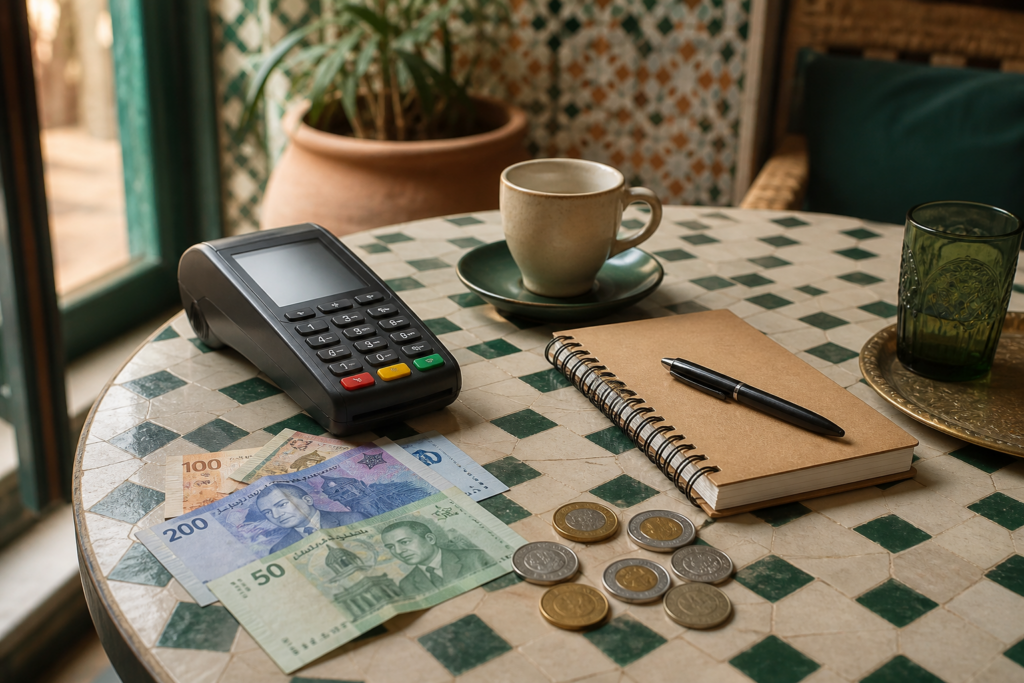
The Moroccan dirham is the currency used for everyday expenses. In large cities and tourist areas, cards are widely accepted, but they do not completely replace cash: a small restaurant, taxi, market or rural establishment may require payment in dirhams.
The best strategy is therefore neither “all cash” nor “cards everywhere.” It involves combining a primary payment method, a separate reserve and a small amount available upon arrival, while understanding the fees charged by your own bank.
Understanding the dirham before you leave
The dirham, abbreviated as MAD or sometimes DH, is not a currency that travellers should carry in large quantities from abroad. The import and export of dirham banknotes are regulated; travellers may keep a maximum of 2,000 dirhams in banknotes to cover certain expenses.
The exchange rate varies. A rounded mental conversion can help you track your budget, but it should not replace the rate actually applied. Banking apps, currency exchange receipts and terminals may display different amounts depending on the fees.
Before departure, enable international card use if necessary, check the limits and note the number for blocking the card. Also ask whether your bank charges a fixed fee, a percentage or both for payments and withdrawals outside your currency area.
Where to exchange currency legally
Currency exchange transactions must be carried out through authorised providers: banks, foreign currency exchange operators and approved sub-delegated establishments. Airports, city centres and major tourist districts generally have identifiable exchange points.
Compare the net amount received, not just a sign promising “zero commission.” A less favourable rate may include a margin greater than a clearly displayed commission. Ask for the currency exchange receipt and keep it until departure.
Avoid currency exchange offered on the street or by someone who accompanies you to an unidentifiable counter. In addition to the risk of fraud or counterfeit banknotes, the transaction does not provide the documentation needed to reconvert any remaining currency.
Declaring significant amounts of foreign currency upon entry
The Office des Changes sets a mandatory declaration threshold for foreign banknotes and negotiable bearer financial instruments whose equivalent value reaches or exceeds 100,000 dirhams. Below this threshold, a voluntary declaration remains possible.
This rule mainly concerns travellers carrying a large sum. A bank card with a high limit is not equivalent to physically imported banknotes. If you are unsure about a particular financial instrument, request a written response from customs or the Office des Changes before travelling.
For a non-resident, the declaration may also be used to justify the re-export of unspent foreign currency. Keep the document with the currency exchange receipts, separately from the cash.
Paying by card: convenient but not universal
Hotels, established riads, supermarkets, modern restaurants and national chains often accept international cards. Before confirming, check the amount displayed in dirhams and keep the terminal in sight.
A merchant may say that the connection is not working or that card payment is only available above a certain amount. Plan a fallback option without putting yourself in difficulty. If a surcharge is requested, ask for the reason before paying.
Some cards require confirmation in an app or by SMS. A working mobile connection is therefore important; our guide https://www.lemarocouvresesportes.com/en/sim-esim-internet-morocco/ helps you prepare for this.
Declining dynamic currency conversion when it is disadvantageous
A terminal or ATM may offer to charge the card directly in euros, dollars or another home currency. This “dynamic currency conversion” provides a familiar amount, but its rate and fees may be less favourable than those of the payment network or your bank.
When offered the choice, selecting payment in dirhams generally allows the card issuer to perform the conversion according to its terms. However, check your bank’s agreement: a card with no foreign exchange fees and a standard card do not produce the same result.
Do not confuse declining the conversion with declining the payment. The screen may display several confirmation prompts. Read each step and ask the merchant not to choose the currency for you.
Using an ATM without multiplying fees
ATMs are plentiful in cities. Choose a machine connected to a bank, ideally during the branch’s opening hours. This makes it easier to get assistance if the card is retained or if a debit appears without banknotes being dispensed.
Fees may come from the Moroccan bank, your bank or the conversion. Withdrawing several small amounts often increases fixed fees. Conversely, carrying a very large withdrawal increases the risk of loss or theft.
Choose an amount suitable for a few days, put the banknotes away immediately and do not spend too long counting the money in front of the machine. Keep the receipt until the transaction appears correctly on the account.
Dividing up cash instead of carrying it all
Keep the amount planned for the day in an accessible wallet. The rest can be placed in a reliable safe or a separate pouch. A small reserve kept separately from the main card allows you to pay for a journey or a meal if the card is blocked.
Do not put your passport, two cards and all your cash in the same bag. While travelling, a copy of your identity document may be useful when the original is kept in a safe place, in accordance with applicable security recommendations.
In busy medinas, have small denominations ready. They make a modest purchase easier and avoid exposing a bundle of cash. Calmly count the change you receive without turning every exchange into a confrontation.
Tipping: a gesture, not a hidden tax
Tipping is appreciated for many services, but it should remain linked to the quality of the welcome and the context. At a restaurant, first check whether service is included on the bill. For a café, porter, guide or driver, a small amount can show appreciation for a service actually provided.
There is no single mandatory percentage for every situation. A tip presented afterwards as a debt is no longer a voluntary gesture. Ask the price of a service before it begins, especially for a tour, a staged photograph or help with luggage.
In a group, decide who pays and who leaves the tip to avoid duplicates. Keeping a few coins and small banknotes makes the gesture more natural.
Markets and bargaining: set your budget beforehand
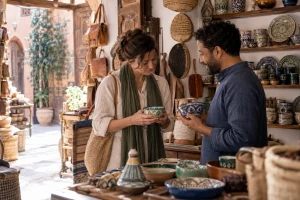
In some souks, bargaining is part of the exchange; in other shops, prices are displayed and fixed. Politely ask the price, compare and agree only if the purchase fits your budget.
Do not begin a lengthy negotiation if you have no intention of buying. Do not let the fear of “paying like a tourist” spoil things over a minor difference. The aim is an agreement understood by both parties, not a symbolic victory.
For an expensive item, ask for a detailed invoice, the shipping terms and the exact materials. A traceable payment provides more recourse than a large amount of cash.
Preparing a realistic budget
Separate the categories: accommodation, intercity transport, meals, visits, purchases and an emergency reserve. Prices vary greatly between a small town, a local establishment and an upscale establishment. A universal daily figure would be misleading.
Pay in advance only for services whose terms are clear. Keep a margin for a late transfer, an additional night or unexpected medical care. Insurance may cover certain events, but it does not always provide the funds immediately.
Whenever you change cities, check the next major expense and the next likely access to an ATM. This habit avoids urgent withdrawals in an isolated area.
Money checklist before and during your stay
- Two payment methods, kept separately.
- International limits and fees checked with the bank.
- Card-blocking number accessible offline.
- A small amount of cash, without exceeding the dirham import rules.
- Currency exchanged only through an authorised provider, with receipts retained.
- Payments and withdrawals confirmed in dirhams when the currency choice appears.
- Customs declaration prepared if the threshold equivalent to 100,000 dirhams is reached.
- Emergency budget separate from everyday expenses.
Official sources consulted
- Office des Changes, General Instruction on Foreign Exchange Transactions 2026: https://www.oc.gov.ma/sites/default/files/reglementation/pdf/2026-01/IGOC%202026_0.pdf
- Office des Changes, provisions relating to manual currency exchange operators: https://www.oc.gov.ma/fr/banques-et-operateurs-de-change-manuel/dispositions-reglementaires-relatives-a-l-activite-de
- Office des Changes, frequently asked questions: https://www.oc.gov.ma/fr/faq
- Moroccan National Tourist Office, practical guide and currency: https://www.visitmorocco.com/fr/