Morocco enters 2026 with a more dynamic economy, several major infrastructure projects under construction and investments intended for the 2030 World Cup. Data published since the beginning of the year make it possible to replace broad promises with verifiable benchmarks.
However, the transformation is neither uniform nor complete. National growth is estimated to have reached 4.9% in 2025, according to the latest publication from the High Commission for Planning, but its benefits depend on employment, purchasing power, water and the reduction of regional disparities. Here are the projects to watch in 2026.
Growth in 2025 is now better measured
The initial estimates published in January 2026 indicated growth of 4.7% in 2025. A later HCP publication raised the result to 4.9%. This difference illustrates how statistics normally work: a forecast or early estimate is revised when more data become available.
The figures must therefore be dated, and 4.7%, 4.9% and other projections should not be presented side by side as if they described three simultaneous realities. For readers, 4.9% is the latest available benchmark for 2025 at the time of this verification.
However, a national rate does not show how added value is distributed among regions, businesses and households. It must be supplemented by employment, income and price data.
What the HCP forecasts for 2026
In January, the HCP forecast growth of 5% in 2026, with agricultural activity increasing by 10.4% and non-agricultural activities by 4.3%. Transport and storage were expected to grow by 5.3%.
These figures are working assumptions, not an outcome that has already been achieved. Agriculture remains sensitive to rainfall, while European demand, energy prices and financing conditions may alter the trajectory of non-agricultural activity.
The government used other assumptions, close to 4.5% or 4.6%, in its budget framework. These differences arise from distinct dates and models; they should not be presented as an irreconcilable contradiction.
Private investment takes centre stage
In April 2026, the tenth National Investment Commission approved forty-four projects representing more than 86 billion dirhams. The announced projects are expected to create jobs and develop several sectors, but their approval does not yet mean that they have been implemented.
Foreign direct investment is estimated to have reached approximately 56.1 billion dirhams in 2025, 22% more than the previous peak in 2018, according to figures presented by the authorities. This increase reflects stronger attractiveness, which will need to be confirmed by disbursements and the capacity actually brought into operation.
Relevant monitoring concerns the implementation rate, sustainable jobs, local purchasing and the spread of skills, not only the amounts announced.
Rail moves to a new scale
The railway programme launched in 2025 represents 96 billion dirhams. Its flagship project is the Kenitra–Marrakech high-speed line, an extension of the Al Boraq route, but it also includes rolling stock and metropolitan services.
In April 2026, ONCF stated that work on the high-speed line had reached cruising speed. Connecting Rabat, Casablanca and Marrakech, as well as airports, is expected to improve passenger mobility and support tourism activity.
The line is not yet open. Opening dates, fares and frequencies will need to be confirmed after construction and testing.
Ports prepare for a new stage in logistics
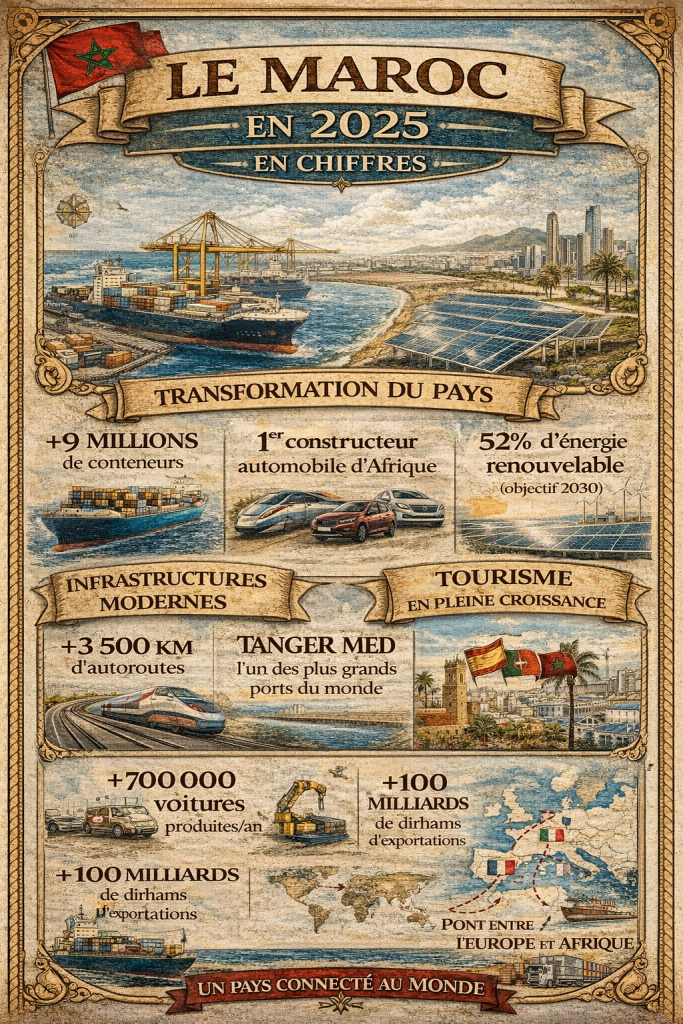
Tanger Med handled more than 11.1 million TEU containers in 2025, consolidating its role as an African and Mediterranean hub. Its efficiency connects Moroccan industrial supply chains to European and global markets.
In the east, Nador West Med is preparing for its operational launch in the fourth quarter of 2026, according to the schedule announced in January. The core infrastructure was reported as complete, and confirmed private investment exceeded 20 billion dirhams.
As of 22 August, this deadline remains a future target. The real test will be the start of operations, the opening of the terminals and the actual arrival of the planned industrial and energy activities.
Energy is accelerating, but the grid must keep pace
Morocco maintains its target of exceeding 52% renewables in its installed electricity capacity by 2030. New solar and wind programmes are under way, while 27 billion dirhams is to be invested in the transmission grid between 2025 and 2030, excluding the major South-Centre connection.
The challenge is no longer only to build power plants. Producing regions must be connected, variable electricity must be balanced, and industry must be supplied with reliable and traceable energy.
Green hydrogen adds an industrial prospect, but the selected projects must still become financed and operational facilities. Announcements do not constitute production.
Tourism must turn records into quality
Morocco benefits from growing international visibility and is preparing for several major sporting events. This momentum supports hotels, restaurants, transport, guides and artisans.
However, growth in arrivals is not enough to measure success. Spending per visitor, length of stay, seasonality, pressure on water and the distribution of benefits beyond the most visited destinations must be monitored.
A sustainable strategy must protect medinas, natural areas and local life. The aim is to welcome more visitors without damaging what makes the country attractive.
The 2030 World Cup accelerates infrastructure development
Preparations for the tournament with Spain and Portugal are driving stadium renovations, transport, airports and urban development. This work can leave a useful legacy if it also meets residents’ everyday needs.
The quality of the project cannot be judged solely during the month of the competition. It depends on the final cost, maintenance, accessibility and use after 2030.
Transparency regarding schedules and coordination among local authorities, operators and public services will be essential to avoid underused facilities.
Water remains the most fundamental constraint
Years of drought have demonstrated the vulnerability of agriculture and several regions. Dams, transfers, desalination and wastewater reuse are part of the response, but no infrastructure can replace rigorous demand management.
Desalination consumes energy and requires distribution networks. Its value increases when it is combined with low-carbon electricity, consistent pricing and reduced losses.
Agricultural, industrial, tourism and urban choices must therefore be assessed together. Growth that ignores water availability would not be sustainable.
Employment and purchasing power: the social test
Major investments do not automatically translate into accessible jobs in every region. Skills, mobility, the quality of training and the development of small businesses determine their real impact.
Purchasing power also depends on inflation and the cost of housing, transport and food. An increase in gross domestic product can coexist with persistent difficulties for some households.
Social indicators must therefore accompany every economic assessment: youth employment, women’s participation, income, social protection and access to public services.
How to assess the transformation at the end of the year
At the end of 2026, actual achievements will need to be compared with announcements: growth actually recorded, investment projects started, kilometres of railway completed, whether or not Nador West Med has entered service, renewable capacity connected and jobs created.
The quality of daily life must also be measured: transport punctuality, access to water, energy costs, health and education services, administrative processing times and the condition of public spaces.
Morocco’s transformation is real in its scale and direction. It will remain credible if it is documented by results, if its benefits are shared and if environmental constraints are incorporated rather than postponed.
Official sources
- Maroc.ma / HCP, growth forecast at 5% in 2026 after an initial estimate of 4.7% for 2025: https://www.maroc.ma/fr/actualites/maroc-la-croissance-economique-prevue-5-en-2026
- Maroc.ma / HCP, updated growth result of 4.9% in 2025: https://maroc.ma/ar/%D8%A7%D9%84%D8%A3%D8%AE%D8%A8%D8%A7%D8%B1/%D8%A7%D9%84%D9%86%D9%85%D9%88-%D8%A7%D9%84%D8%A7%D9%82%D8%AA%D8%B5%D8%A7%D8%AF%D9%8A-%D8%A7%D9%84%D9%88%D8%B7%D9%86%D9%8A-%D8%B3%D8%AC%D9%84-%D8%AA%D8%AD%D8%B3%D9%86%D8%A7-%D8%A8%D9%84%D8%BA-49-%D9%81%D9%8A-%D8%A7%D9%84%D9%85%D8%A7%D8%A6%D8%A9-%D8%B3%D9%86%D8%A9-2025
- Maroc.ma, tenth National Investment Commission, April 2026: https://www.maroc.ma/fr/actualites/10eme-commission-nationale-des-investissements-approbation-de-44-projets-dune-valeur-totale-depassant
- Maroc.ma, Royal Cabinet statement on Nador West Med, January 2026: https://www.maroc.ma/fr/actualites/communique-du-cabinet-royal-0
- ONCF, railway programme review, April 2026: https://www.oncf.ma/fr/Actualites/Programme-ferroviaire-historique-l-oncf-marque-une-annee-d-avancees-concretes-au-service-d-une-vision-strategique
- Tanger Med, 2025 financial communication: https://www.tangermed.ma/wp-content/uploads/documentations/2026/Communication-financiere.pdf