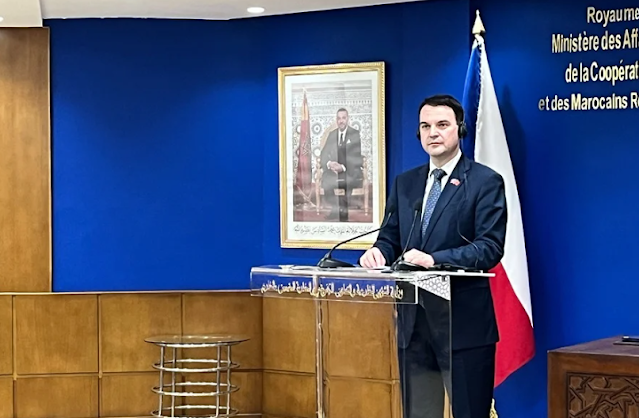
Morocco and the Czech Republic announced on 26 March 2026 their intention to elevate their relations to the level of a strategic partnership. The meeting in Rabat highlighted economic cooperation, defence, energy, migration, culture, tourism and prospects linked to the 2030 World Cup.
On Western Sahara, however, a conclusion not confirmed by Czech documents should be avoided: Prague has not recognised Moroccan sovereignty over the territory and has not officially adopted the autonomy plan as the sole solution. Its public position continues to give a central role to the United Nations and Security Council resolutions.
What happened on 26 March 2026
Czech Deputy Prime Minister and Minister of Foreign Affairs Petr Macinka met his Moroccan counterpart Nasser Bourita in Rabat. Both sides described a bilateral relationship that had reached a high level of maturity.
They expressed their intention to establish a structured strategic partnership and maintain regular political dialogue. The visit was accompanied by a delegation of Czech companies interested in the Moroccan market.
This diplomatic development is significant. On its own, it does not make it possible to attribute a new legal position on Western Sahara to Prague.
The official information published by Morocco
The Moroccan Ministry of Foreign Affairs emphasised the areas of cooperation and shared interests. It also reported that the Czech Republic welcomed Morocco’s co-hosting of the 2030 World Cup and the opportunities offered to its companies.
The official presentation reviewed does not contain any Czech wording recognising the Moroccan character of Western Sahara or explicitly supporting the autonomy plan as the sole basis.
This absence matters because the same ministry generally publishes precise wording when a partner adopts a new position on the issue.
The position published by the Czech ministry
The Czech Ministry of Foreign Affairs states that it respects the leading role of the United Nations and the relevant Security Council resolutions. It reiterates the principle of self-determination within the UN framework.
It also specifies that the Czech Republic has never recognised the Sahrawi Arab Democratic Republic, does not maintain diplomatic relations with it and does not support it.
Not recognising the SADR does not automatically mean recognising Morocco’s sovereignty. These are two distinct legal positions.
Why “support for the autonomy plan” would be excessive
A state may consider the Moroccan plan serious or useful for negotiations, exclusively support this plan, or recognise Moroccan sovereignty. These formulations do not have the same diplomatic significance.
To attribute any of them to the Czech Republic would require a joint communiqué, a government statement or an official publication that states it clearly. The documents verified as of 22 August 2026 do not provide this evidence.
The previous headline presenting Czech support as something likely to “change the game” therefore went beyond the confirmed facts.
The United Nations framework remains central
Western Sahara has been on the United Nations list of Non-Self-Governing Territories since 1963. MINURSO was established in 1991, and the Security Council renews its mandate while calling for a political solution.
States may express different preferences, but the international diplomatic process continues to be conducted within this framework. Resolutions and official reports must be read according to their exact wording.
Referring to a solution as already settled would ignore the ongoing process and the differing positions of the parties and member states.
What the non-recognition of the SADR means
The Czech clarification rules out one possibility: Prague does not treat the SADR as a recognised state and does not maintain diplomatic relations with it. This position may be viewed favourably by Rabat.
It nevertheless leaves the question of final status open, which the Czech government links to the United Nations process. The non-recognition of one entity does not amount to an automatic transfer of sovereignty to another party.
This distinction is essential to provide information without turning a diplomatic nuance into a legal victory.
Why the bilateral partnership is progressing nonetheless
Morocco offers Czech companies an industrial market, logistics infrastructure and a gateway to other African markets. Czech companies have expertise in energy, transport, defence, industry and technology.
The two countries can therefore deepen their relations without complete alignment on every international issue. This is how many strategic partnerships normally operate.
The March 2026 business delegation shows that the momentum is based primarily on concrete projects and preparations for 2030.
The 2030 World Cup as an accelerator
The Czech Republic welcomed the selection of Morocco alongside Spain and Portugal. Projects involving stadiums, transport, airports, energy and digital services are of interest to its companies.
These opportunities may generate contracts and transfers of expertise. They must be distinguished from diplomatic positions on Western Sahara: an economic interest does not constitute implicit political recognition.
The outcome will be measured by signed agreements, completed investments and the duration of cooperation after the tournament.
How this compares with the positions of other countries
In 2026, some partners used much more explicit wording. Costa Rica described autonomy under Moroccan sovereignty as the most feasible solution, while Germany reaffirmed the plan as a serious and credible basis for negotiations.
These statements were covered in dedicated publications by the Moroccan ministry, with precise quotations. No equivalent wording appears in the Morocco–Czech Republic communiqué reviewed.
The comparison does not diminish the relationship with Prague. It simply makes it possible to assess positions according to the same documentary standard.
Signs that would indicate a future change
A change could appear in a joint statement, a vote, a parliamentary response or a new page published by the Czech ministry. The opening of a consular representation or formal recognition would constitute a different action altogether.
Any update will need to cite the original text, its date and its author. Media summaries are not sufficient when they replace precise diplomatic terms with more dramatic wording.
As of 22 August 2026, the available public position remains centred on the UN, without recognition of the SADR and without explicit official support for the autonomy plan as the sole solution.
A strategic relationship without hasty conclusions
The March 2026 visit marks a genuine milestone in Moroccan-Czech relations. There are many areas of cooperation, and the involvement of companies may produce tangible results.
However, in the documents reviewed, it did not demonstrably change the Czech position on the status of Western Sahara. The most accurate conclusion is therefore twofold: bilateral rapprochement confirmed, diplomatic shift on Western Sahara not established.
This caution protects the article’s credibility and makes it possible to acknowledge any future change when it is documented.
Institutional sources
- Moroccan Ministry of Foreign Affairs, Morocco–Czech Republic strategic partnership, 26 March 2026: https://diplomatie.ma/fr/maroc-tch%C3%A9quie-une-volont%C3%A9-partag%C3%A9e-d%E2%80%99%C3%A9lever-leurs-relations-au-rang-de-partenariat-strat%C3%A9gique
- Czech Ministry of Foreign Affairs, official position of the Czech Republic on Western Sahara: https://mzv.gov.cz/jnp/cz/zahranicni_vztahy/vyrocni_zpravy_a_dokumenty/poskytnute_informace/cr_a_zapadni_sahara.mobi
- Czech Ministry of Foreign Affairs, visit to Morocco on 25 and 26 March 2026: https://mzv.gov.cz/jnp/cz/udalosti_a_media/tiskove_zpravy/ministr_zahranici_spolecne_s_ceskymi.mobi?force_format=mobile
- Embassy of the Czech Republic in Rabat, March 2026 business delegation: https://mzv.gov.cz/rabat/cz/obchod_a_ekonomika/doprovodna_podnikatelska_mise_pana.mobi
- United Nations, MINURSO and the framework for the Western Sahara process: https://peacekeeping.un.org/fr/mission/minurso