
Morocco’s goods imports grew faster than its exports in the first half of 2026. The merchandise trade deficit consequently widened by 23.5% to MAD 198.380 billion, according to provisional Foreign Exchange Office data. This figure does not describe every transaction with the rest of the world: services produced a surplus, travel receipts increased, remittances from Moroccans abroad rose and the net flow of foreign direct investment improved.
These flows must first be separated, then read together. Calling a car export, a hotel stay and a family remittance all “exports” would obscure rather than explain the economy.
Goods: faster import growth
Between January and June 2026, Morocco imported MAD 458.778 billion of goods, 15.3% more than a year earlier. Goods exports reached MAD 260.397 billion, up 9.7%.
The difference produced a deficit of MAD 198.380 billion. The coverage ratio — the share of goods imports offset by goods exports — fell from 59.6% to 56.8%.
A deficit does not automatically signal collapse. It can also increase when businesses import machinery, components or energy for production. Composition and persistence matter.
What Morocco imported more of
Purchases of capital goods rose 21.2% to MAD 112.342 billion. Energy-product imports increased 28.9% to MAD 68.582 billion, while finished consumer goods reached MAD 111.116 billion, up 14.2%.
Energy growth may reflect both price and volume. Capital equipment can support future investment, although its effect depends on projects being completed and productive. Consumer goods respond more directly to domestic demand.
HCP estimates that domestic demand was the main driver of first-half activity. It also notes a negative contribution from net external demand because imports increased faster than exports.
Automotive and aerospace exports advanced
Automotive exports reached MAD 93.655 billion, an increase of 17.4%. Aerospace rose 19.3% to MAD 17.323 billion, while agriculture and food products increased 5.7% to MAD 52.382 billion.
The trend was not uniform. Phosphates and derivatives fell 2.3% to MAD 45.428 billion, and textiles and leather declined 6.5% to MAD 21.069 billion.
Sector-level reading is therefore essential. Growth in the total can conceal weakness in a labour-intensive industry; a short-term fall can result from international prices rather than lower physical volumes.
Services generated a surplus
Services follow a different accounting logic. At the end of June, services exports were MAD 161.151 billion and imports MAD 81.120 billion. The resulting surplus was MAD 80.031 billion, up 16.8%.
Travel, transport, business services and other activities are included. This surplus does not mechanically erase the goods deficit, but it improves Morocco’s broader external position.
Goods and services must keep their definitions. A vehicle physically crosses a border; a service may be supplied remotely or consumed in Morocco by a non-resident.
Travel, remittances and FDI are three distinct flows
Travel receipts reached MAD 64.898 billion over six months, up 15.9%. They represent spending by non-residents in Morocco. Moroccan residents’ travel spending abroad was MAD 16.098 billion, giving a positive travel balance of MAD 48.800 billion.
Remittances from Moroccans living abroad reached MAD 61.480 billion, 9.9% more than a year earlier. These are current transfers to households and other recipients, not exports or tourism receipts.
Foreign direct investment receipts were MAD 33.911 billion. After MAD 7.750 billion of expenditure, the net flow was MAD 26.161 billion, up 31.5%. A half-year flow does not describe the entire investment stock or the quality of projects.
Tangier makes logistics visible
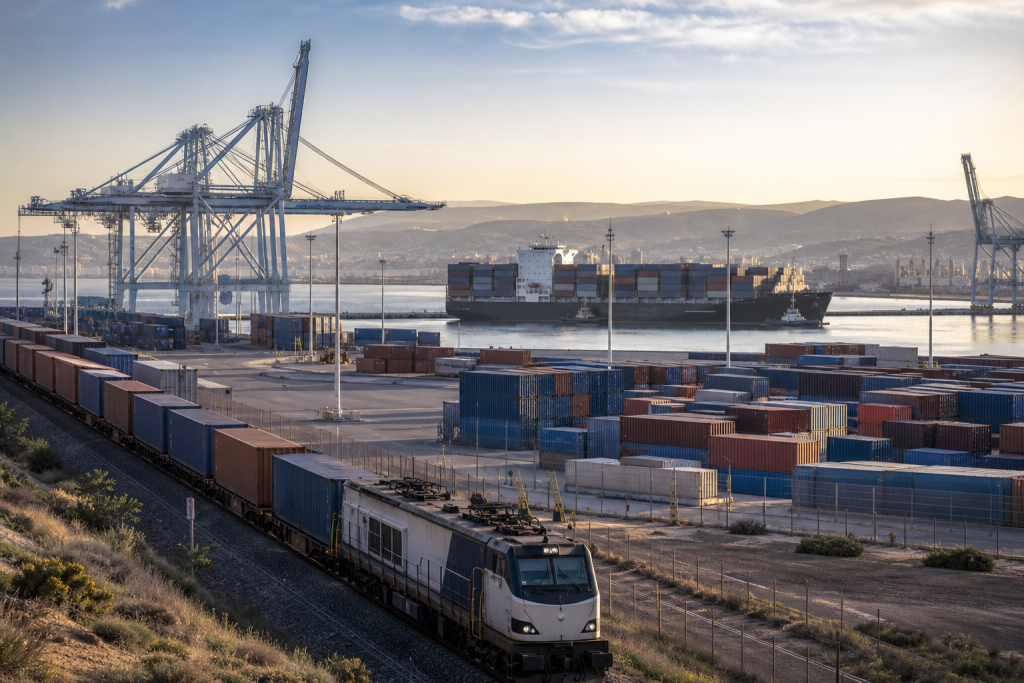
Tangier’s region illustrates the connection between ports, industry, shipping routes, rail and business zones. It cannot stand for all of Morocco’s foreign trade, but it helps explain how a logistics chain supports both imports and exports.
Our Tangier destination page covers the city beyond the port: the Strait, its history, the medina and its role as a crossroads. This is an editorial link; no affiliate offer is attached to an economic subject without a direct match.
Logistics performance also needs to be measured through time, cost, reliability and links to local suppliers, not just terminal tonnage.
Provisional figures can be revised
The Foreign Exchange Office marks the June figures as provisional. They may change in later consolidated releases. The percentages compare January-June 2026 with January-June 2025, not a single month with a full year.
HCP contributes a different macroeconomic perspective: production, demand and the trade contribution to growth. Its estimates do not replace exchange records; they answer another question.
A reliable article therefore preserves the source document, date, status and unit attached to every figure.
A practical reading framework
- Goods: exports, imports, deficit and coverage ratio.
- Industries: automotive, food, phosphates, textiles and aerospace.
- Services: receipts and expenditure related to services.
- Travel: spending by non-resident visitors and residents abroad.
- Remittances: current transfers, separate from trade.
- FDI: receipts, expenditure and net flow, distinct from the stock.
- Status: provisional end-June figures, subject to revision.
The result is more demanding but more informative: Morocco imported more to meet demand and investment needs, while several exporting industries and services continued to expand.
Sources consulted
- Foreign Exchange Office, monthly external-exchange indicators at the end of June 2026, provisional data: https://www.oc.gov.ma/sites/default/files/2026-07/Indicateurs_mensuels_JUIN_2026.pdf
- High Commission for Planning, Economic Outlook No. 50, July 2026: https://www.hcp.ma/Point-de-conjoncture-N-50-Juillet-2026_a4337.html
- Foreign Exchange Office publications portal, accessed 23 August 2026: https://www.oc.gov.ma/fr/publications