Moulay Idriss Zerhoun and Volubilis are close to each other, but they do not tell the same story. The first is a living town connected with Idrisid history and an active religious life. The second is a protected archaeological site that has been on UNESCO’s World Heritage List since 1997.
Bringing them together in one day can provide a rich reading of the Zerhoun area. It requires visitors not to turn the town into a backdrop or the ruins into a collection of mosaics. The itinerary needs enough time for observation, rest and the unexpected.
Distinguish the town from the archaeological site
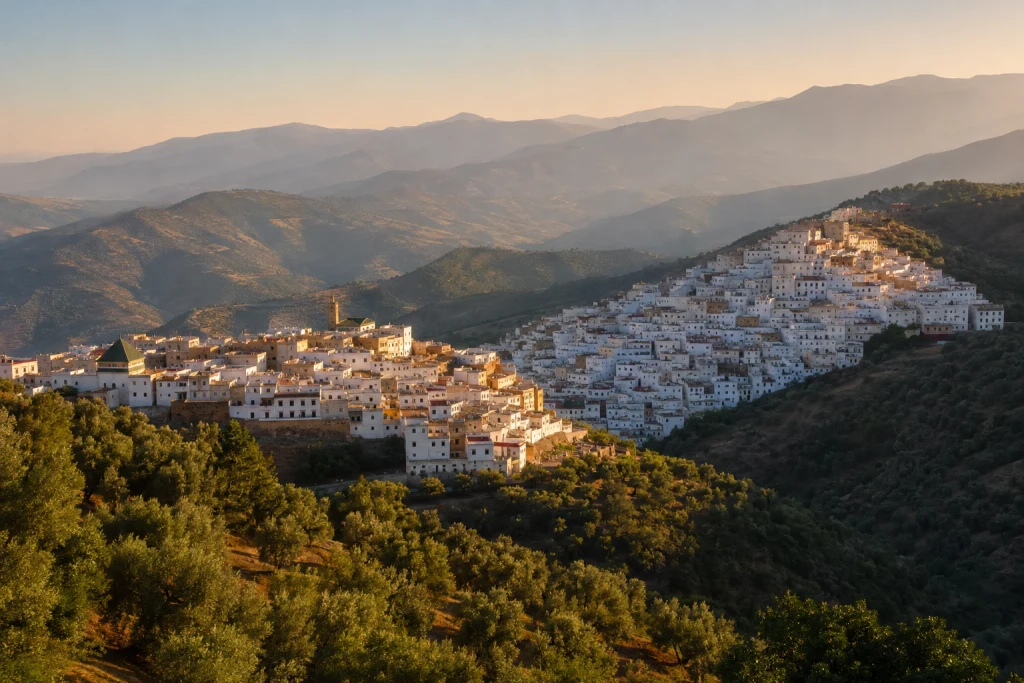
Moulay Idriss Zerhoun spreads over steep ground above an agricultural landscape. Sloping streets, viewpoints and everyday spaces shape a visit. Some places serve religious or private purposes and are not automatically open to everyone.
Volubilis follows a different logic. UNESCO describes a 42-hectare archaeological property documenting Mauretanian, Roman, Christian and Islamic phases. Its significance comes from both the remains and the landscape and cultural exchanges they record.
Read Volubilis beyond the Roman label
The site is often introduced as a Roman city. That phrase identifies one period, but it does not sum up the ten centuries of occupation documented by UNESCO. Urban design, inscriptions, mosaics and building materials bear witness to several cultures and transformations.
An attentive visit should not chase only the arch or the most familiar picture. Looking at the organisation of neighbourhoods, the slope, the surrounding farmland and the site boundaries explains why heritage value extends beyond each isolated monument.
Understand the Idrisid connection without flattening history
Volubilis briefly became the capital of Idris I, founder of the Idrisid dynasty, who is buried in the neighbouring town bearing his name. Morocco’s National Tourist Office places Moulay Idriss Zerhoun within that history and the wider Meknes area.
The historical connection does not turn both places into one continuous museum. The present town has its own pace, residents, activities and rules of respect. A date or dynastic narrative is a reference point, not permission to enter every space.
Choose an order that fits light and energy
There is no universal order. The archaeological site involves walking in exposed terrain, while the town has slopes and lanes. Season, heat, fitness and the hours actually displayed should guide the choice.
A realistic day gives each place a proper block of time and avoids adding several major stops. Opening hours, prices and access conditions can change; check them with managers or official channels on the day of the visit.
Move between them without inventing a guaranteed service
The two places are geographically close, but MOP does not present a transport timetable as permanent without current official data. A taxi, driver, rented vehicle or local solution may work depending on the real situation.
Before leaving, agree on the price or understand the meter, confirm the return point and keep a fallback. Finding an outbound ride does not guarantee an immediate return late in the day. Accommodation and onward transport to Meknes should remain separate from any unverified promise.
Respect a place of pilgrimage and residence
The mausoleum and pilgrimage give Moulay Idriss Zerhoun a religious dimension that cannot be reduced to an attraction. Visitors need to follow signs, local instructions and access limits around sacred spaces.
Modest clothing, a measured voice and asking before photographing anyone are simple habits. An open door does not prove that a place is intended for visitors. A refusal or boundary should be accepted without debate.
Protect Volubilis through ordinary behaviour
Staying on permitted routes protects surfaces and structures. Do not climb a wall, move a stone or touch a mosaic for a picture. Water and waste need to be managed without leaving a trace.
UNESCO also stresses the surrounding landscape and protected buffer zone. An archaeological site is not an object detached from its territory: views, farmland and the relationship with Zerhoun contribute to its interpretation.
Support local activity without forcing an encounter
Tea, a meal or a purchase can support local activity when the price and origin are clear. Asking simple questions is better than demanding a demonstration or personal story.
The word “authentic” guarantees neither local manufacture nor fair remuneration. A respectful exchange accepts that a merchant sells, a craftsperson may not want to be filmed and a resident is not an improvised guide.
What MOP suggests carrying
- Suitable water, sun protection and stable shoes.
- A payment method accepted locally, without assuming everything is digital.
- Confirmed outward and return transport.
- Opening hours and access conditions checked that day.
- A charged battery, while keeping the phone away in sensitive places.
- Enough time to drop a stop rather than rush through it.
Sources consulted
- UNESCO, official Archaeological Site of Volubilis record, accessed 4 September 2026: World Heritage property 836
- Moroccan National Tourist Office, official Meknes and Zerhoun brochure: Meknes, Moulay Idriss and Volubilis
- Moroccan National Tourist Office, archaeological overview accessed 4 September 2026: Morocco’s archaeological treasures