
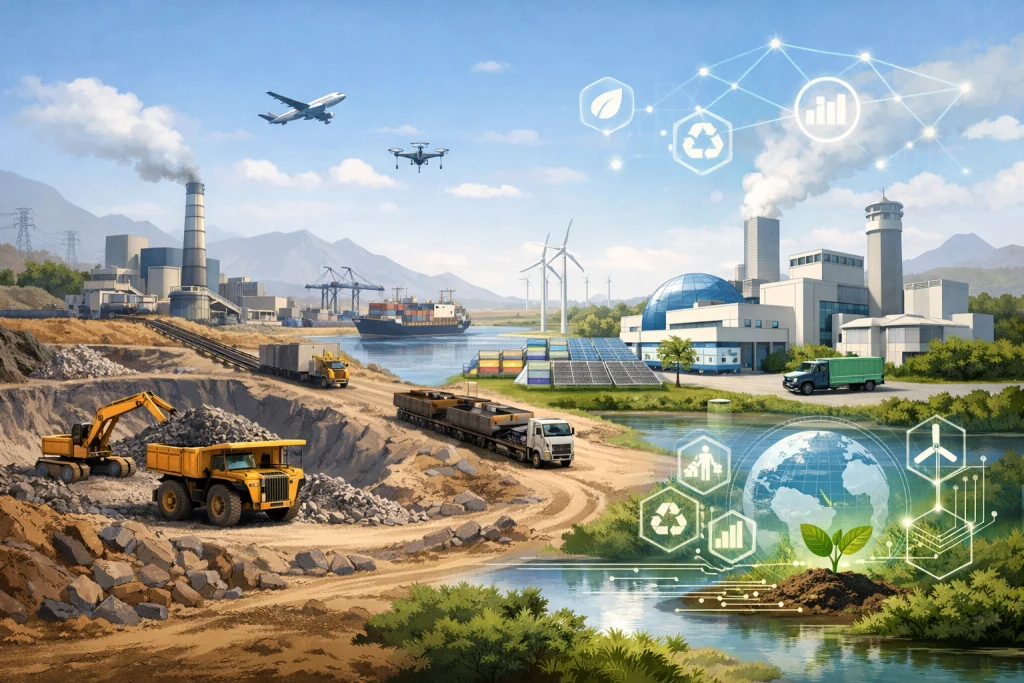
Editorial illustration, generated image, depicting the transition from extraction to an integrated mining value chain.
A third edition opens in Rabat
The third International Mining Congress in Morocco, known as IMC Morocco 2026, has opened in Rabat. The reviewed sources confirm the launch of a gathering devoted to mining industry issues in Morocco and across Africa. The event is organised by the Fédération de l’Industrie Minérale and AME Trade within a framework bringing together institutional and professional mining stakeholders.
The overall event window runs from October 6 to October 8, 2026. An important distinction is required: reviewed reports describe two days of debates, while the complete calendar covers three days. The final day is associated with scheduled technical or site visits. This structure accounts for the apparent difference between the length of the conference programme and the full event period.
Moving from extraction to integrated value chains
The congress’s central question is how mining economies can move beyond a model focused mainly on extraction and give a larger role to local processing. From this perspective, the value of a mineral resource does not depend only on extracting it. It is also linked to the industrial, technical and financial capabilities required to process it and connect it to more complete value chains.
At the African level, the programme places this discussion within a broader ambition to integrate mining value chains. The congress therefore provides a forum for examining how more processing activity might be retained on the continent. The sources describe this direction as a strategic priority and an industry question for discussion, rather than an adopted policy or an outcome that has already been secured.
That distinction is essential when assessing the event’s immediate significance. The opening confirms the existence of a sectoral agenda and a platform for dialogue. It does not, by itself, establish that new processing capacity will be built, that a project will be completed or that a regulatory change will result from the discussions.
Financing, investment and technology on the agenda
Building a more integrated value chain also requires attention to financing and investment. These subjects are part of the congress agenda alongside the industrial issues. The discussions are intended to examine the conditions needed to develop mining projects and processing capacity, but the reviewed sources do not document any newly committed financing resulting from the event.
Technology is another component of the programme. It is presented as part of the development and modernisation of the mining sector. Its inclusion shows that the debate is not limited to the availability of mineral resources. It also concerns the tools, processes and capabilities required for mining and related industrial activities to evolve.
The programme includes several forms of professional exchange and seeks to connect geological, industrial, financial and technological aspects of the sector. For participating companies and institutions, the immediate value therefore lies primarily in sharing information, presenting priorities and considering possible cooperation. The verified documentation does not yet support treating those prospects as firm announcements.
ESG practices form part of the debate
Environmental, social and governance practices, commonly grouped under the acronym ESG, are also among the congress themes. Their place on the agenda situates the sector’s transformation within a framework broader than production alone. The discussions are therefore intended to connect industrial objectives with governance questions and responsible practices.
At this stage, however, ESG should be described as a subject of discussion. The verified sources do not document the adoption of a new ESG standard at the congress or the entry into force of an additional obligation. For readers and industry operators, the event mainly indicates which issues its organisers and participants regard as strategically important.
What remains to be confirmed
The available documentation establishes the opening, timing, organisers and principal themes of the programme. It also places this third edition in the context of earlier gatherings. However, aggregate figures supplied by the organiser for the two previous editions must not be presented as attendance achieved in 2026, and the reviewed material does not yet establish a final participant total for this edition.
Technical visits were scheduled for October 8. As of the research date, their completion had not been verified, so they should be described as planned rather than completed. The same caution applies to any potential industrial, financial or institutional results arising from the congress.
The next significant update would be a closing communiqué or primary documentation recording agreements, declarations, investment commitments, awards or final attendance figures. Until such material is available, IMC Morocco 2026 is best understood as a forum for debate and strategic positioning on the future of African mining value chains, rather than the announcement of an immediate change for the public.