
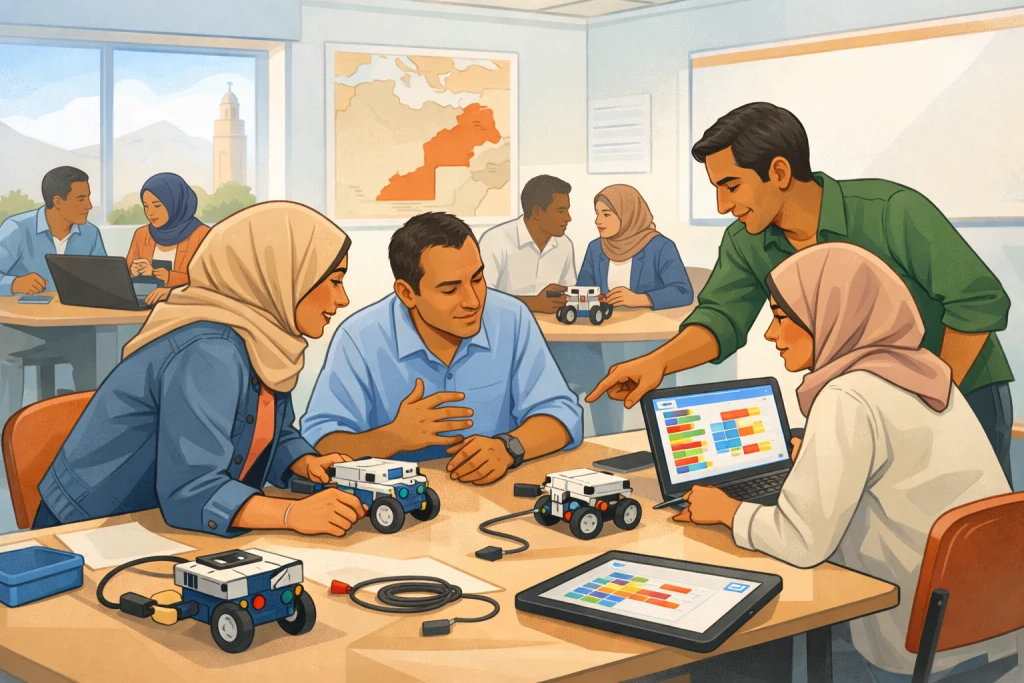
The Route 250 national caravan was launched in Rabat on October 27, 2026. Organized by the Ministry of National Education with LOOP for Science & Technology and the U.S. Embassy in Morocco, the initiative is structured as a training programme focused on integrating emerging technologies into teaching. Its launch is confirmed by both the ministry and a Maroc.ma report carrying information from MAP.
Route 250 is the name used by the ministry for the caravan. The MAP report describes it more generally as a national training caravan for artificial intelligence and educational robotics. Both sources cover the same October 27 launch in Rabat and identify the same partners. Neither provides a complete schedule for the regional stages expected to follow the launch.
Practical training for educators
The programme is intended to strengthen educators’ digital, pedagogical and technical skills by supporting the classroom integration of emerging technologies. Its specialized practical training covers three areas identified by the ministry: programming, robotics and artificial intelligence. Route 250 is therefore presented as a professional training initiative for education staff, rather than as evidence of learning gains or classroom outcomes that have already been measured.
In its dedicated announcement, the ministry says the direct teacher audience includes primary-school and lower-secondary educators. The MAP account uses broader language, referring to education staff drawn from different teaching cycles. Those descriptions should retain their separate attributions because the available sources do not provide a more extensive list of the professional roles or categories eligible to join the programme.
Thirty participants as a local core group
According to Ilham Laaziz, the ministry’s digital-resources director, each stage is designed for 30 education staff representing different teaching cycles. The participants are expected to form a core group capable of extending the training’s impact in their local settings. This 30-person model is reported by Maroc.ma, but it does not appear in the ministry’s dedicated Route 250 announcement.
The model places emphasis on transmission among education professionals, with those trained during each stage expected to act as a local reference group. The sources describe this multiplier approach as part of the programme’s design, but they provide no measurement of its effectiveness. They also do not state the total number of stages or the final number of participants who may be reached nationally.
Interactive tools and teaching practices
LOOP founding member Imane Berchan said the practical component uses interactive tools and robots. In her account, these resources are intended to support lesson and examination preparation, conversations about digital safety, and activities based on exploration and experimentation. These are planned uses within the training programme, not classroom effects that have already been independently evaluated or demonstrated through published implementation data.
The ministry also links Route 250 to developing computational thinking, creativity and problem-solving abilities among learners. It presents the programme as supporting more interactive teaching practices. These points describe the institution’s stated pedagogical objectives. The reviewed sources do not yet offer an evaluation, classroom deployment indicators or measured student results that would establish whether those objectives have been achieved.
Planned reach across all 12 academies
The programme is intended to cover all 12 of Morocco’s regional education and training academies. The ministry further states that training will extend to more than 20 provincial directorates. Organizers say later stops will take the caravan through different regions, but the available report gives no city-by-city itinerary and announces no dates for those journeys after the Rabat launch.
That national scope is one of Route 250’s main announced features, although several operational details remain unavailable. The sources do not specify the caravan’s duration, budget, final number of stages or expected overall participant total. It is therefore not possible to calculate final national coverage from the stated model of 30 education staff participating at each individual stage.
Part of a broader educational technology effort
Route 250 arrives in a context in which the ministry has already linked investment in artificial intelligence to education reform. On January 12, 2026, it connected that effort with its 2022-2026 roadmap, the expansion of digital skills, pedagogical innovation, and training for pedagogical and technical staff. This earlier framework provides institutional context for the caravan’s launch later in the year.
Educational robotics also had national visibility before Route 250 was launched. On May 14, 2026, the ministry held the finals of the 11th educational robotics competition in Rabat. Twelve projects representing regional academies were selected from 45 projects entered in regional qualifiers, providing another example of an institutional initiative focused on educational robotics during the same year.
U.S. Embassy chargé d’affaires Benjamin Ziff said the programme should help teachers guide pupils toward responsible and safe technology use while reinforcing their digital skills. His statement expresses an intended contribution of the programme rather than a measured result. Confirming its effects will require later information about regional stops, participant totals, training resources and the technologies’ subsequent use in classrooms.