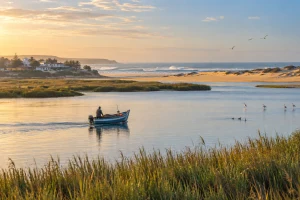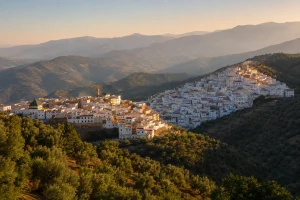
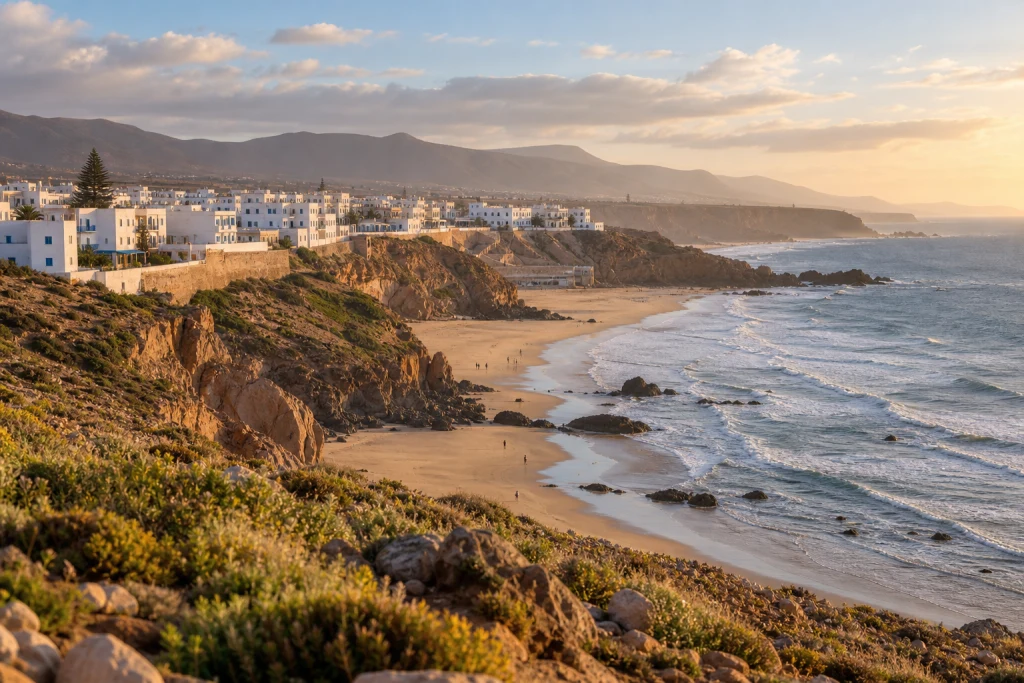
Sidi Ifni is shaped by a constant relationship between town and ocean edge. White buildings, twentieth-century urban lines, ochre cliffs and a long beach create a landscape that feels unlike either a large resort or a traditional medina.
The Moroccan National Tourist Office describes Sidi Ifni as a former Spanish enclave perched on a cliff, with Spanish-influenced architecture and a broad beach. That summary offers a useful first key, but the town rewards visitors who do not reduce it to one historical period.
Start with the geography
Before the façades comes the setting. The town belongs to the Guelmim-Oued Noun region, on a coast where the land descends towards the Atlantic. From several streets and higher points, the view moves quickly from built space to cliffs and open water.
That topography shapes a visit. A short distance on a map may include a slope, strong wind or an access point that requires a detour. Plan modest walks, know the route back and ask locally which passages are open and maintained.
Notice an urban legacy without freezing it
Geometric lines, curved volumes and particular proportions evoke the town’s twentieth-century history. The Spanish influence identified by the tourism office is best read across the urban fabric rather than through a checklist of monuments.
Look at the relationships between buildings, squares and sight lines. Some structures have changed purpose, while others may be closed or fragile. Photographing from public space and respecting marked limits lets you appreciate the heritage without entering an inaccessible property.
Connect architecture with a longer history
Sidi Ifni’s memory did not begin with its modern buildings and does not end there. Morocco’s official portal records 30 June 1969 as the date when Spanish forces left and the town was recovered by Morocco, after a history of resistance in which the Aït Baâmrane tribes played an important part.
This history deserves precise language. An architectural walk becomes more meaningful when it acknowledges both the visible traces of a colonial period and Moroccan accounts of sovereignty, local communities and territory.
Walk at the pace of everyday life
Sidi Ifni is not an abandoned film set. Shops, cafés, markets, public services and homes give its streets a present-day rhythm. Leave time for ordinary scenes without turning every façade or resident into a photographic subject.
Ask before making a portrait or taking a picture inside a business. A few words exchanged about a building, a neighbourhood or the weather often add more understanding than a hurried circuit guided only by a map.
Approach the Atlantic carefully
The broad beach defines many images of Sidi Ifni, but an open view does not guarantee easy swimming. Swell, wind, tides, currents and access conditions vary. Local guidance and instructions available on the day should always take priority over a travel description.
Stay away from unstable cliff edges, avoid unmarked tracks and leave enough time to return before dark. If you plan to surf or join another water activity, confirm supervision, equipment, the level required and cancellation conditions with the operator.
Choose one day or a slower stay
One day can introduce the town, several urban perspectives and the coast. An overnight stay makes room for gentler light, unhurried walking and an alternative if wind makes the seafront less comfortable.
Do not treat this suggested duration as a guaranteed programme. Transport schedules, site access and road times need to be checked for your dates. In Sidi Ifni, spare time is part of a sensible plan.
Place Sidi Ifni within a wider journey
The tourism office’s Agadir guide places Sidi Ifni about thirty kilometres from Mirleft. That proximity can inspire a coastal sequence, but travellers still need to check the route, available transport and actual journey time.
The official regional page sets Sidi Ifni within the broader landscape of Guelmim-Oued Noun. The town can therefore be approached as a link between coast and inland territory, not merely as an isolated excursion squeezed into a schedule.
Leave with more than one reading of the town
Sidi Ifni brings together dramatic geography, sensitive history and contemporary urban life. None of those layers should erase the others. The lasting memory may be an ocean view, an architectural detail, a conversation or simply time spent watching the light change.
Plan lightly, observe closely and verify whatever depends on current conditions. That approach allows the town to exist beyond expected images and turns an Atlantic stop into an attentive reading of place.