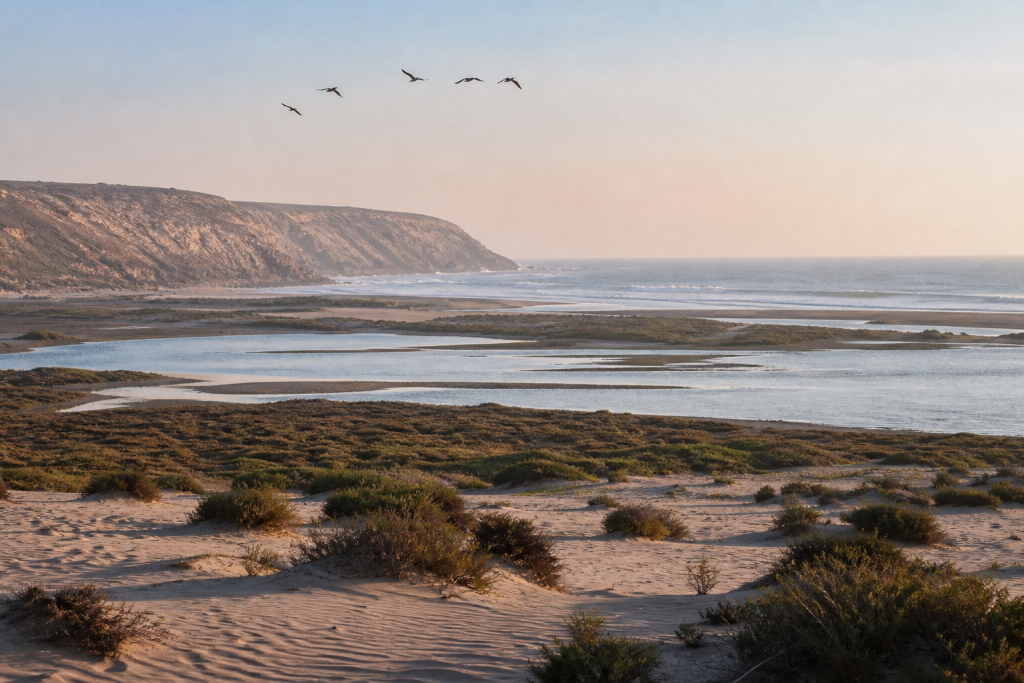
South of Agadir, Souss-Massa National Park protects a collection of landscapes rather than a single viewpoint: estuaries, wetlands, steppe, dunes, beaches and Atlantic cliffs. This diversity supports fragile plants and wildlife.
A useful visit does not try to approach every animal or cover the largest possible distance. It takes time to understand habitats, follows authorised routes and accepts that wildlife observation remains uncertain.
What the park protects
The official Visit Agadir portal says the park covers more than 30,000 hectares between the mouths of the Souss and Massa rivers. It combines coastal habitats, steppe and wetlands, and contributes to the conservation of rare or threatened species.
Morocco’s National Tourist Office particularly highlights birdlife and the northern bald ibis. Species and population figures provide context, not a guaranteed checklist for a tour. Seasons, tides, weather and animal behaviour affect every observation.
A nature reserve, not a staged safari
The word “safari” sometimes appears in commercial descriptions. It should not suggest a route on which large animals appear at every stop. Souss-Massa is first a conservation area with regulated zones and activities.
Decline an offer that promises to chase wildlife, approach a nest or leave an authorised circuit for a photograph. The absence of a dramatic sighting does not mean that the visit failed.
Book through management or an authorised operator
Visit Agadir states that ecovisits are booked with the park management or through authorised private operators and involve an approved ecoguide. That should become a selection criterion.
Before paying, ask for the operator’s name, guide status, planned circuit, group size and rules followed. The phrase “local guide” alone does not describe the role or naturalist competence.
Half-day or full day
The regional portal presents both half-day and full-day formats. A half-day provides a first reading when transport and the circuit remain focused. A full day gives more time to change habitat, observe and pause.
The advertised duration should separate transport from Agadir and time actually spent inside the park. Ask for pickup place, stop lengths and the intended return time.
Transport from Agadir
The park covers a large area south of the city. A generic name such as “Souss-Massa excursion” does not guarantee the same route. Some tours concentrate on an estuary, others on a reserve, village or coastal sector.
Check vehicle type, seat belts, cooling, passenger count and the plan when a track or access point is closed. With a private vehicle, never enter an unauthorised trail simply because it appears on a map.
Watch birds without disturbing them
Maintain distance, limit noise and follow the ecoguide’s instructions. Binoculars or a long lens provide better observation than approaching. Do not publish the precise location of a nest or sensitive site.
Avoid audio playback used to attract birds. Feed no animal and take no feather, egg or plant. Photography comes after maintaining natural behaviour.
Beaches, cliffs and swimming
The park’s coast includes wild beaches and cliffs. Visit Agadir warns that some waters are rougher than Agadir Bay. A beach stop therefore does not prove that swimming is permitted or sensible.
Stay away from unstable cliff edges, supervise children and follow local warnings. Tides and swell may reduce a passage or isolate low ground.
What to carry
Take water, sun protection, a hat, closed shoes and a windproof layer. Binoculars are more useful than heavy camera equipment for a first visit. Carry out waste and avoid packaging that can blow away.
Ask whether water and a meal are included. Tell the operator about dietary or medical requirements before departure and keep essential items with you.
Families, accessibility and pace
An outing can work for a family when vehicle time, stops and walking are suitable. Ask about the recommended minimum age, child seating and toilet access.
For reduced mobility, request the terrain type, walking distance and whether observation is possible from an accessible point. The word “easy” is not enough; a concrete description is required.
Compare an ecovisit offer
- Identified operator and ecoguide.
- Authorised circuit and a clear naturalist purpose.
- Group size and actual time inside the park.
- Transport, meal, water and equipment included or excluded.
- Cancellation terms and adaptation to weather.
- Distance, noise and photography rules.
MOP gives preference to offers that protect the site even when this reduces proximity to wildlife. That principle matters more than a promise to “definitely see” one species.
Fit the trip into an Agadir stay
Give the park a half-day or full day without adding Taghazout on the same day. Our three-day Agadir itinerary separates the city, coast and nature.
Use the Agadir destination page to build a coherent stay around the bay and Souss region.
Sources consulted
- Souss-Massa Regional Tourism Council, Souss-Massa National Park and ecovisit arrangements: https://visitagadir.com/en/destinations/souss-massa-national-park/
- Moroccan National Tourist Office, nature around Agadir-Taghazout: https://www.visitmorocco.com/en/travel/agadir-taghazout/nature
- Souss-Massa Regional Tourism Council, park beaches and coastal caution: https://visitagadir.com/destinations/les-plages-du-parc-naturel-de-souss-massa/