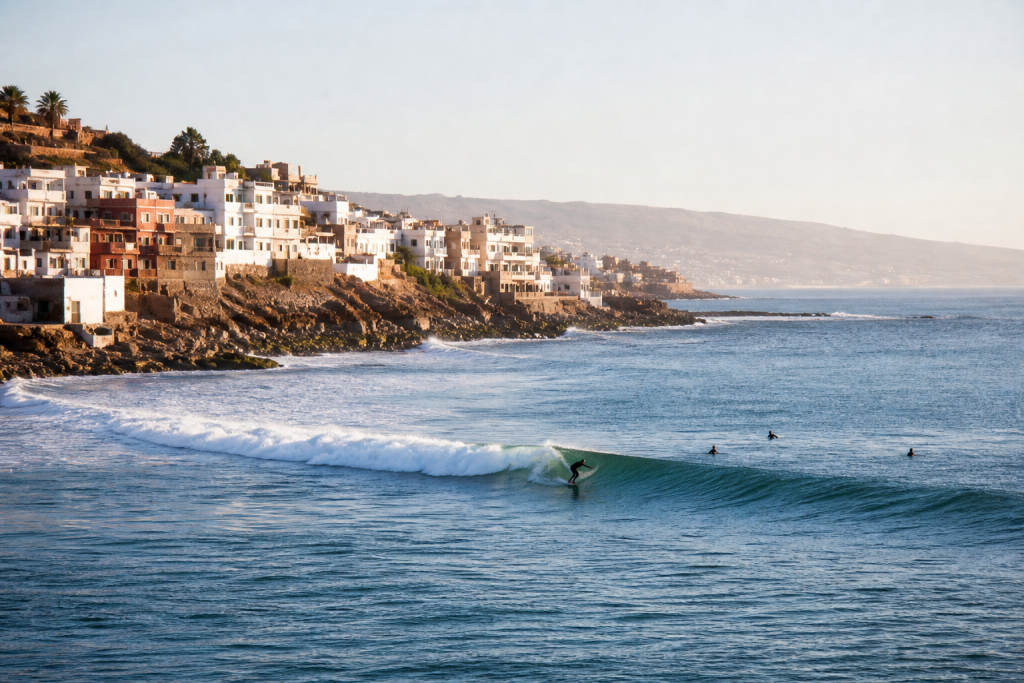
Taghazout is often presented as a single “surf spot”. In reality, the coast north of Agadir contains waves, seabeds and exposure levels that differ greatly. A dramatic image of Anchor Point describes neither a first lesson nor tomorrow’s conditions.
The right choice begins with an honest ability assessment and a same-day reading of the ocean with a local professional. No calendar can guarantee a specific wave.
Beginner, intermediate or advanced: move beyond vague labels
A beginner learns positioning, paddling, standing and priorities in a suitable area. An intermediate surfer still needs to describe actual independence: can they cross broken waves, read a current and return to the exit without help?
The number of weeks spent surfing is not enough. Tell the school the wave size you normally handle, frequency of sessions, board used and ability to manage a fall. A responsible provider may suggest an observation session before taking someone to a more demanding break.
Famous breaks are not compulsory goals
The official Visit Agadir portal describes several parts of the Souss-Massa coast. Anchor Point is associated with a powerful right-hand wave and significant volumes of water when the swell rises. Other beaches and peaks are more appropriate for learning when conditions allow.
Choosing a break because its name is famous can place the group in difficulty and obstruct independent surfers. A school should move a session when wind, swell, tide or crowding makes a location unsuitable.
What a useful lesson should explain
Before entering the water, the instructor should introduce the equipment, zone, visible currents, return signal and response after a fall. A lesson should also cover priority, distance from others and protecting the head while resurfacing.
Ask for the maximum number of students per instructor and whether the teacher remains in the water. A large “surf experience” may include transport, photographs and lunch without providing more teaching time.
Check the school and insurance
Ask for the operator’s identity, instructor qualifications, insurance for the activity and incident procedure. For a minor, confirm the accepted age, supervision and any special terms.
The offer should state what happens when conditions are poor: move to another beach, reschedule, alternative activity or refund. A promise of “guaranteed surfing” is not credible when it ignores the ocean.
Board, wetsuit and equipment condition
A large stable board generally supports learning. The leash must be suitable, the board should have no dangerous edge and the wetsuit should fit both temperature and body shape.
Report a worn attachment, damaged fin or torn suit before the session. Rinse equipment as instructed and never leave a board across a busy route on the sand.
Season, swell and weather: decide each day
The National Tourist Office and Visit Agadir associate Taghazout with surfing through much of the year, with a particular reputation for cooler-season swells at some point breaks. That does not mean every beach suits every level year-round.
Wind, swell direction, period, tide and seabed transform a session. Read a forecast, but leave the final choice to someone observing the site. An app cannot see a swimmer, an unusual set or temporarily closed access.
Safety in the water
Never surf alone at an unfamiliar location. Identify entry, exit, rocks, currents and a landmark on shore. If carried sideways, do not fight blindly against the flow: signal for help and follow the response learned with the instructor.
Protect the head after a fall, keep distance from other boards and retain your board when it provides flotation. Fatigue, cold and dehydration reduce judgement well before complete exhaustion.
Respect the village and surf community
Taghazout is a living community, not a set built around visitors. Use authorised access, avoid blocking lanes with a vehicle and take waste away. Long showers and excessive towel changes add pressure on water in a dry region.
In the water, respect priority, do not snake a wave and do not enter an advanced zone simply for a photograph. Conduct matters as much as performance.
Where to stay for surfing
A base in Taghazout or Tamraght reduces early transfers. Staying in Agadir gives a wider urban choice, but requires confirmation of transport, departure and return. Our guide to where to stay in Agadir and Taghazout compares the options.
For a package with transport, check whether the provider chooses the beach after reading conditions or automatically drives every group to the same location.
Compare a surf offer
- Actual ability accepted and how it is assessed.
- Maximum group size and whether the instructor is in the water.
- Qualifications, insurance and emergency procedure.
- Board, wetsuit, transport and meals included or excluded.
- Policy when conditions are unsuitable.
- Meeting point, time in the water and total advertised duration.
MOP gives preference to offers that make these points visible before payment. The lowest price or most dramatic photograph cannot replace supervision.
Sources consulted
- Moroccan National Tourist Office, beaches and surfing in Agadir-Taghazout: https://www.visitmorocco.com/en/travel/agadir-taghazout/beach
- Souss-Massa Regional Tourism Council, guide to regional surf spots: https://visitagadir.com/en/activites/discover-the-surf-spots-of-souss-massa/
- Souss-Massa Regional Tourism Council, regional sports activities: https://visitagadir.com/en/experiences/sports-activities-in-souss-massa/