Tangier occupies a unique position in northern Morocco, facing the Strait of Gibraltar and close to where the Mediterranean and Atlantic meet. This geography has shaped its port, trade, rivalries and reputation as a city open to several horizons.
Yet reducing it to a “crossroads between East and West” erases much of its Moroccan identity. Tangier can be understood through its medina, kasbah, 20th-century districts, coastal landscapes and contemporary transformation. It deserves a visit that distinguishes documented history from literary myths.
A city facing the strait
From the heights, the strait seems to bring two continents closer together. Above all, it remains an international shipping route subject to winds, currents and heavy traffic. Tangier’s position explains the strategic importance attached to the city over the centuries.
Its urban area now extends far beyond the medina. The Port of Tangier Ville, the seafront, the modern city and the new districts form a continuous whole, while the capes and beaches lie outside the centre.
This distinction helps to build a realistic itinerary. A walk through the medina, a cultural visit and an excursion to Cape Spartel do not require the same amount of time or the same mode of transport.
A history spanning several periods
Tangier has experienced successive presences and powers: ancient, Islamic, Portuguese, English and then Moroccan, with periods of diplomatic and commercial rivalry. The city therefore cannot be explained through a simple opposition between two worlds.
In the early 20th century, its international status strengthened the presence of foreign missions, businesses, artists, journalists and adventurers. This period left behind architecture and an extensive body of literature, but also inequalities and accounts that were sometimes exoticising.
Tangier returned fully to Moroccan sovereignty in the mid-20th century. The present-day city does not live in nostalgia for the international zone: it is a major urban, cultural, university, industrial and logistics centre.
Tangier’s medina, without a false UNESCO listing
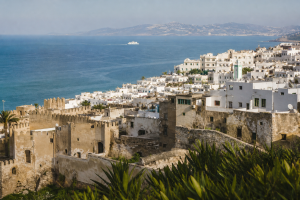
The medina is arranged along the slope between the port, souks, squares and kasbah. Its lanes bring together homes, shops, fondouks, places of worship and buildings transformed over time.
Contrary to a widespread claim in some older guidebooks, Tangier’s medina is not among the nine Moroccan properties inscribed on the UNESCO World Heritage List. This fact does not diminish its historical value; it avoids attributing to it an official heritage status that it does not possess.
Listing is not, moreover, the only way to understand a historic district. Observing its volumes, doors, uses and restorations reveals what makes the medina distinctive without resorting to an inaccurate label.
Grand Socco, a threshold between two cities
Grand Socco, or 9 April 1947 Square, marks a transition between the medina and the city developed outside the walls. It is a space for movement, encounters and commerce rather than an isolated monument.
Nearby, the Mendoubia Gardens offer a place to pause in a very busy area. The streets lead towards the markets, the medina and several buildings connected with the city’s cultural history.
For visitors, Grand Socco is a useful landmark. It is a good place to start exploring on foot, while also showing that Tangier was built in layers: the old city does not end abruptly where the modern city begins.
The kasbah and the former Sultan’s palace
The kasbah overlooks the medina and the strait. Its quieter streets, gates and viewpoints form one of Tangier’s most coherent areas. Here too, this is a residential district: respecting private entrances and residents takes priority over seeking the perfect shot.
The former Sultan’s palace, Dar el-Makhzen, now houses a museum devoted to the arts and history of Morocco. The Moroccan National Tourist Office presents it as one of the kasbah’s major landmarks.
Collections, opening hours and access conditions may change. A cultural visit should therefore be planned through official channels or checked locally, without assuming permanent access to every room.
Petit Socco, cafés and literary memory
Petit Socco is associated with cafés, exchanges and memories of the international period. Foreign writers and artists contributed to its renown, but their perspectives form only one part of Tangier’s history.
Delacroix and Matisse are often mentioned in tourist accounts, as are Paul Bowles and other 20th-century authors. Their works can enrich a visit if placed in the context of their period, rather than being used to present the city as a mysterious, unchanging setting.
The historic cafés remain active establishments. Their names, operations and condition may change; it is best to approach them as present-day places filled with memories rather than as guaranteed museums.
The Cervantes Theatre and the Spanish influence
The Gran Teatro Cervantes, built in 1913, is one of the most visible reminders of the Spanish cultural presence in Tangier. Its façade and history recall the importance of performance and artistic exchange in the city during the early 20th century.
Its status, renovation work and accessibility have changed. Seeing it from a public space does not mean that the interior is open to visitors. Any announcement of reopening or programming should be checked for the dates of the stay.
Spanish influence also appears in certain buildings, names, linguistic habits and family ties in northern Morocco. It complements the city’s Amazigh, Arab, African, Mediterranean and Atlantic dimensions.
Modern Tangier and the seafront
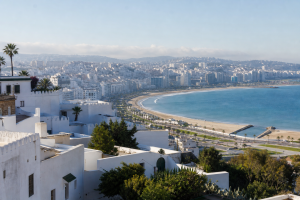
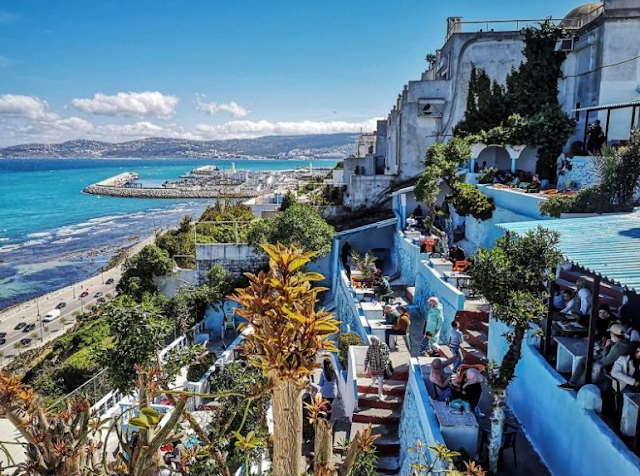
Boulevard Pasteur, the 20th-century buildings, Place de France and the shopping streets reveal another Tangier. The Terrasse des Paresseux offers a well-known view over the port and bay, while the city continues to grow denser around these landmarks.
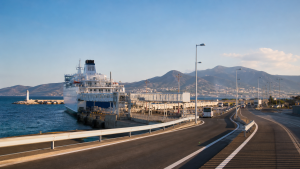
The seafront has been profoundly transformed. The Port of Tangier Ville accommodates ferry services and leisure boating activities in particular, while the former port areas have been redeveloped.
The urban beaches are easy to see, but their condition, water quality and swimming conditions vary. Follow signs and local recommendations rather than assuming that every section of the bay is suitable for swimming.
Tangier Ville is not Tangier Med
Tangier Med is a large port and logistics complex located east of Tangier, near the strait. It is not in the city centre and should not be confused with the Port of Tangier Ville.
This confusion leads to inaccurate distances and transport advice. Travellers arriving by ferry should check the exact port shown on their ticket, because the journey to central Tangier differs greatly depending on the terminal.
Tangier Med plays a major role in Morocco’s contemporary maritime and industrial trade. It is part of the region’s economic story, but it is not an attraction that can be reached on foot from the medina.
Cape Spartel, between the strait and the Atlantic
Cape Spartel lies west of Tangier, outside the centre. Its lighthouse and coastal landscapes reveal the opening towards the Atlantic and the entrance to the strait. The Moroccan National Tourist Office lists it among the destination’s major excursions.
The phrase “meeting of two seas” is appealing, but it does not describe a fixed line visible in the water. Currents, colours and atmospheric conditions vary. The site is better understood through geography than through the promise of a photograph.
Wind, fog and heavy swells can alter the experience. Visitors should remain within authorised areas around the cliffs and viewpoints, especially when the ground is wet.
The Caves of Hercules between geology and legend
The Caves of Hercules are located on the Atlantic coast, near the cape. They are associated with mythological tales, particularly those concerning the Greek hero Hercules. These stories form part of the site’s folklore but should not be presented as historical facts.
Their formation, openings and traces of human exploitation form a distinct geological and heritage subject. The famous opening facing the sea is often compared to the shape of Africa; this resemblance depends on the viewpoint.
Access, facilities and visitor numbers may change. It is best to plan Cape Spartel and the caves together as an organised half-day trip rather than adding them to a walking route through the medina.
Perdicaris Park and Rmilat Forest
Perdicaris Park, in Rmilat Forest, offers trails, vegetation and views over the coast. The site is named after Ion Perdicaris, who was connected with a diplomatic episode in the early 20th century, but its current value also lies in its role as a natural area and a place for walking.
As in any wooded area, the risk of fire, temporary closures and trail conditions depend on the season. Visitors must follow instructions, leave no waste and avoid any open flame.
The park is some distance from the heart of the medina. Return transport and closing time should be planned in advance, particularly as daylight begins to fade.
Planning a coherent stay
A first day can combine Grand Socco, the medina, the kasbah and the modern city. A second half-day or full day can be used to explore Cape Spartel, the Caves of Hercules and possibly Rmilat, depending on opening hours and conditions.
Walking is suitable for the historic centre, but the slopes and cobblestones can be tiring. For the coast, a taxi or organised transport is generally necessary. The price and route should be clarified before departure.
Tangier also deserves time without monuments: observing the port, visiting a market, entering a museum and exploring the 20th-century districts provide a more accurate picture than simply accumulating famous places.
A Moroccan, international and contemporary city
Tangier’s openness to the world is real, but it should not confine the city to a fantasised cosmopolitan past. Its medina, museums, infrastructure and present-day districts reflect a Moroccan history in motion.
By correcting the false UNESCO listing and distinguishing sites in the centre from coastal excursions, the journey becomes clearer. Tangier then appears as it truly is: a city of the strait, carrying multiple memories and undergoing rapid contemporary transformation.
Institutional sources
- Moroccan National Tourist Office, Tangier destination: https://www.visitmorocco.com/fr/voyage/tanger
- UNESCO World Heritage Centre, properties inscribed in Morocco: https://whc.unesco.org/fr/etatsparties/ma
- Moroccan National Tourist Office, Tangier culture section: https://www.visitmorocco.com/fr/voyage/tanger/culture
- Tangier Med Port Authority, overview of the port complex: https://www.tangermedport.com/fr/