Most trips to Morocco take place without medical problems, but misunderstood insurance, forgotten medication or dehydration can turn a simple incident into a costly difficulty. Preparation should be adapted to age, health, duration, activities and the regions visited.
This guide provides general guidance verified as of 22 August 2026. It does not provide any diagnosis and is not a substitute for a consultation. A doctor or international vaccination centre should answer personal questions, particularly in the event of pregnancy, chronic illness, immunosuppression or travel with an infant.
Check your insurance before booking activities
A bank card may include assistance, but its coverage depends on the policy and sometimes on whether the trip was paid for with that card. Ask for a certificate stating Morocco, the dates, the people covered, medical expenses, hospitalisation and repatriation.
Check the coverage limits, excess and exclusions. High-altitude hiking, surfing, quad biking, riding a two-wheeler or an excursion in an isolated area may require an additional option. An activity sold locally is not automatically covered.
Note down the assistance number, policy number and procedure for opening a case. The insurer may require you to contact it before incurring a major expense, except in a life-threatening emergency. Keep an offline copy and share it with someone close to you.
Seek advice before departure if the situation requires it
France Diplomatie recommends checking the vaccination schedule and seeking advice from a doctor or specialist centre sufficiently early. Additional vaccinations may be suggested depending on the conditions and duration of the trip, particularly against hepatitis A, typhoid, rabies or hepatitis B.
The recommendation is not the same for an urban weekend and for several weeks in a rural area. The traveller’s origin may also affect the certificates required, for example when arriving from a country affected by poliomyelitis.
Provide the professional with information about your itinerary, activities and medical history. Do not start a vaccine or treatment based on a generic list found online.
Transport your medication correctly
Bring the necessary quantity, with a small reasonable margin, in the original packaging. A prescription using the international nonproprietary name makes it easier to identify the medication. For a controlled or injectable product, ask about the exact formalities before departure.
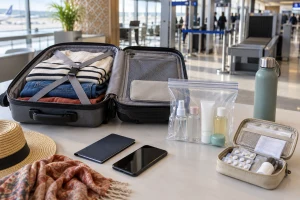
Divide essential medication between your cabin baggage and a reserve when this is permitted. Do not put everything in checked baggage. Maintain the cold chain with a device approved by the pharmacist and check air security rules.
Never buy medication on the street. If necessary, go to an identifiable pharmacy and describe any allergies, current treatments and symptoms. A pharmacist is not a substitute for a doctor when a consultation is necessary.
Prepare a simple and useful first-aid kit
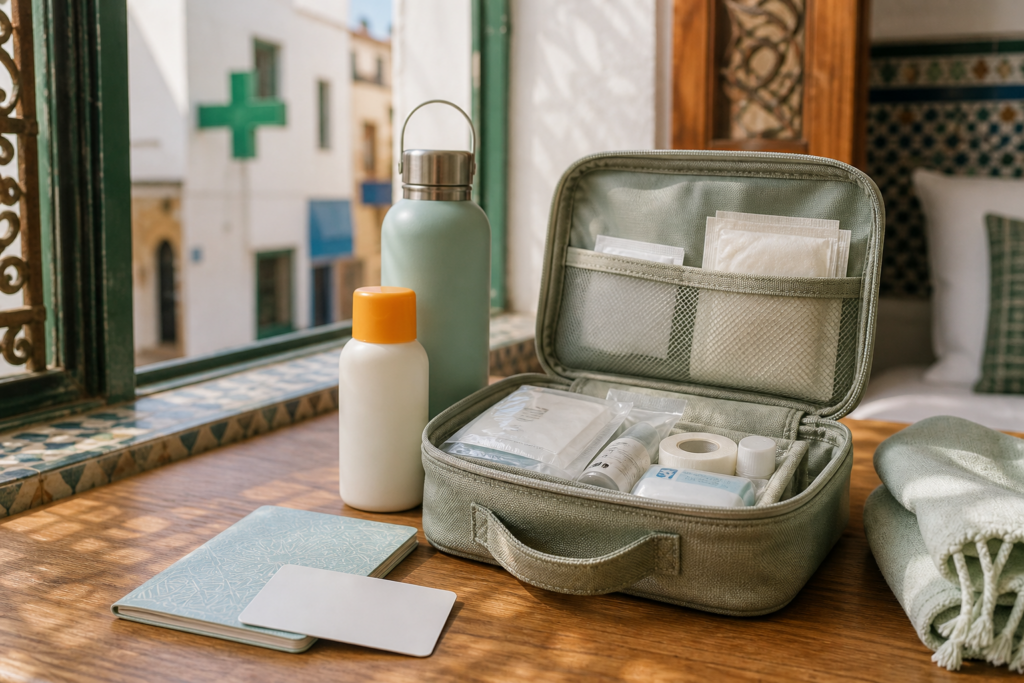
A kit may contain the supplies usually recommended by your healthcare professional: dressings, antiseptic, a thermometer, sun protection, alcohol-based hand sanitiser and personal medication. Adapt it to your activities rather than bringing an improvised pharmacy.
Check expiry dates and storage conditions. The heat inside a closed vehicle can damage certain products. Keep the information leaflets and avoid transferring tablets into unlabelled containers.
For a child, doses depend on weight and age. Ask the doctor or pharmacist for written instructions instead of adapting an adult dose.
Water, food and digestive health precautions
Official advice recommends regular hand hygiene, thoroughly cooked food and safe water. A bottle must be properly sealed. In situations where quality is uncertain, avoid ice cubes, poorly washed raw vegetables and products left at room temperature for a long time.
These precautions do not prevent you from discovering Moroccan cuisine. Choose busy establishments, observe food turnover and begin gradually if your body is sensitive.
In the event of diarrhoea, hydration is important, but certain signs require medical advice: blood, high fever, severe pain, dehydration, prolonged symptoms or a vulnerable person. Do not take leftover antibiotics without a prescription.
Heat, sun, cold and altitude
The climate varies between the coast, desert, inland cities and mountains. In Marrakech or the South in summer, plan visits during the cooler hours, drink regularly and protect your skin and head. Thirst is not always a sufficiently early warning sign.
In the Atlas Mountains, temperatures can drop quickly, even after a hot day. A hike requires suitable clothing, water, a means of navigation and information about local conditions.
Headaches, confusion, feeling unwell or stopping sweating may indicate a heat-related emergency. Move the person to shelter and contact the emergency services.
Animals and the risk of rabies
Avoid touching or feeding dogs, cats and monkeys, even when they seem accustomed to tourists. A bite, scratch or saliva on broken skin requires immediate, prolonged washing with soap and water, followed by urgent medical advice.
Preventive rabies vaccination may be recommended for certain trips, but it does not remove the need for care after exposure. In an isolated area, anticipate how long it will take to reach a medical facility.
Explain this rule to children before the visit. Taking photographs from a distance is preferable to contact with an animal used as an attraction.
Pharmacy, doctor or emergency: choose the right level of care
A pharmacy can help with a simple need and refer you for a consultation. For a serious symptom, injury, allergic reaction or worsening condition, contact a doctor or the assistance service. In the event of immediate danger, call the emergency services.
The Moroccan Ministry of Health notably lists 15 for the SAMU and fire brigade, 19 for the police and 177 for the gendarmerie. Local lists of hospitals and doctors should be checked for each city, as numbers and services may change.
Give the precise location, a landmark, the callback number and the nature of the emergency. If possible, send someone to guide the emergency services to the entrance of the medina or accommodation.
What to do in the event of hospitalisation
Contact the assistance service as soon as the situation allows. Some establishments may ask for a guarantee or payment of the costs. The embassy does not pay medical expenses on behalf of the traveller.
Ask for medical reports, prescriptions, itemised invoices and proof of payment. These documents are necessary for the insurer and useful to the doctor who will provide follow-up care.
Do not sign a document you do not understand without asking for an explanation. A trusted person, the assistance service or the consulate can help identify contacts, without taking the place of the medical team.
Mental health, fatigue and pace of travel
Changes in temperature, noise, travel and disruption to routines can be tiring. Plan breaks, especially with children, an older person or a chronic illness. A less packed schedule leaves some flexibility in the event of mild symptoms.
Keep sleep and meals as regular as possible. For medication taken at a fixed time, ask the prescriber how to manage the time difference, even if modest, or long days of travel.
An acute psychological difficulty deserves the same attention as a physical problem. Contact the insurer to identify appropriate care and stay with the person if their safety is at risk.
To adapt these precautions to a child’s pace and needs, also see https://www.lemarocouvresesportes.com/en/morocco-with-kids-transport-accommodation/
Pre-departure health checklist
- Personalised consultation if your health or itinerary warrants it.
- Routine vaccinations checked and additional recommendations discussed.
- Insurance covering medical care, hospitalisation, activities and repatriation.
- Medication in its original packaging with a prescription using INNs.
- Assistance and emergency numbers accessible offline.
- Suitable kit, without excessive self-medication.
- An initial medical facility identified for each major stage.
- Someone close to you informed of the itinerary and insurance details.
Official sources consulted
- France Diplomatie, health in Morocco, updated 7 August 2026: https://www.diplomatie.gouv.fr/fr/information-par-pays/maroc/conseils-aux-voyageurs-sante
- Moroccan Ministry of Health, emergencies and useful numbers: https://www.sante.gov.ma/urgences/Pages/default.aspx
- Institut Pasteur, recommendations for travel to Morocco: https://www.pasteur.fr/fr/centre-medical/preparer-son-voyage/maroc
- France Diplomatie, useful contacts in Morocco: https://www.diplomatie.gouv.fr/fr/information-par-pays/maroc/conseils-aux-voyageurs-contacts-utiles
- France Diplomatie, safety in Morocco, updated 7 August 2026: https://www.diplomatie.gouv.fr/fr/information-par-pays/maroc/conseils-aux-voyageurs-securite