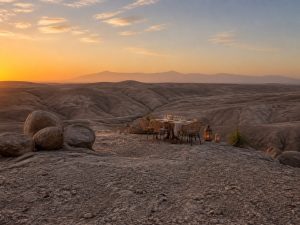
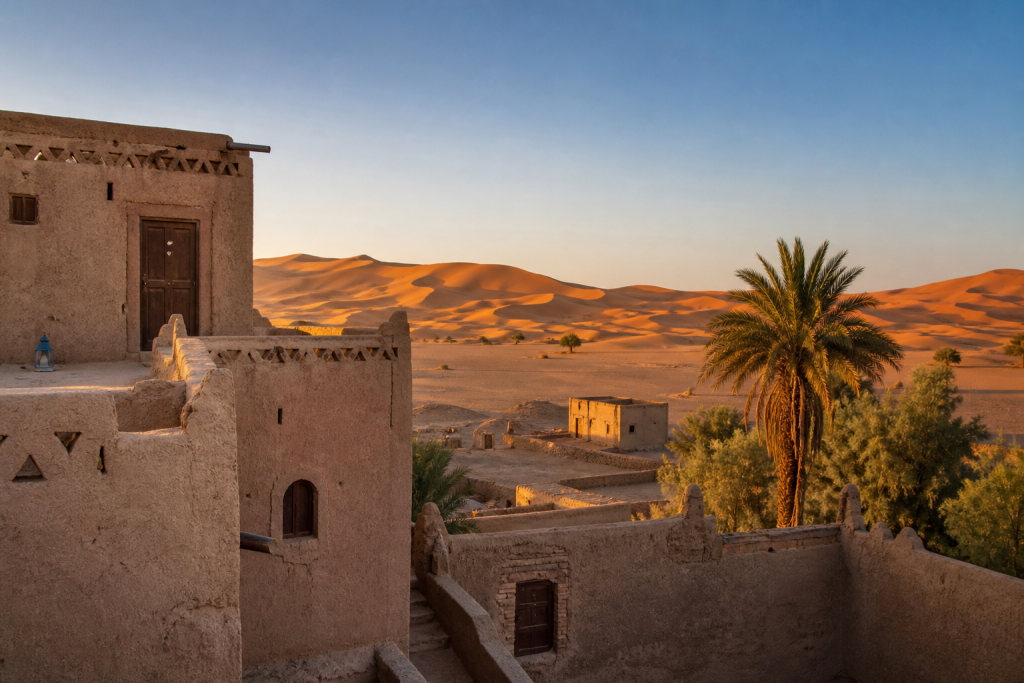
“Desert accommodation” can mean a village room, a lodge at the dune edge or a camp reached through a separate transfer. The decision should begin with location and logistics, not a sunset photograph.
MOP ranks no camp and copies no Expedia price or availability. This guide keeps commerce separate from transport, safety and comfort criteria.
Merzouga and Hassilabied: a fixed base near the dunes
A village base simplifies luggage, meals, electricity and departures. It can suit families or travellers who prefer returning to a room after an outing.
Check the real distance to sand, road condition, heating or cooling and evening meals. An “erg view” guarantees neither direct access nor quiet.
Desert camp: identify the exact place
Camps stand at different distances from roads. Request coordinates, transfer mode, duration, departure point and luggage limit. Confirm private or shared bathrooms, bedding, water, electricity and heating.
“Luxury” is not a standard. A decorated tent proves neither insulation, emergency procedure nor responsible waste management.
Transfer by 4×4, foot or animal
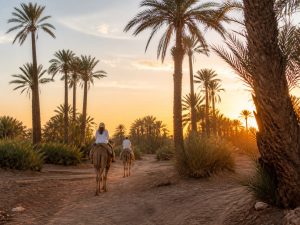
Obtain the time, operator and vehicle. For any animal activity, observe condition, refuse overloading or mistreatment and request an alternative when needed.
A night arrival increases confusion. Meet in daylight and keep a working contact. Do not follow an unidentified intermediary.
Heat, cold, wind and rain
Desert days can be hot and nights cold. Wind reduces visibility; heavy rain may affect tracks and dry riverbeds. Ask about recent conditions and accept cancellation of an unsafe outing.
Carry water, sun protection, a warm layer and personal medication. A remote camp should explain communication and evacuation arrangements.
Meals, water and facilities
Confirm included meals, drinking water and dietary needs. Ask how wastewater, rubbish and energy are managed. Responsible operations do not leave waste behind dunes.
Families should check lighting, paths, fire safety and bathroom distance. Children remain under direct supervision.
Erfoud, Rissani and long road stages
Morocco’s National Tourist Office places Merzouga within a broad territory linking Midelt, Errachidia and the Tafilalet. These are not neighbouring districts. Calculate driving, stops and daylight arrival.
A late coach or flight requires a confirmed transfer. Avoid combining a long road, camp transfer and sunset activity without margin.
Compare on Expedia with the right questions
First establish whether the offer is a fixed property or camp and where its transfer begins. Read cancellation, meals, bathrooms, luggage and access; obtain inclusions in writing.
Before booking ask: what coordinates, what transfer, what night equipment, what happens in bad weather and how does the next-day return work?
One or two nights and a fallback
One night concentrates the road, transfer, activity and departure. Two nights can reduce pressure and allow an unsafe outing to be cancelled, but only when meals, water and cancellation terms remain explicit.
Keep a village contact or fixed base able to organise a return. Share the route and expected time with another person. Isolation belongs to the landscape; it must not remove the traceability of the stay.
Families, health and accessibility
Families need protected fire areas, lighting, secure paths and close bathrooms. Ask whether a child-sized bed means a real bed or an improvised mattress. Travellers with respiratory, mobility or other medical constraints should describe them before accepting a sand transfer.
Keep medication in the personal bag, not luggage sent separately. A camp must be honest when it cannot meet an access need. Choose a fixed lodge when a reliable vehicle approach, electricity or bathroom is essential.
Continue with the Desert destination guide and MOP’s Merzouga and Erg Chebbi guide.
Sources consulted
- Moroccan National Tourist Office, Errachidia–Midelt–Merzouga: https://www.visitmorocco.com/en/travel/errachidia-midelt-merzouga
- Moroccan National Tourist Office, Merzouga nature: https://www.visitmorocco.com/en/travel/errachidia-midelt-merzouga/nature