Crown Prince Moulay El Hassan launched operations at the first container terminal of the Nador West Med industrial-port complex on October 31, 2026. The facility is located in Iaâzzanène, in Nador province. The ceremony represented the start of an initial operational component, rather than the completion of every terminal, industrial platform, transport connection and energy installation planned across the wider development.
MSC Group President Diego Aponte attended the launch alongside other executives from MSC and Terminal Investment Limited. He described Nador West Med as a major project that would strengthen Morocco’s position as a maritime hub and called the start of operations an important milestone for his group, according to Yabiladi’s report based on material from Morocco’s MAP news agency.
A project designed to complement Tanger Med
In a statement dated October 28, 2026, the Royal Office said Nador West Med complements Tanger Med and reinforces Morocco’s logistics, industrial and energy positioning. Aponte’s assessment of the port’s maritime role therefore sits within a broader framework that connects container activity with the complex’s planned industrial, logistics and energy components, rather than treating the newly opened terminal as a standalone development.
According to the Royal Office, Nador West Med has mobilized 54 billion dirhams in public and private investment across its port, industrial, logistics and energy components. That overall figure should not be confused with spending on the eastern terminal alone. It reflects the scale of the wider project, while the October 31 event specifically concerned the first operational phase of one container terminal.
An operating structure linking Marsa Maroc and MSC
The eastern terminal is operated under a 25-year concession by West Med Container Terminal. Marsa Maroc controls the company through a holding of 50% plus one share, while Terminal Investment Limited, which belongs to the MSC group, holds 50% minus one share. The structure consequently gives Marsa Maroc control while directly involving the terminal operator associated with MSC in the facility’s development and operation.
The terminal represents an investment of approximately 5 billion dirhams, or about 480 million euros, and is being developed in phases. This phased approach means that the operational launch should not be read as confirmation that the entire final configuration is already complete. Available corporate material also reflected an evolving commissioning timetable before the first phase was formally launched at the end of October 2026.
Infrastructure planned for large container vessels
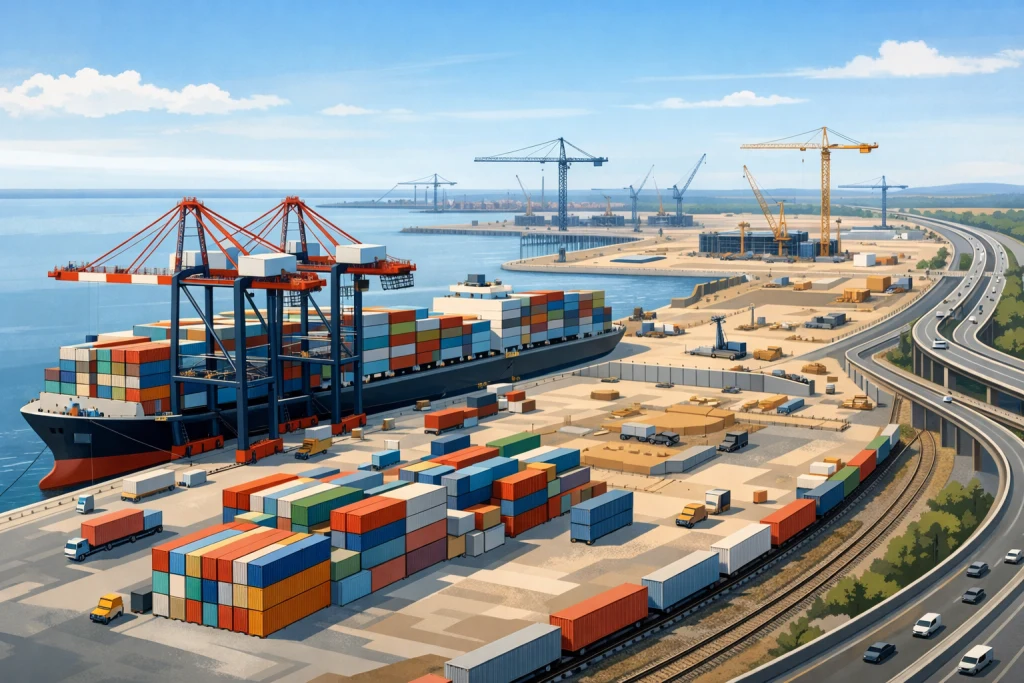
In its planned full configuration, the eastern terminal is to include 1,520 metres of quay, an 18-metre draught and 70 hectares of container yards. It is designed to receive container ships carrying up to 24,000 twenty-foot equivalent units. These specifications indicate the intended technical scale of the facility, although the terminal’s development and expansion are proceeding through successive phases.
The Royal Office gives the terminal’s eventual annual capacity as 3.5 million containers. Official and corporate documents have, however, rounded the ultimate capacity to either 3.4 million or 3.5 million TEUs. The 3.5 million figure should therefore be understood as the capacity stated by the Royal Office, rather than as an independently precise measurement that has been expressed identically across every available source.
A second terminal planned for April 2027
The next announced stage is the entry into service of a second, western container terminal in April 2027, with planned annual capacity of 1.8 million TEUs. Assigned to the Marsa Maroc–CMA CGM partnership, the facility is expected to have 900 metres of quay and 38 hectares of yards. Its associated investment has been estimated at approximately 3 billion dirhams.
Together, the first and second container terminals are expected to mobilize 8 billion dirhams in private investment, according to the Royal Office. The April 2027 date, stated capacity and planned configuration of the western facility nevertheless remain forward-looking elements. They describe the next phase as currently scheduled and should be distinguished from the operations that actually began at the eastern terminal on October 31, 2026.
Land connections, energy plans and local benefits
Planned land connections include a 49-kilometre railway link between Selouane and Nador West Med and a 105-kilometre motorway connection from Guercif. The energy plan also includes a hydrocarbon terminal backed by storage potential of 4 million cubic metres and a liquefied natural gas terminal capable of processing up to 5 billion cubic metres annually. These elements extend beyond container handling alone.
The transport and energy facilities remain announced components and should not all be treated as completed at the time of the first terminal’s launch. King Mohammed VI called for the projects’ economic and social benefits to reach the surrounding provinces and for training programmes aligned with emerging activities to support youth employment. The practical delivery of these connections, facilities and local benefits therefore remains subject to future confirmation.