
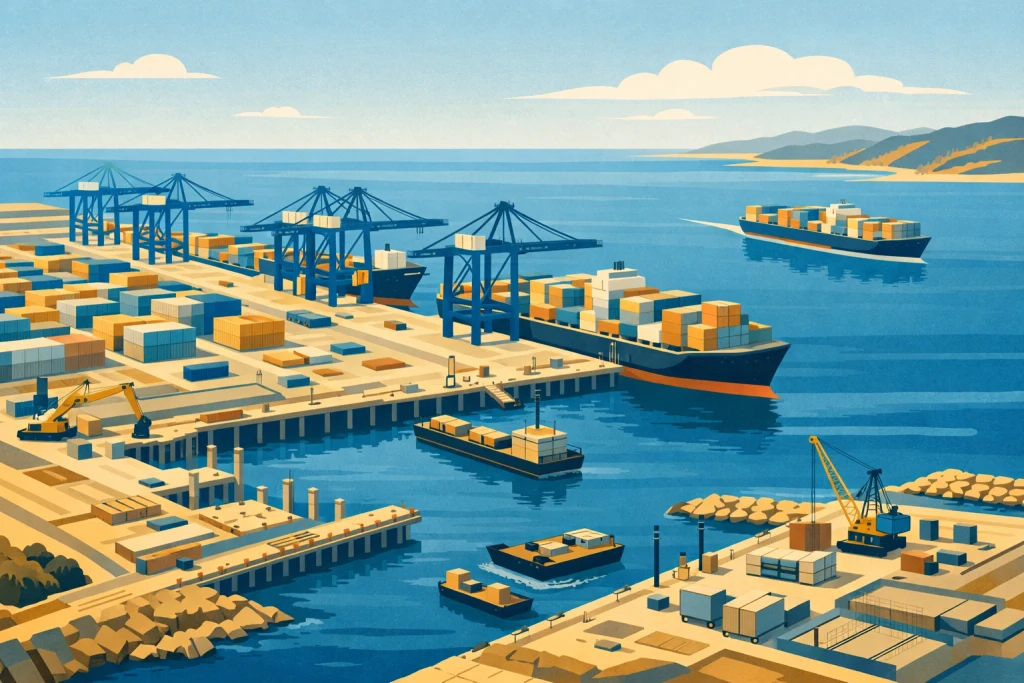
Morocco announced the imminent launch of construction of Tanger Med 3 on October 28, 2026, following a working session chaired by King Mohammed VI in Rabat. The new port is to be built west of Tanger Med 2. The announcement therefore establishes the project’s general location and indicates that construction is approaching, but it does not provide a precise date on which physical work is scheduled to begin.
Tanger Med 3 is presented as a new component of the port complex, not as capacity that is already available. Its announced scope includes 1,200 metres of quay and an additional annual container-handling capacity of 4.5 million twenty-foot equivalent units, or TEU. These figures describe the project’s planned scale. They do not represent containers currently being handled or traffic that is guaranteed once the terminal opens.
Public port funding and a separate private concession
The publicly funded component for developing the new port is valued at 8 billion Moroccan dirhams. That amount should remain separate from investments that may fall under the private concession because the verified information does not provide a breakdown allowing the figures to be combined. It indicates the scale of the publicly financed port works, but it is not, by itself, a comprehensive estimate of every expense associated with the future terminal and its operation.
A concession agreement has been signed with Maersk-owned APM Terminals for the development and operation of the new container terminal. The announced structure therefore combines publicly funded port development with a private operator responsible for the concession terminal. The verified details identify the concessionaire and its broad role, but they do not specify the operating arrangements, stages of private investment or commercial conditions that will apply after the terminal enters service.
Commissioning expected in mid-2031
The Tanger Med 3 container terminal is expected to enter service in mid-2031. That timetable comes from the director general of Tanger Med Port Authority and was also reported by Le Matin, whereas the Royal Office statement only describes the start of construction as imminent. The distinction is important: mid-2031 is the communicated commissioning horizon for the terminal, not a precise date for the beginning of construction work.
Until that expected commissioning, the announcement documents no immediate operational change for shippers, passengers or nearby residents. The additional capacity of 4.5 million TEU remains prospective and depends on the port being built and the terminal becoming operational. Practical effects will therefore need to be assessed as construction milestones, operating arrangements and more detailed commissioning information are released during the period leading up to the planned opening.
Part of a broader expansion programme
The Tanger Med 3 development accompanies an ongoing expansion of the passenger and roll-on/roll-off port. It is also intended to enable an eastern extension of Tanger Med 2. The project is therefore not limited to the new terminal’s 1,200 metres of quay. It forms part of a wider reconfiguration of the complex in which several components contribute to the announced evolution of its overall capacity.
Taken together, the wider expansion programme could raise the Tanger Med complex’s total annual capacity to about 20 million containers. This is a projected capacity that depends on multiple projects, not the port’s current throughput. Nor should it be interpreted as a guarantee that 20 million containers will actually be handled every year after the different developments have been completed and placed into service.
Current traffic is different from future capacity
The available baseline is the traffic recorded in 2025. Tanger Med’s four container terminals handled 11,106,164 TEU that year, an increase of 8.4% from 2024. That figure measures containers actually handled, unlike the additional 4.5 million TEU of capacity planned for Tanger Med 3 and the potential total capacity of about 20 million containers associated with the broader expansion programme.
Tanger Med attributed part of its container-volume growth in 2025 to the commissioning of the latest TC4 extension, which is operated by APM Terminals. This provides context for the operator’s existing role within the complex. It does not establish that Tanger Med 3 will immediately produce the same traffic development, because the new terminal still has to be constructed and is not expected to open until several years later.
Reuters described Tanger Med as the largest port in Africa and the Mediterranean by container-handling capacity. That leadership should be tied specifically to this metric rather than extended to every category of port activity. The complex is also a major transshipment hub and a gateway for Morocco’s automotive exports, placing the announced expansion within its existing logistics functions without establishing what future traffic volumes will ultimately be.
Long-term ambitions remain conditional
The port programme is intended to mobilise public and private capital, support territorial development and create employment opportunities. The Royal Office also called for training programmes aligned with the activities expected to emerge. These points describe the economic and social aims attached to the expansion, but the verified information does not yet state how many jobs may be created, when recruitment could begin or what the proposed training programmes will contain.
Over the longer term, the reported objective is to reach capacity of 20 million TEU and enter the global top ten by 2036. This remains a target, not a ranking that Tanger Med has already achieved. Important future confirmations will include a dated start for construction, progress on the works, detailed operating arrangements and whether the announced mid-2031 commissioning horizon for the new terminal is maintained.