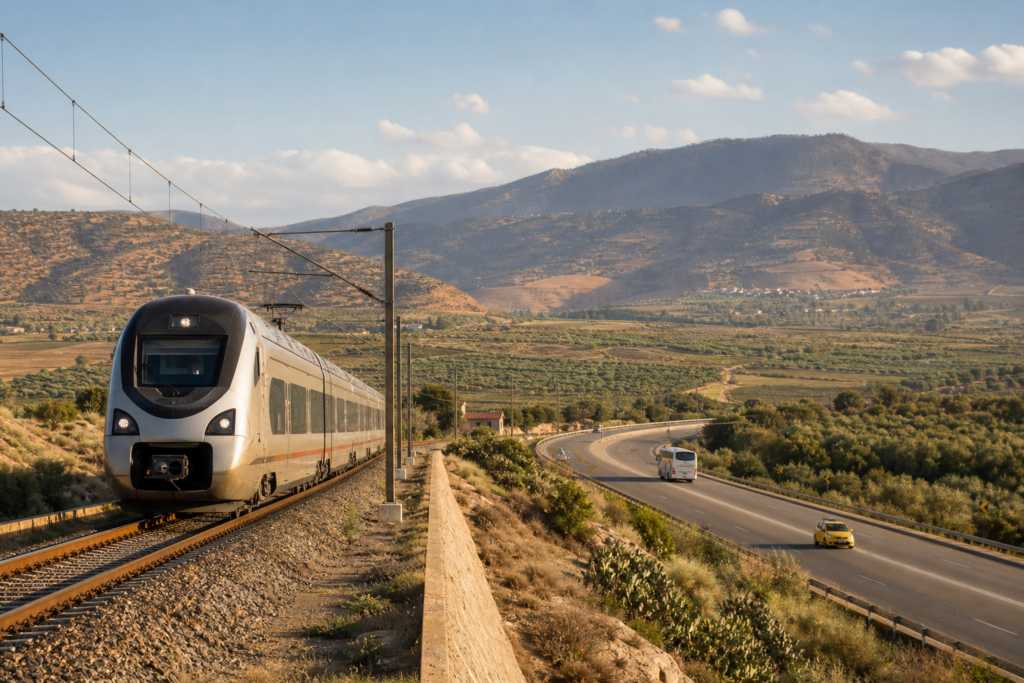
Morocco is rarely explored using a single mode of transport. Trains are efficient on the main routes they serve, coaches connect many cities, taxis cover the final kilometres and cars provide access to less frequently served routes. The right choice depends more on the journey than on any overall ranking.
This guide offers a decision-making method rather than a fixed timetable or fare. Frequencies, prices, roadworks and traffic conditions change; they must be confirmed directly with the operator before each journey.
Start by mapping out the stages of the trip
List the cities in order, then note the distance, desired arrival time, amount of luggage and available flexibility for each connection. A Marrakech–Rabat–Tangier itinerary is well suited to rail travel, whereas a circuit through mountain villages requires other solutions.
Avoid stringing together several long stages simply because they appear close on a map. Terrain, urban crossings, breaks and road conditions can lengthen the journey. A late arrival also increases the cost of the final taxi and reduces the number of fallback options.
Book the critical segments first: a connection with a flight, departure on a public holiday or a route with a limited timetable. Short urban journeys can remain flexible.
Trains for the main routes served
ONCF operates Al Boraq on the Tangier–Kenitra–Rabat–Casablanca route and Al Atlas or regional trains on other routes, particularly to Marrakech, Fez, Meknes, Oujda and El Jadida. The network does not cover every tourist destination, but it is often the most straightforward choice between major cities.
The electronic ticket can be shown on a phone. For Al Boraq and Al Atlas, online seat selection is available subject to the conditions specified by ONCF. Fares vary according to the train, class, flexibility and sometimes how far in advance you book.
Check oncf-voyages.ma for the actual timetable. An old screenshot or a table published in an article does not account for engineering works, periods of high demand and service adjustments.
Managing a train connection effectively
A connection that is short in theory can become stressful with children, large bags or an unfamiliar station. Allow some extra time, especially if the second ticket is linked to a non-changeable booking or a flight.
Check the exact name of the station. Casablanca notably has Casa Voyageurs and Casa Port, which do not serve the same purpose. In Rabat, Agdal and Ville are not interchangeable for every journey. The ticket and app provide the correct reference.
During peak periods, arriving a little early makes it easier to find your way. Keep the ticket available offline and monitor the screens, as the platform may be announced shortly before departure.
Coaches to extend coverage
The coach network connects a large number of cities not served by train. Comfort levels and practices differ between companies. For a long-distance journey, favour an identifiable operator, a vehicle assigned to a scheduled route and a ticket issued through an official channel.
Ask whether luggage in the hold requires a receipt or surcharge. Keep documents, medication, devices and valuables with you. A label with a reachable telephone number helps if two suitcases look alike.
For a night departure, check the address of the bus station and how you will get there. The lowest price does not necessarily compensate for waiting in an isolated location or arriving in the middle of the night.
Petit taxis and grand taxis do not serve the same purpose
A petit taxi generally operates within a city, and its colour varies by location. A grand taxi serves longer routes, outlying areas or intercity connections. Practical rules and fares may differ by city.
Use an official taxi rank whenever possible. For a petit taxi equipped with a meter, calmly ask for it to be switched on. For a negotiated fare or a journey by grand taxi, agree on the price, whether the ride is private or shared and the exact destination before leaving.
Accommodation providers can arrange a transfer, which is often more expensive but useful for a late arrival or when travelling with bulky equipment. Ask for the total price in writing, not just the driver’s name.
Rental cars offer freedom, with constraints
A car becomes worthwhile for a rural itinerary, several stops in one day or remote accommodation. It is less useful in the heart of medinas, where access, parking and navigation can be difficult.
Read the contract: deposit amount, excess, exclusions, fuel policy, mileage, additional driver and procedure in the event of an accident. Photograph the vehicle at pick-up and return, including the tyres, windows and fuel level.
Foreign drivers can use a valid national driving licence during a temporary stay within the applicable limits; an international driving permit can make communication easier. Our dedicated guide https://www.lemarocouvresesportes.com/en/driving-morocco-licence-tolls-fuel-safety/ details the road-related checks.
Driving at night requires real caution
National roads are often well maintained, but they can be narrow and used by pedestrians, two-wheelers, animals, slow vehicles and drivers making unpredictable overtaking manoeuvres. Reduced visibility at night shortens reaction time.
Avoid planning a long stage after a flight or a day of sightseeing. Fatigue, darkness and unfamiliarity with the road combine. Spending a night near the arrival point may be safer than saving on accommodation.
On motorways, check ADM Trafic for conditions and fares. Off the motorway, do not treat an app’s estimate as a guaranteed arrival time.
With children or a lot of luggage
The train offers space and avoids the need to drive, but platforms and connections require organisation. A pre-booked transfer can simplify the first or last kilometre. When renting a car, request a compliant child seat before confirming the booking and check it when the vehicle is handed over.
Reduce the number of changes. A family may prefer a slightly longer direct journey to two tight connections. Keep water, snacks, sun protection and suitable clothing accessible, and do not place essential medication in the luggage hold.
To plan the overall pace, also see https://www.lemarocouvresesportes.com/en/morocco-with-kids-transport-accommodation/
For a person with reduced mobility
High-speed railway stations were designed with accessibility facilities, and ONCF states that it offers assistance. However, accessibility varies between stations, trains, pavements, vehicles and accommodation.
Contact the operator before departure and describe the wheelchair, transfer needs and level of independence precisely. Ask for confirmation regarding the departure station, arrival station and chosen vehicle. A general “accessible” label is not enough.
The guide https://www.lemarocouvresesportes.com/en/accessible-morocco-reduced-mobility/ provides a checklist of questions for the entire stay.
Tickets, apps and fake intermediaries
Use official websites or ticket offices for key journeys. Check the domain before entering card details. A sponsored advertisement or familiar logo does not guarantee that the seller is the operator.
Keep tickets as PDFs or in your phone’s wallet. Also note the departure address, because “Marrakech station” may refer to the railway station while a coach departs from another terminal.
If a ticket is sold by an intermediary, identify who operates the service and who handles exchanges or refunds. The answer must be clear before payment.
A five-question method for choosing
- Is the destination served directly by train?
- Does the timetable allow for a daytime arrival and a comfortable connection?
- How much do the ticket, terminal–accommodation transfer and luggage cost?
- Will the car actually be used or left in a car park?
- Is there a fallback option in the event of a delay or cancellation?
For a rail route, the train often comes out on top. For a destination without rail service, compare a scheduled coach with a transfer. For a multi-stop circuit, a car may become the rational choice. In a medina, walking and occasionally using a petit taxi often avoids the constraints of parking.
Official sources consulted
- ONCF, passenger section and electronic ticket: https://www.oncf.ma/fr/Voyageurs
- ONCF, timetables and booking: https://www.oncf-voyages.ma/
- ONCF, Al Boraq and stations served: https://www.oncf.ma/fr/Al-boraq
- ONCF, engineering works and traffic information: https://www.oncf.ma/fr/Voyageurs/Nouveautes/Info-travaux
- Autoroutes du Maroc, traffic, fares and assistance: https://www.adm.co.ma/fr
- France Diplomatie, useful information and transport in Morocco, updated 7 August 2026: https://www.diplomatie.gouv.fr/fr/information-par-pays/maroc/conseils-aux-voyageurs-informations-utiles