Travelling in Morocco with a wheelchair, a cane, significant fatigue or a temporary mobility issue is possible, but accessibility varies considerably from one place to another. A recently built station may be accessible, while the next pavement has a high kerb; a hotel may have an accessible room behind three steps.
The word “accessible” is therefore not enough. Preparation involves translating a personal need into measurable questions, obtaining confirmations and planning a fallback solution. This guide does not rank establishments; it provides a verification method.
Describe needs without relying on a label
Two people with reduced mobility do not have the same constraints. Note the minimum door width, turning radius, transfer options, bed height, shower access, possible walking duration and need for assistance.
Specify the type of wheelchair, its weight, dimensions and how it folds. For an electric wheelchair, add the battery type and charger. For a visually impaired or hearing-impaired person, describe the communication aids required.
This information sheet can be sent to accommodation providers and transport operators. A “no problem” response should be followed by measurements, photos or specific procedures.
Build an itinerary with fewer transitions
Each transfer adds a potential risk: platform, step, boot that is too small or absent vehicle. Limit changes of city and choose bases offering several accessible activities nearby.
Allow extra time between the train and the transfer. Assistance may require an appointment in advance. Arriving during the day makes it easier to identify an obstacle and leaves time to find another solution.
Classify the stages into three categories: confirmed, possible with assistance and unverified. Do not fill the itinerary with places in the third category.
Train: confirm the station, platform and assistance
ONCF states that high-speed railway stations were designed to provide access for people with reduced mobility and that it has developed inclusive measures. However, the accessibility of one station does not guarantee that of all stations or every connection.
Contact ONCF before the journey, specifying the train, departure station, arrival station, type of wheelchair and transfer needs. Ask where to report and how long before departure. Keep the confirmation and reference number.
Also check the last mile: the taxi available at the station must accept the wheelchair and be able to reach the accommodation’s actual entrance. The guide https://www.lemarocouvresesportes.com/en/getting-around-morocco-train-bus-taxi-car/ helps you combine modes of transport.
Flying and wheelchair batteries
Contact the airline as soon as you book. Provide the dimensions, weight, battery type, need for a transfer seat and ability to climb steps. Assistance codes must correspond to the actual need and should not be chosen at random.
Photograph the wheelchair before check-in and protect removable parts. Carry the freewheel and handling instructions in a visible pouch. Label parts without displaying more personal data than necessary.
On arrival, report any damage immediately before leaving the designated area. Keep the report, photos and receipts for repairs or emergency rental equipment.
Accessible taxis and transfers
A spacious vehicle is not necessarily accessible. Ask whether the person remains in the wheelchair or transfers to a seat, which ramp or platform is used, the interior height, the tie-down points and the space available for accompanying travellers.
For a folding wheelchair, confirm the boot dimensions and whether the driver will assist. For a heavy wheelchair, a standard vehicle may be unsuitable even if the seller accepts the booking.
Ask for a photo of the actual vehicle planned and written confirmation of the price, times and waiting arrangements. Keep the contact details of a second provider for your arrival.
Accommodation: measure the entire access chain
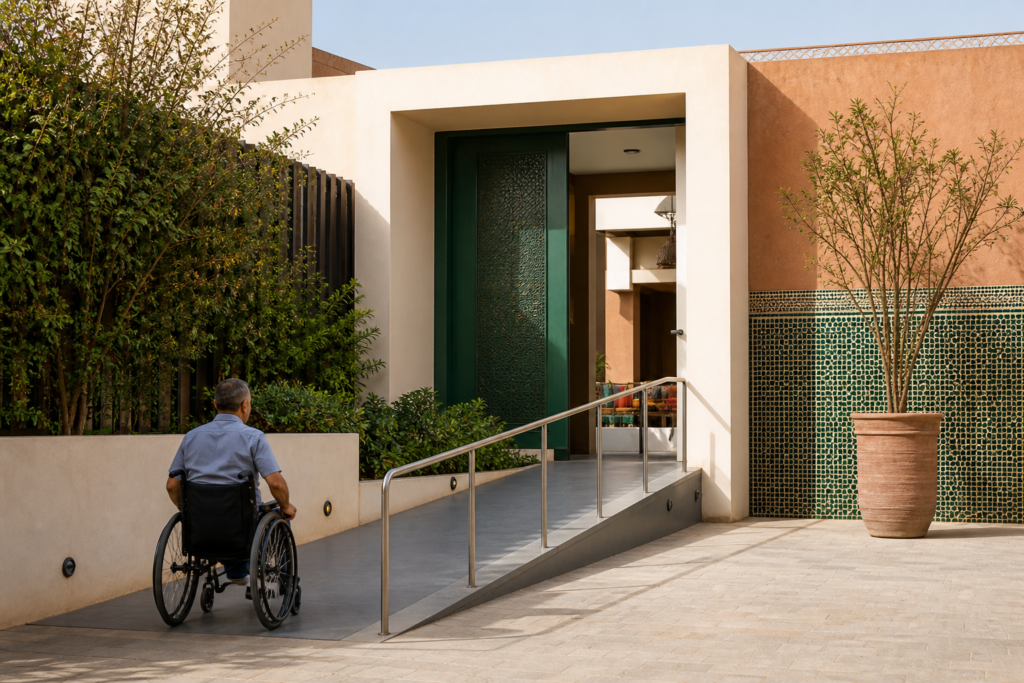
Start at the drop-off point: slope, surface, steps, door width and lift. In a medina, a riad may be far from any vehicle access. A ground-floor room is not accessible if the entrance has impassable steps.
For the room, ask about the door width, circulation space, bed height and whether a patient lift can be positioned if necessary. In the bathroom: step-free shower, grab rails, stable seat, toilet height and lateral space.
Ask for recent photos with a size reference or measuring tape. A wide-angle image can conceal a step and make the space appear artificially larger.
Medinas: prepare for the experience without making false promises
Medinas often have cobblestones, slopes, thresholds, steps, narrow passageways and crowds. This does not make all of them impossible to visit, but the route must be chosen street by street and according to the wheelchair.
A local guide with genuine experience can identify alternative entrances, quiet times and rest stops. Ask what has been tested with a traveller who has comparable needs, not merely whether the guide “can help”.
Accepting improvised carrying puts the person and helpers at risk. Decide in advance which transfers are acceptable and refuse any solution that does not respect safety or dignity.
Museums, monuments and gardens
Contact each site about the entrance, toilets, lift and inaccessible areas. A monument may offer an interesting partial route even if not all rooms are accessible. Ask what will actually be visible.
Modern gardens or large open spaces may be easier, but gravel, slopes and heat matter. Plan for shaded areas, benches and the total distance.
When a visit is impossible, look for an alternative of equal value: an accessible museum, workshop, panoramic terrace or digital interpretation. The aim is not to tick off the same itinerary as everyone else.
Beach, desert and nature
An accessible promenade does not necessarily provide access to the sand or water. Ask whether there is an access mat, amphibious wheelchair, trained staff and accessible toilets. Check the dates and hours when the service is available.
In the desert, sand, transfers and the camp can make the experience complex. Ask about the type of vehicle, the surface between the parking area and the tent, the bed, toilets and evacuation plan. Refuse a vague promise.
For the mountains, choose a suitable route with an experienced provider. The weather and remoteness reduce the available emergency options.
Health, energy and assistive equipment
Check that the insurance covers the medical condition, equipment and repatriation. Identify a healthcare facility at every major stage. The guide https://www.lemarocouvresesportes.com/en/travel-health-morocco-insurance-pharmacies-emergencies/ provides details about insurance and emergencies.
Bring essential spare parts, tools, chargers and prescriptions. For electrical equipment, confirm the voltage accepted by the charger and bring a suitable power bank when authorised by the manufacturer.
Heat increases fatigue and can affect some equipment. Plan breaks, water and an air-conditioned or shaded place.
Travelling with a companion without undermining independence
Before departure, discuss the assistance wanted, actions that are not permitted and rest periods. The companion should not systematically answer on behalf of the person concerned.
Distribute documents and payment methods, but keep decisions with the traveller. Providers must address the traveller directly.
Also plan rest for the companion. Occasional professional assistance can make the stay safer for both people.
Test confirmations before paying
Send the same needs sheet to several providers and compare the precision of their responses. A detailed response that acknowledges a limitation is more reliable than an immediate “everything is accessible”.
Ask about the cancellation terms if the promised equipment is unavailable. Keep written correspondence and names. A few days before arrival, reconfirm the vehicle, room and assistance.
If information changes, adapt the itinerary rather than forcing a dangerous situation. Replacing one stage does not diminish the value of the trip.
Checklist of questions to copy
- How many steps are there between the street, reception and the room?
- What is the minimum width of the doors and lift?
- Is the shower step-free and equipped with a stable seat?
- Does the vehicle have a ramp, tie-downs and sufficient height?
- Has assistance been booked at both stations or terminals?
- Are the accessible toilets open during visiting hours?
- Which route has already been tested for comparable needs?
- What written solution is planned if the equipment is unavailable?
Official sources consulted
- ONCF, access for people with reduced mobility at Al Boraq stations: https://www.oncf.ma/fr/Al-boraq/Services/Services-en-gare
- ONCF, measures and discount card for people with disabilities, 2 December 2025: https://www.oncf.ma/fr/Actualites/Des-reductions-inedites-au-profit-des-personnes-en-situation-de-handicap
- ONCF, passenger information and customer relations centre: https://www.oncf.ma/fr/Voyageurs
- Moroccan National Tourist Office, practical guide: https://www.visitmorocco.com/fr/
- France Diplomatie, health in Morocco: https://www.diplomatie.gouv.fr/fr/information-par-pays/maroc/conseils-aux-voyageurs-sante