Morocco will co-host the 2030 World Cup with Spain and Portugal. Preparations are accelerating work on stadiums, transport, airports, accommodation and urban development. However, a spectacular rendering is not enough to measure progress or usefulness after the tournament.
To track these projects, it is necessary to distinguish renovation, reconstruction, temporary facilities and new stadiums, then link each stadium to its schedule, cost, access and future uses.
A tournament shared by three countries
The tournament will be held on both sides of the Mediterranean. The final allocation of matches, FIFA requirements and the operational schedule determine the extent of each city’s transformation.
A candidate city does not automatically host the same number or type of matches. Announcements must be reviewed when the official schedule changes.
Preparations do not concern only the pitch: training, security, broadcasting, volunteers and fan zones require other facilities.
Nine stadiums already at the heart of AFCON
In February 2025, the government was monitoring the development of nine stadiums intended for AFCON 2025, with announced deadlines between March and August of the same year. This work is a step towards 2030.
A renovation may cover stands, roofing, the pitch, lighting, media facilities, hospitality, access control or security. Saying that a stadium has been “redone” does not specify the scope.
Feedback from previous competitions must assess queues, visibility, transport, accessibility and maintenance, not only the inauguration.
The Grand Stade Hassan II in Benslimane
The new Hassan II stadium is being built in Benslimane province, between Casablanca and Rabat. In February 2025, a government communication announced completion in December 2027.
Its planned very large capacity makes it a project distinct from urban renovations. Construction must be monitored through milestones: earthworks, structure, envelope, equipment, testing and certification.
Access will also be a major issue. A stadium far from city centres requires rail, roads, shuttles, crowd management and a return solution after a late match.
Marrakech, Rabat, Tangier, Fez and Agadir
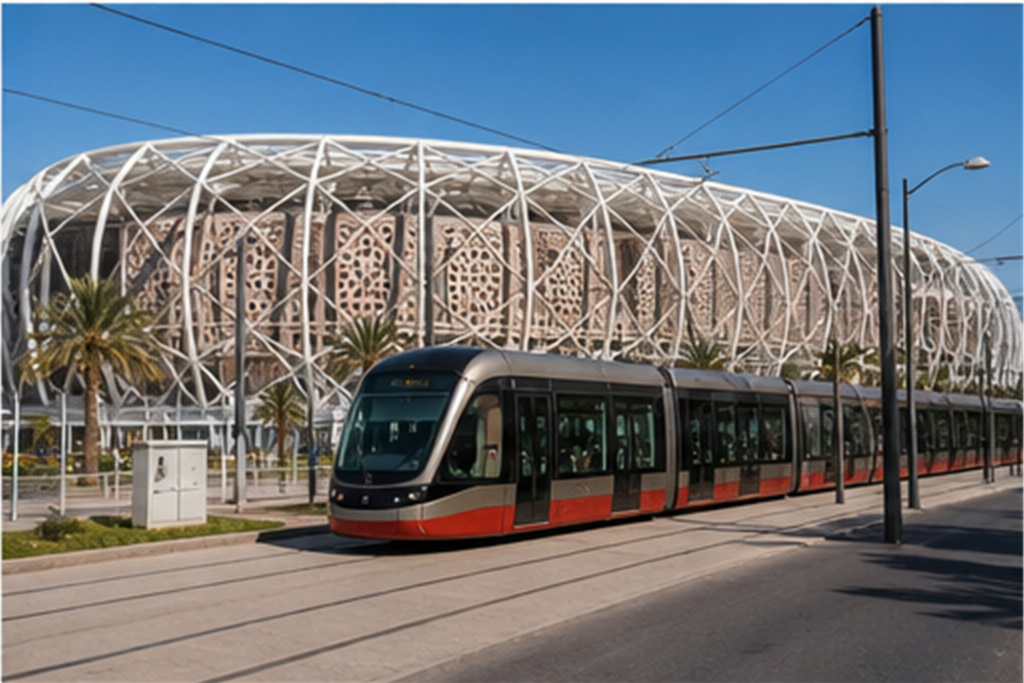
The major host cities have existing stadiums that have been renovated or adapted. Their contexts vary: proximity to the city centre, rail network, tramway, major roads and tourism pressure.
The same specifications therefore produce different projects. In Rabat, urban transport is an asset; elsewhere, shuttles and new connections become more critical.
For each city, the useful figures are permanent capacity, accessible seating, travel time from the railway station and the crowd dispersal plan.
Mobility matters as much as seating
Sixty thousand people cannot all leave by car at the same time. Rail, tram, bus, walking, park-and-ride facilities and real-time information must work together.
The Ministry of Equipment has announced the acceleration of motorway projects, including connections linked to preparations for 2030. Airports are following their own expansion strategy.
Our analysis of Morocco’s airports by 2030 makes it possible to connect international arrivals with mobility in the cities.
Initial cost and the stadium’s lifetime cost
The construction price is only part of the cost. Energy, the pitch, roofing, security, cleaning, staff and technical upgrades continue after the tournament.
An oversized stadium can become difficult to operate. The legacy depends on resident clubs, concerts, events, public spaces and the financial model.
Communications should publish the updated cost, funding sources, schedule and operating plan. Comparing two stadiums by gross cost without specifying the scope is misleading.
Universal accessibility
FIFA standards require provisions for disabled spectators, but the complete chain begins with booking and ends with the return journey. Ticketing, transport, routes, seating, toilets and evacuation must be consistent.
Wheelchair spaces without a nearby companion seat or with restricted visibility are not enough. People who are visually impaired, hard of hearing or have invisible disabilities also have needs.
The Accessible Morocco guide provides a method for verifying information rather than a simple “reduced mobility” label.
Energy efficiency and water
A large stadium consumes water and energy for the pitch, toilets, lighting and cooling. The reuse of treated water, efficient equipment and renewable energy production can reduce the impact.
Performance must be measured during operation, not merely announced at the design stage. The source of the water, consumption per event and system maintenance are concrete indicators.
Our article on water in Morocco places these needs in the context of national water stress.
Neighbourhoods around the stadiums
A stadium transforms land, commerce, traffic and noise. Residents sometimes benefit from new roads and services, but may experience construction work, higher prices or street closures.
Useful consultation sets out schedules, access for local residents, compensation and future uses. Local businesses must be able to participate without being replaced solely by temporary operators.
After 2030, public spaces, local sports facilities and transport will matter more than the façade seen on television.
The Morocco 2030 Foundation
In July 2025, the government adopted the bill creating the Morocco 2030 Foundation, tasked with coordinating and monitoring projects for major competitions.
In July 2026, the sports authorities reiterated the need for continuous preparation with Spain and Portugal. This governance must connect the state, local authorities, the federation and operators.
Coordination does not replace the publication of indicators. The schedule, risks, contracts and operational tests remain necessary for assessment.
Monitoring method through to the tournament
- Identify the stadium and the exact scope of the work.
- Distinguish permanent and temporary capacity.
- Record the initial cost, revisions and future operation.
- Monitor rail, bus, walking and post-match evacuation.
- Verify end-to-end accessibility.
- Measure water and energy during operation.
- Publish tests, certifications and feedback from events.
- Assess use of the neighbourhood after 2030.
Sources consulted
- Maroc.ma, steering committee for the nine stadiums and Hassan II stadium: https://maroc.ma/fr/actualites/le-chef-du-gouvernement-preside-une-reunion-du-comite-de-pilotage-du-suivi-des-projets-de-stades
- Maroc.ma, creation of the Morocco 2030 Foundation: https://www.maroc.ma/fr/actualites/le-conseil-de-gouvernement-adopte-le-projet-de-loi-portant-creation-de-la-fondation-maroc-2030
- Maroc.ma, joint preparations updated on 17 July 2026: https://maroc.ma/fr/actualites/lorganisation-de-la-coupe-du-monde-2030-un-chantier-strategique-dans-le-cadre-de-la-vision
- Maroc.ma, motorway projects for 2030: https://maroc.ma/fr/actualites/le-ministere-de-lequipement-et-de-leau-semploie-accelerer-les-etudes-techniques-des-projets
- FIFA, 2030 World Cup: https://www.fifa.com/