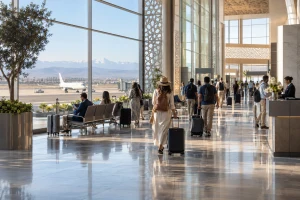
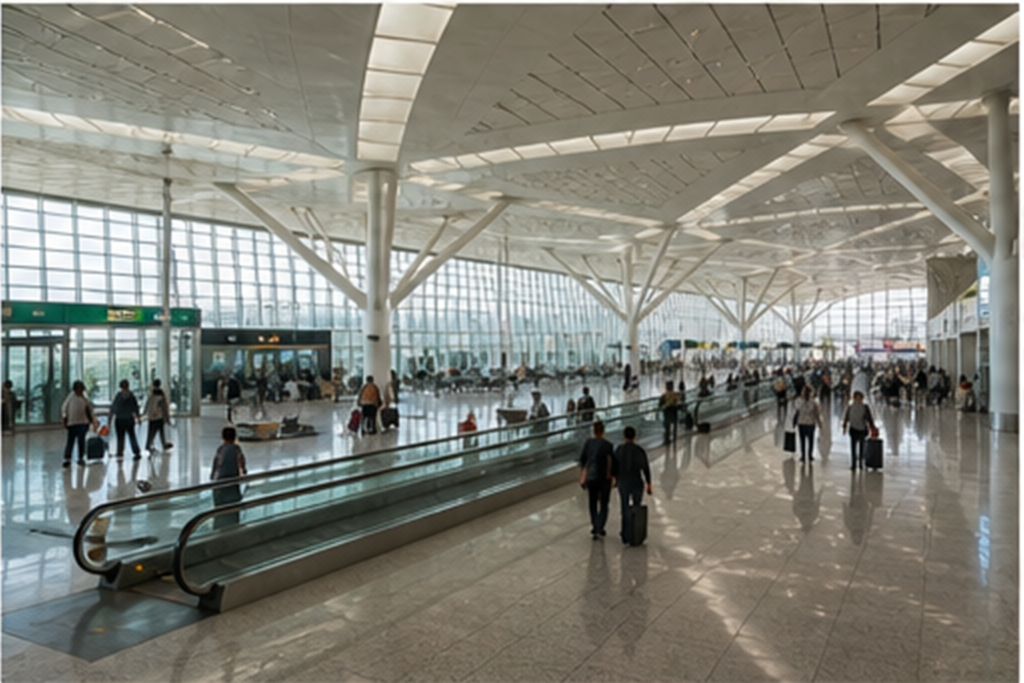
The “Airports 2030” strategy is intended to modernise Morocco’s infrastructure, support traffic growth and prepare for major international events. The announcements cover terminals, air navigation, the passenger experience and the transformation of the National Airports Office.
To understand this undertaking, it is necessary to distinguish between current capacity, target capacity and the traffic actually handled. A terminal that has been announced or is under construction is not yet an available service.
A national target of 80 million
In April 2025, the government announced the objective of increasing the capacity of the Kingdom’s airports from around 30 to 80 million passengers by 2030. This figure combines several airports.
Capacity is not traffic. It describes what the infrastructure should be able to handle under certain conditions. Passenger numbers then depend on airlines, routes, controls and operations.
Comparing the figures therefore requires three columns: design capacity, observed annual traffic and the opening date of the new facilities.
Casablanca Mohammed V as a future hub
In February 2025, ONDA stated that it wanted to increase the capacity of Casablanca Mohammed V from 14 to 35 million passengers by 2029. The airport is intended to support Royal Air Maroc’s intercontinental ambitions.
The project is not limited to expanding a hall. Connections, baggage sorting, aircraft stands, rail or road access, border control and air navigation must evolve together.
A successful hub is also measured by connection times, baggage reliability and information in the event of delays, not only by the terminal’s design.
Marrakech facing strong growth
Marrakech Menara handles significant tourist traffic and seasonal peaks. The projects are intended to increase capacity and streamline arrivals, departures and controls.
During construction, future capacity does not immediately shorten queues. Travellers should allow extra time, check the terminal and follow their airline’s instructions.
Transport between the airport and the city remains one link in the journey. An increase in flights without improvements to buses, taxis and road access would shift the waiting time outside.
Agadir, Tangier, Fez and the host cities
The strategy covers several airports, particularly in cities linked to tourism, industry and the 2030 competitions. The projects do not all have the same schedule or level of maturity.
An expansion may mean a new terminal, redevelopment of an existing terminal, a runway, an aircraft apron or control equipment. Articles must name the element precisely.
For a trip, consult the airport’s ONDA page and the airline. A national announcement does not confirm a schedule, gate or local connection.
A 38 billion dirham investment agreement
In July 2025, the government and ONDA signed a 2025–2030 memorandum of understanding covering 38 billion dirhams of investment. This funding supports the airport transformation and associated infrastructure.
An amount stated in an agreement is not a final bill that has already been paid. Tenders, awarded packages, construction work, revisions and commissioning must be monitored.
Useful transparency brings together cost, schedule, added capacity and quality indicators. Any cost overrun or delay must be compared with what was actually delivered.
Air navigation and safety
ONDA also manages air navigation. Modernising control centres, communications, data and meteorology increases airspace capacity and resilience.
According to an official ONDA statement, Nador Airport received a modernised centre as part of this programme. This type of investment remains invisible to passengers but is essential.
Safety must not be set against efficiency. Automation and new equipment must reduce waiting times while maintaining controls.
Passenger experience and digital technology
The strategy promises an experience closer to international standards: information, passenger journeys, services and digital tools. The outcome must be assessed through accessibility, the quality of announcements, Wi-Fi, complaints and assistance.
A self-service kiosk does not help if it does not accept the traveller’s document or if no human assistance is available. Multiple languages and an easy-to-follow journey remain necessary.
Personal data collected must be protected. Digital transformation comes with cybersecurity and service continuity requirements.
Accessibility and families
A new terminal must make travel easier with wheelchairs, pushchairs, baggage and connections. Lifts, toilets, seating and actual distances must be published.
Request assistance from the airline within the required time frame and confirm the meeting point. The airport and the airline have different roles.
Our guides Accessible Morocco and travelling with children provide the questions to ask before the flight.
Royal Air Maroc and the network
Royal Air Maroc’s programme contract aims for a significant increase in its fleet by 2037. Airports must be able to accommodate more aircraft, connections and maintenance operations.
A target fleet does not mean that all aircraft have been ordered or delivered. Route and frequency announcements remain the responsibility of airlines and change faster than buildings.
The hub’s success will depend on coordination between the fleet, slots, control, staff and baggage handling.
What travellers should check now
Book according to the service operating on the day of the flight, not according to 2030 capacity. Confirm the airport, terminal, check-in deadline, baggage and transport to the city.
Allow more time during construction work and download documents for offline access. For entry into the country, our guide to Morocco entry requirements remains the practical reference.
For a connecting flight, check whether baggage is checked through to the destination and whether border control is required.
Overview through to 2030
- National target capacity: 80 million passengers.
- Casablanca: announced target of 35 million in 2029.
- Investment under the agreement: 38 billion dirhams over 2025–2030.
- Actual traffic: consult ONDA’s annual reports.
- Construction: distinguish between contract award, construction, testing and opening.
- Service: measure queues, baggage, accessibility and information.
- Network: distinguish between infrastructure and flights actually on sale.
- Date: revise each figure following every new official statement.
Sources consulted
- ONDA, launch of the Airports 2030 strategy: https://www.onda.ma/content/download/18086/230128/version/1/fichier/Communique%CC%81%2Bde%2Bpresse%2BStrat%C3%A9gie%2BA%C3%A9roports%2B2030.pdf
- Maroc.ma, national target of 80 million: https://www.maroc.ma/fr/actualites/aeroports-une-capacite-de-80-millions-de-passagers-ciblee-lhorizon-2030
- Maroc.ma, 38 billion dirham government–ONDA agreement: https://www.maroc.ma/fr/actualites/signature-dun-protocole-daccord-entre-le-gouvernement-et-londa-pour-la-periode-2025-2030-dun-montant
- ONDA, modernisation of air navigation: https://www.onda.ma/content/download/18684/234697/version/1/fichier/Communique%CC%81%2Bde%2Bpresse%2BONDA%2BVF.pdf
- National Airports Office: https://www.onda.ma/