Moroccan traditions do not form an unchanging calendar that every family follows in the same way. They take different forms depending on regions, generations, urban or rural settings, linguistic affiliations and family histories. Some relate to religious practice, others to social life, a craft, a territory or contemporary creation.
For visitors, understanding them begins with an essential distinction: a public celebration is not the same as a family occasion, and a performance intended for the public does not provide access to people’s private lives. This guide therefore offers points of reference without claiming to reduce all Moroccans to a single way of welcoming, celebrating or passing on traditions.
Hospitality, between an everyday gesture and a personal relationship
Offering tea, coffee or something to eat can signify a welcome, a break or the pleasure of conversation. Mint tea has become one of Morocco’s most recognisable symbols, but it is not served according to the same ceremony everywhere. The amount of sugar, herbs used, teapot and timing vary according to the household, season and region.
It is better to receive this gesture as a courtesy rather than an attraction. In someone’s home, follow the host’s directions: remove your shoes if asked, wait until everyone has been served, and accept or decline politely. Photographing the preparation or the family requires explicit permission.
Hospitality also does not oblige a family to open its private space. In heavily visited areas, an invitation may be spontaneous, commercial or a mixture of both. The best approach is to remain attentive to the context and not turn an encounter into proof of “authenticity”.
Ramadan: a religious month that transforms the rhythm of daily life
Ramadan is the ninth month of the Muslim calendar. For those who fast, it notably involves refraining from eating and drinking from dawn until sunset. It is also associated with prayer, reflection, sharing and solidarity. Children, people who are ill, travellers or others may not fast depending on their circumstances and practice; it is not for visitors to ask them to justify this.
In Morocco, the opening hours of workplaces, shops, monuments and transport services may change during this period. In the late afternoon, streets often become quieter as the breaking of the fast approaches, before activity resumes in the evening. The experience differs from one city and neighbourhood to another.
Non-Muslim travellers are not required to fast. Discretion is nevertheless appreciated when eating, drinking or smoking in public during the day. Tourist hotels and restaurants may continue to serve food; check their opening hours rather than assuming that they will operate as usual.
The end of the month is marked by Eid al-Fitr, whose date depends on the lunar calendar and the official announcement. Families gather, share meals and visit relatives according to their means and customs. When planning a stay, only dates announced by the Moroccan authorities should be used.
Eid al-Adha: a religious and family celebration
In Muslim tradition, Eid al-Adha commemorates Abraham’s trial. In Morocco, the celebration may involve prayer, ritual sacrifice, sharing meat and family visits. Actual practices vary according to each household’s choices, means and circumstances.
For visitors, the main consideration is practical: many services close or slow down, travel may be busier before the celebration, and some street scenes may be surprising. Do not photograph a person, a sacrifice or a family occasion without permission. Here again, the official date must be checked each year.
Presenting Eid solely from the perspective of sacrifice would overlook its spiritual, social and family dimensions. Conversely, idealising it as a custom practised identically everywhere would erase the diversity of ways in which it is observed.
Weddings: possibly several days, but no single model
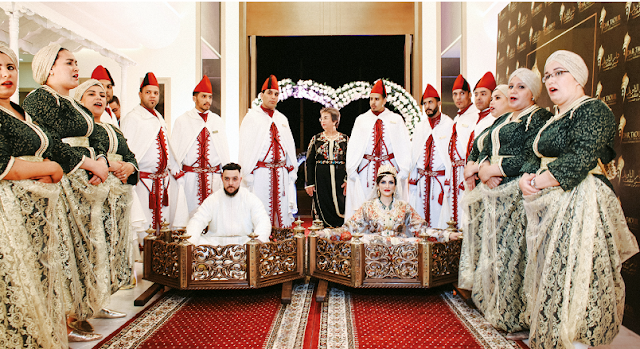
Moroccan weddings may bring together music, ceremonial clothing, meals, henna and ritual sequences, but their format varies considerably. An urban ceremony held in a venue, a village wedding and a modest union celebrated within a family do not necessarily follow the same programme.
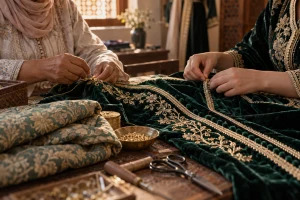
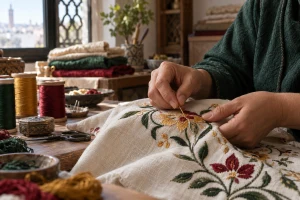
The neggafa traditionally assists the bride with the choice and sequence of outfits and certain parts of the ceremony. The caftan, takchita, jewellery and accessories involve many crafts. Since 2025, the arts, traditions and skills associated with the Moroccan caftan have been inscribed by UNESCO on the Representative List of the Intangible Cultural Heritage of Humanity.
Henna may accompany weddings and other stages of life. In 2024, UNESCO inscribed the rituals and aesthetic and social practices associated with henna in a multinational nomination involving Morocco. This recognition concerns shared practices and knowledge, not a mandatory sequence of events.
Being invited to a wedding is a personal privilege. Visitors should ask how to dress, when to arrive and whether it is appropriate to bring a gift. They should avoid publishing images of the couple, children or guests without their consent, even if other people are taking photographs.
Birth, childhood and mourning: privacy before curiosity
Major stages of life may be accompanied by gatherings, prayers, meals, the choice of a name or gifts. Their forms vary among regions and families. Some traditions are maintained, while others are simplified or reinterpreted. It would be misleading to draw up a list that would become a presumed standard.
Birth and mourning belong first and foremost to the private sphere. Outsiders should wait to be invited and follow the directions given. Condolences should remain restrained; cameras have no place without an explicit request from the family. Respect sometimes means not attending, not asking questions and giving people space.
Moussem: a religious, social, economic or cultural gathering
The word “moussem” refers to periodic gatherings that may be linked to a local saint, an agricultural calendar, trade, an equestrian practice or a community’s identity. Their scale and purpose vary. Some now welcome national and international audiences; others retain a primarily local character.
The Moussem of Tan-Tan, inscribed by UNESCO in 2008, illustrates this diversity. It brings together nomadic peoples of the Sahara for exchanges, competitions, songs, poetry and Hassaniya oral traditions. Its history should not be used to explain all the country’s moussems: each gathering has its own context.
Before attending, check the programme and rules with the official organisers. Some sequences are public, while others are religious or community-based. An accessible event does not mean that every participant agrees to be filmed close up.
Tbourida: collective precision, horses and transmission
Often called “fantasia” in tourism terminology, tbourida is a Moroccan equestrian performance inscribed by UNESCO in 2021. A sorba, or troupe, brings together an odd number of riders and horses under the direction of a leader. The parade includes the hadda, a phase of greeting and positioning, followed by the talqa: the riders gallop and attempt to synchronise a blank-powder shot.
The performance involves far more than the final sound. It draws on the training of riders and horses, harness-making skills, costumes, gestures, collective organisation and transmission within families or territories. Clothing and equipment may represent a region or troupe.
Spectators must remain in the designated areas and follow safety instructions. They must neither cross a barrier to obtain an image nor disturb the horses. For an accurate description of the practice, the term tbourida is preferable; “fantasia” may be mentioned as a familiar name, but it does not convey the full meaning of the name used in Morocco.
Contemporary festivals: tradition does not exclude creativity
Morocco’s cultural calendar also includes festivals of music, cinema, dance, literature and visual arts. Some showcase repertoires such as Gnaoua, malhoun or Amazigh music; others create encounters between Moroccan and international artists.
A festival is not automatically a traditional ritual. It is an organised event with a programme, partners and sometimes a tourism objective. It may nevertheless play a role in the visibility, transmission and evolution of a practice. This distinction avoids artificially contrasting an “authentic” past with a contemporary culture that is supposedly less legitimate.
Dates, locations and admission conditions may change. Check the organiser’s official website or accounts before planning a trip around an event. An old poster or blog article does not confirm the next edition.
Music and oral traditions: listen to the context
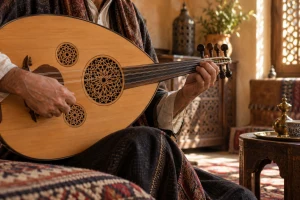
Morocco is home to many musical and poetic repertoires rooted in different languages, cities and histories. Malhoun, sung poetry long associated with craft guilds and cities, was inscribed by UNESCO in 2023. Gnaoua practices, Amazigh ahwach and ahidous, and Hassaniya traditions have followed other paths.
Grouping all these forms of expression under the label “folk music” erases what distinguishes them. At a performance, the programme, the artists’ names and an explanation of the venue provide useful points of entry. Buying a ticket or an official recording contributes more to performers’ work than publishing a complete recording without permission.
How to attend respectfully
Three principles are often enough: ask, observe and accept a refusal. Ask before photographing a person or a private occasion. Observe how participants behave and the spaces reserved for them. Accept that a ceremony may not be intended for visitors.
Modest clothing may be appropriate at a religious site, in a village or at a family celebration. Mosques are generally not accessible to non-Muslims in Morocco, except for sites explicitly open to them, such as the Hassan II Mosque in Casablanca, subject to its visitor rules. Follow the signs and the instructions of staff on site.
Finally, avoiding generalisations improves both respect and the quality of the account. Write “in this family”, “at this moussem” or “in this region” rather than “Moroccans always do this”. This precision leaves traditions with what keeps them alive: their capacity to vary, evolve and belong first and foremost to those who practise them.
Institutional sources
- UNESCO, “Tbourida”, inscription 2021: https://ich.unesco.org/fr/RL/la-tbourida-01483
- UNESCO, “Moussem of Tan-Tan”, inscription 2008: https://ich.unesco.org/fr/RL/le-moussem-de-tan-tan-00168
- UNESCO, elements of Morocco’s intangible cultural heritage: https://ich.unesco.org/fr/etat/maroc-MA
- UNESCO, “The Moroccan caftan: art, traditions and skills”, inscription 2025: https://ich.unesco.org/fr/RL/le-caftan-marocain-art-traditions-et-savoir-faire-02077