Morocco has one of the oldest and richest political histories in the Islamic world. For more than twelve centuries, this kingdom at the crossroads of Africa, Europe and the Arab world has been shaped by several dynasties that have left a profound mark on its identity.
From the first Idrisid rulers in the 8th century to the current Alaouite dynasty, Morocco’s history is a succession of periods marked by conquests, religious reforms, trade and extraordinary cultural development.
Each dynasty helped build what Morocco is today: a country that is both deeply rooted in its traditions and open to the world.
In this article, we invite you on a fascinating journey through 1,200 years of Moroccan history, exploring the great dynasties that shaped the kingdom.
The Idrisids (789–974): the birth of Morocco
Morocco’s political history truly began with the Idrisid dynasty, founded at the end of the 8th century.
Its founder, Idris I, was a descendant of the Prophet Mohammed. After fleeing the political conflicts that were shaking the Middle East, he found refuge in Morocco, where he was welcomed by Amazigh tribes.
In 789, he founded an independent Islamic state in the Volubilis region. This event marked the beginning of the first organised Moroccan kingdom.
His son, Idris II, continued his father’s work and considerably expanded the kingdom. He founded the city of Fez, which quickly became a major religious, cultural and economic centre.
By the 9th century, Fez was already one of the most important cities in the Muslim world. It was also during this period that the famous Al Quaraouiyine University was founded, considered one of the oldest universities in the world still in operation.
The Idrisid dynasty thus laid the foundations of Morocco’s religious and political identity.
The Almoravids (1040–1147): conquerors of the desert
After a period of political fragmentation, a new force emerged in the Sahara: the Almoravids.
This Amazigh religious movement arose among the desert’s nomadic tribes. Their aim was to reform the practice of Islam and unite the Muslim territories of the Maghreb.
The Almoravid leader Youssef Ibn Tachfin became one of the most important figures in Morocco’s history.
In 1070, he founded the city of Marrakech, which became the new capital of the Almoravid Empire. Also read: Morocco, between heritage and landscapes.
Under his rule, the empire extended:
- from Senegal and the Sahara
- across all of Morocco
- to Andalusia in Spain
The Almoravids also played a decisive role in European history by intervening in Spain to support the Muslim kingdoms of Al-Andalus.
In 1086, they won a major victory against the Christian kingdoms at the Battle of Zallaqa.
This victory strengthened their power and made Marrakech one of the most influential capitals in the Muslim world.
The Almohads (1147–1269): the height of medieval Morocco
In the 12th century, the Almohads seized power after overthrowing the Almoravids.
This new dynasty, founded by the religious reformer Ibn Toumert, built one of the most powerful empires in the Islamic world.
At its height, the Almohad Empire extended:
- from Morocco
- to Algeria and Tunisia
- as far as Andalusia
This period is often considered the golden age of medieval Morocco.
The Almohads left an exceptional architectural legacy. Several of Morocco’s iconic monuments date from this period:
- the Koutoubia Mosque in Marrakech
- the Hassan Tower in Rabat
- the Giralda in Seville
Morocco also became a major intellectual centre where philosophy, science and medicine flourished.
The Andalusian philosopher Ibn Rushd (Averroes) is one of the most famous figures of this period.
The Marinids (1269–1465): the age of madrasas
After the decline of the Almohads, the Marinid dynasty established itself in Morocco.
The Marinids chose the city of Fez as their capital and made it a major intellectual centre.
They built numerous madrasas, religious schools intended to train scholars and jurists.
Among the most famous are:
- the Bou Inania Madrasa
- the Attarine Madrasa
- the Sahrij Madrasa
These monuments are still considered masterpieces of Moroccan architecture today.
The Marinid dynasty also helped develop trade relations between Morocco, Europe and sub-Saharan Africa.
The Saadians (1549–1659): wealth and prestige
In the 16th century, a new dynasty came to power: the Saadians.
This period was marked by great economic prosperity thanks to the trade in gold from Africa.
The most famous ruler of this dynasty was Ahmed Al-Mansour, nicknamed Al-Mansour Ad-Dahbi (the Golden).
Under his rule, Marrakech experienced a period of great wealth.
The Saadians are particularly famous for:
- the victory over Portugal at the Battle of the Three Kings in 1578
- the construction of the sumptuous El Badi Palace
- the magnificent Saadian Tombs
The Battle of the Three Kings was a major event that transformed the political balance between Europe and North Africa.
The Alaouite dynasty (1666–present): continuity and modernity
For more than three centuries, Morocco has been ruled by the Alaouite dynasty.
This dynasty was founded in the 17th century and remains one of the oldest reigning dynasties in the world today.
One of its most famous rulers was Moulay Ismail, who transformed the city of Meknes into an imperial capital.
He commissioned:
- the impressive ramparts of Meknes
- the royal palace
- the famous Bab Mansour gate
In the 20th century, Morocco entered a new phase of its history with the French and Spanish protectorate established in 1912.
The country regained its independence in 1956 under the reign of King Mohammed V.
His son Hassan II continued the country’s modernisation, while the current ruler, Mohammed VI, is carrying out major economic and social reforms.
The legacy of the dynasties in Morocco today
The history of Morocco’s dynasties is not confined to history books.
It is visible everywhere:
- in the medinas
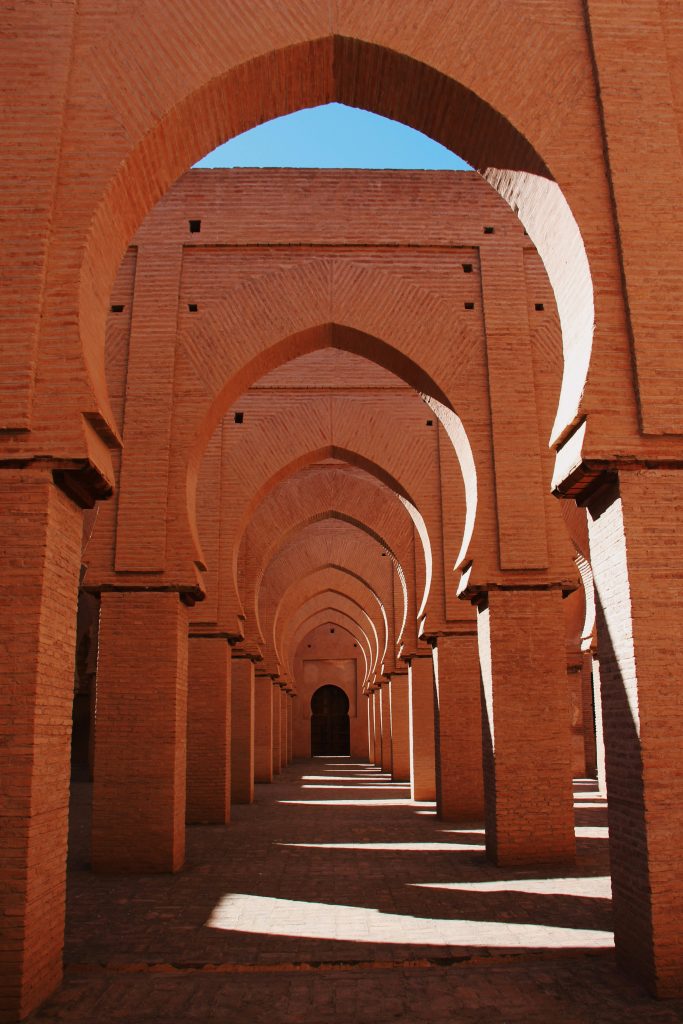
- in the mosques
- in the palaces
- in the imperial cities
Marrakech, Fez, Meknes and Rabat still bear the traces of these great dynasties today.
Modern Morocco is therefore the result of a long historical process in which Amazigh, Arab, African and Mediterranean influences intermingle.
Conclusion
For more than 1,200 years, Morocco’s dynasties have shaped the history of a unique kingdom.
From the Idrisids to the Alaouites, each era helped build Morocco’s identity: a country proud of its past and looking towards the future.
Understanding the history of these dynasties means understanding the deep roots of a country that continues to write its history at the heart of Africa and the world.
© LeMarocOuvreSesPortes.com