Marrakech can be explored during a short stay, but good planning will help you avoid spending all your time in transport or queues. The medina is mainly explored on foot, the main monuments do not all have the same opening hours, and the heat completely changes the pace of a day. The neighbourhood where you stay also influences the experience.
This guide answers practical questions: how many days to allow, where to stay, how to reach the centre, organise visits and respect local places. To understand the history of the dynasties, neighbourhoods and heritage, also read our profile of Marrakech. Information that may change—prices, opening hours, access and event schedules—should always be confirmed with official websites before departure.
How many days should you spend in Marrakech?
Two days allow for an initial discovery focused on the medina: Jemaa el-Fna, the souks, one or two monuments and a garden. The schedule will be packed and leave little room for detours.
Three or four days offer a better balance. You can group sites by area, return to the medina at different times of day and devote half a day to Gueliz or a garden. This format also allows you to accommodate a change in opening hours or a closure without disrupting the entire stay.
Five days or more suit travellers who want to slow down, take part in a workshop, explore the cultural scene or add an excursion. A trip to the Atlas Mountains should not be presented as a simple extension of the city: it requires transport, suitable preparation and the selection of a responsible operator.
The ideal number of days therefore depends less on a universal list of must-see sights than on your pace. If you are travelling with children, during very hot weather or if you enjoy photography, plan fewer visits per day.
Choosing a neighbourhood in which to stay
The medina suits those who want to be as close as possible to the alleyways, souks and activity of the historic centre. Riads are often arranged around an inner courtyard, creating a pleasant contrast with the street. However, vehicles cannot always reach the door, some alleyways are difficult to identify when you first arrive, and noise levels vary greatly depending on the location.
Before booking, ask for the exact drop-off point, the walking distance with luggage and whether the accommodation arranges a welcome. The phrase “near Jemaa el-Fna” can refer to very different surroundings. A property beside an accessible road does not offer the same tranquillity as a riad at the end of a derb.
Gueliz offers wider streets, modern hotels, restaurants and more direct access to taxis. It is a practical choice for travellers who want to alternate between the medina and the modern city. Hivernage has a greater concentration of upscale properties and large hotels. The Palmeraie offers resorts farther away, so every journey to the centre must be included in the time and budget for your stay.
To compare accurately, add any transfers, breakfast, taxes shown when booking and daily travel time to the room price.
Getting to Marrakech and organising your arrival
Marrakech Menara Airport is a short distance from the centre, but the actual transfer time depends on traffic and the drop-off point. Taxis and public transport options serve the city. Routes, prices and timetables may change: check them in the official guide from the Marrakech-Safi Regional Tourism Council or with your accommodation.
If you arrive late or are staying in the medina, an organised transfer can make finding your way easier at first. Ask in writing for the total price, meeting place and name of the point where the vehicle will drop you off. A member of the accommodation staff may sometimes accompany you on foot for the final part.
Marrakech is also connected by train to several major Moroccan cities. The railway station is in the modern city. Consult ONCF directly for timetables and ticket purchases, especially during weekends, holidays and festivals. For intercity coaches, use operators’ official platforms rather than an old timetable copied onto a blog.
Getting around the city
In the medina, walking remains the most efficient option. Distances look short on a map, but detours, crowds and stops lengthen the journey. Download a map that can be used offline and save the address of your accommodation. The name of a riad is not always enough for a driver; a landmark or medina gate is more useful.
Scooters, bicycles, carts and pedestrians share narrow passageways. Walk predictably, keep children close to you and avoid blocking a route to take a photo. After dark, use familiar routes or ask your accommodation for advice.
Small taxis are suitable for urban journeys outside pedestrian areas. Confirm how the meter works or the applicable price before departure, according to the local rules in force. For a journey booked by the hotel, ask whether the amount is fixed. The bus may be useful between the modern city and certain locations, but its usefulness depends on your specific itinerary.
Renting a car is generally not necessary for visiting Marrakech. Parking and traffic add constraints, while the vehicle will remain outside a large part of the medina. A rental makes more sense for a regional itinerary, after checking road and insurance conditions.
The best time according to how you travel
Spring and autumn generally offer the most comfortable temperatures for walking. These are also popular periods, so book earlier if your dates are fixed. Winter can be mild during the day, but evenings and mornings are cool. Not all historic accommodation offers the same insulation or heating.
Summer can be very hot. Plan outdoor visits early in the morning, take a long break during the hottest hours and postpone walks until the evening. An air-conditioned room and a swimming pool can improve comfort, but you need to check what the property actually offers.
Ramadan changes daily routines, opening hours and activity at the end of the day. Travelling during this month remains possible and can be rewarding, provided you anticipate closures, behave discreetly when eating or drinking in public and respect the breaking of the fast. The dates depend on the lunar calendar and must be officially confirmed.
Building an itinerary by area
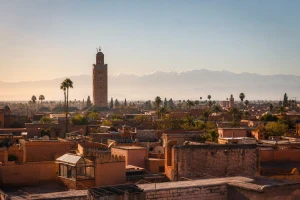
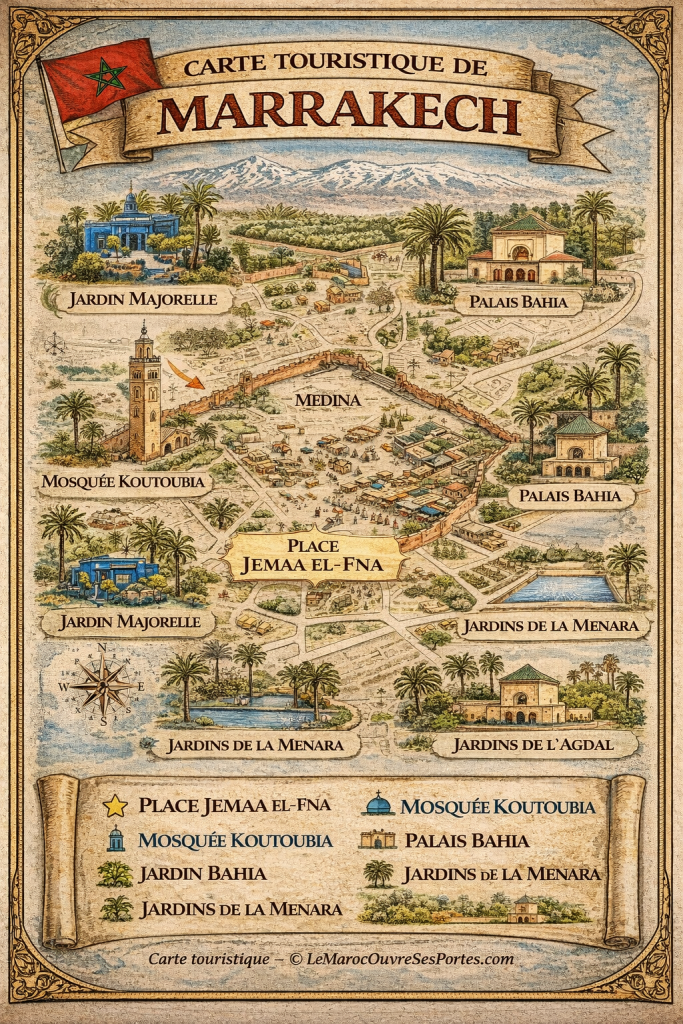
Grouping visits limits journeys back and forth. A first area brings together Jemaa el-Fna, the Koutoubia and the souks. You can devote a flexible day to it, returning to the square in the evening to observe its change in atmosphere.
In the south of the medina, Bahia Palace, the Mellah, the Saadian Tombs and El Badi Palace can form a second group. There is no need to visit everything in succession. Two monuments explored properly are better than a race driven by ticking boxes.
In the north, Ben Youssef Madrasa, the Marrakech Museum and the fondouks allow you to explore another part of the old urban fabric. Access and opening hours for each site should be checked separately.
For the gardens, do not assume that they are close to one another. Jardin Majorelle is in the modern city and uses a highly sought-after ticketing system; use its official channel to check time slots. Menara and Agdal have different histories and visiting conditions. Plan the journeys before combining them within the same half-day.
Booking monuments and activities without falling into traps
Official tickets should be prioritised when online booking is available. Check the website domain, cancellation conditions and what is included. An intermediary platform may sell a ticket, guided tour or transfer under a very similar name; compare before paying.
For a guide, choose an authorised professional and clarify the duration, language, price, meeting point and whether commercial stops are included. A souk tour may include shops, but you should be able to find out whether they are part of the itinerary and remain free not to buy anything.
For a cooking class or craft workshop, ask who actually leads the activity, how many participants are accepted and what share of the payment goes to the professional. The words “cooperative” and “community-based” are not enough to demonstrate a fair model.
Budget: think by category rather than announcing a magic number
The cost of a stay varies greatly depending on the season, neighbourhood and level of comfort. Set out four categories: accommodation, meals, transport and visits. Add a margin for shopping, tips and unexpected expenses. Exact prices quickly become outdated; consult current rates when booking.
When dining, a small local eatery, neighbourhood café, stall and hotel restaurant do not belong to the same category. Look at the menu and prices before ordering. If an item is charged by weight or the price is not displayed, ask for the estimated total.
Negotiation takes place in the souks, but that does not mean you have to push every price to the minimum. First decide what the item is worth to you, ask questions about how it was made and remain courteous. For an expensive or shipped purchase, request a detailed invoice.
Health, heat and everyday safety
Drink regularly, protect yourself from the sun and adjust your level of exertion. In summer, a midday walk can become exhausting very quickly. Bring your usual medication and check the official health recommendations relevant to your circumstances before travelling.
As in any popular destination, keep your phone, wallet and documents secure in crowded areas. Calmly refuse an approach and move away if it becomes persistent. Someone who spontaneously offers to “show you the way” may expect payment; ask an established shopkeeper or your accommodation instead.
For an emergency, keep the contact details for your insurer, accommodation and relevant consular services. Numbers and procedures should be checked before departure, not memorised from an old guide.
Travelling respectfully in an inhabited city
A medina alleyway is not a studio. Ask before photographing a person, a craftsperson at work or the inside of a shop. Respect a refusal without insisting. Avoid flying a drone: Moroccan regulations are restrictive, and importing or using a device requires specific authorisation.
Wear modest clothing in residential neighbourhoods and near religious sites. The Koutoubia is an active mosque and its interior is not open to tourist visits. Do not block an entrance and keep your voice down during prayer times.
At Jemaa el-Fna, some photos or interactions are offered in exchange for payment. Agree on the terms before taking the picture and remain attentive to animal welfare. You can choose not to participate in an activity that does not align with your values.
Finally, limit water and energy use whenever possible. Marrakech is located in an environment affected by water stress. A private swimming pool or daily change of linen has a cost that goes beyond the hotel bill.
The pre-departure checklist
One week before travelling, confirm transport timetables, your arrival transfer and the drop-off point. Download your tickets and an offline map. Check the official opening hours of your two or three priority sites, especially during Ramadan, on a public holiday or during a period of construction work.
Keep a copy of your documents, a card for the accommodation in French or Arabic and a backup payment method. Bring shoes suitable for cobblestones, sun protection and an extra layer in winter.
Once there, leave some flexibility. Marrakech is not well suited to a precisely timed ten-stop schedule. A tea that takes time, an open workshop or a temporarily closed alleyway are not planning failures. A good practical guide does not eliminate the unexpected: it provides enough reference points to embrace it.
Official sources to check before travelling
- Marrakech-Safi Regional Tourism Council, transport: https://visitmarrakech.com/fr/planification/transports/
- Marrakech-Safi Regional Tourism Council, planning your stay: https://visitmarrakech.com/en/planning/
- Moroccan National Tourist Office, Marrakech destination: https://www.visitmorocco.com/fr/voyage/marrakech
- ONCF, train timetables and tickets: https://www.oncf-voyages.ma/
- UNESCO, “Medina of Marrakesh”: https://whc.unesco.org/fr/list/331