Marrakech cannot be reduced to either its most famous square or the ochre walls that gave it its nickname. It is a city where several eras remain visible in its urban landscape: the medina founded in the 11th century, the gardens and water systems, the palaces of successive dynasties, the neighbourhoods built in the 20th century and a contemporary metropolis focused on culture, commerce and tourism.
To understand it, you have to slow down. Behind the intensity of the souks and the major monuments are residential neighbourhoods, workshops, local markets and places where people gather. This portrait recounts the history and character of Marrakech. Opening hours, transport, length of stay and planning advice are deliberately reserved for our practical guide, so that each article serves a clear purpose.
An Almoravid foundation at the foot of the Atlas Mountains
The medina of Marrakech was founded around 1070-1072 by the Almoravids. Its location connected routes from the Sahara, the Atlantic plains and the passes through the Atlas Mountains. The city quickly became a major political and commercial centre. Its name eventually became associated, in several European languages, with that of Morocco.
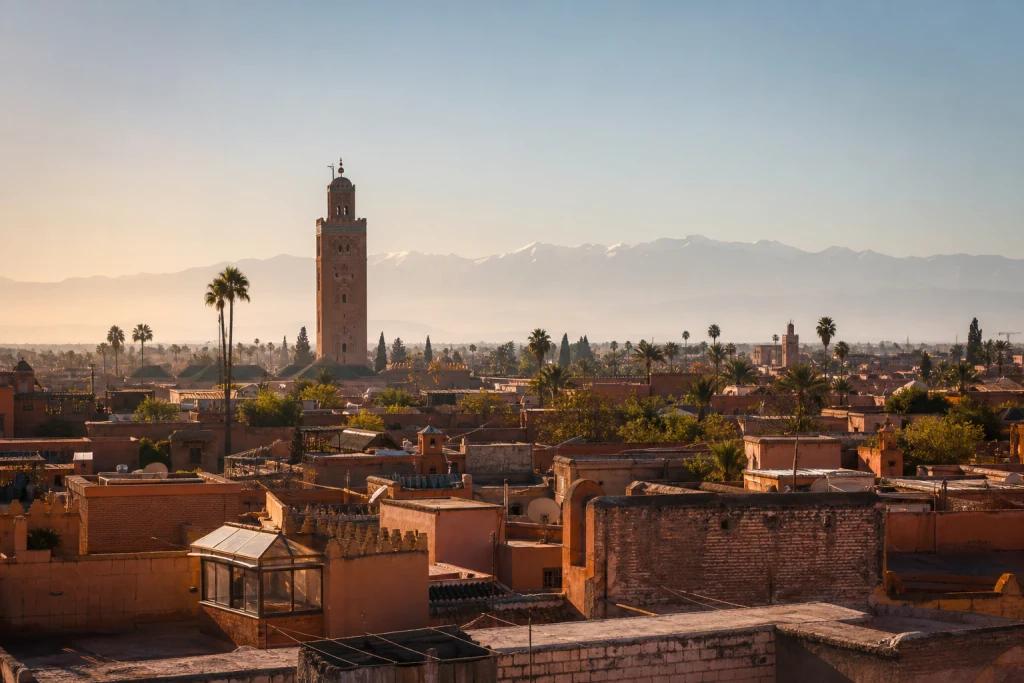
The Almohads took Marrakech in the 12th century and made it their capital in turn. The Koutoubia, whose minaret still dominates the city skyline, dates from this period. The ramparts, gates, gardens and vast royal spaces bear witness to a city designed as both a seat of power and a crossroads of trade.
Marrakech’s political importance subsequently fluctuated. The Marinid, Saadian and Alaouite dynasties moved or reasserted the centre of power depending on the period. In the 16th and 17th centuries, the Saadians notably left behind El Badi Palace and the Saadian Tombs. At the end of the 19th century, Bahia Palace expressed another architectural language: courtyards, interior gardens, stucco, painted wood and zellige come together in an architecture of splendour and intimacy.
This layering explains why Marrakech does not have a single “golden age”. Each period transformed the city, sometimes by reusing or erasing what came before it.
The medina, a historic city that is still inhabited
A UNESCO World Heritage Site since 1985, the medina encompasses an urban fabric far more extensive than a tourist setting. Its narrow streets serve houses, mosques, ovens, fountains, fondouks, schools, shops and workshops. Their functions have evolved, but the neighbourhood remains alive.
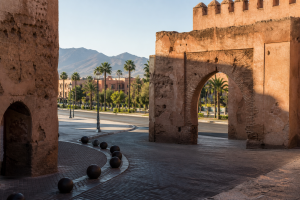
The ramparts form a visible boundary between the old city and its modern extensions. Inside, finding your way does not follow the logic of a grid plan. The main routes lead towards gates, souks or religious sites, then branch into narrower passageways. This layout creates constant changes in light, noise and density.
Heritage status does not shelter the medina from risk. UNESCO highlights pressures linked to urban transformations, unsuitable materials, changing housing patterns and the vulnerability of the palm grove and ancient water systems. Restoring a riad or monument is therefore not valuable solely for its aesthetic result: it raises questions about techniques, residents and the continuity of the neighbourhood.
Jemaa el-Fna, a square and a cultural space
Jemaa el-Fna changes throughout the day. A space for movement and commerce gradually takes the form of a large stage where vendors, cooks, musicians, storytellers and audiences come together. This ability to unite oral, musical, social and commercial expressions explains its symbolic power.
UNESCO inscribed the cultural space of Jemaa el-Fna Square on the Representative List of the Intangible Cultural Heritage of Humanity in 2008, following an initial proclamation in 2001. The inscription does not concern only the buildings surrounding it. Above all, it recognises practices, knowledge and forms of expression without which the square would lose its meaning.
Tourism’s success creates a paradox. It brings an audience and income, but it can also transform practices to meet an expected image. Observing the square attentively means recognising the work of artists and vendors, asking before taking photographs and not treating its participants as decorative elements.
The souks, between production, commerce and display
North of Jemaa el-Fna, the souks form a network of streets where activities were long organised by trade. The boundaries are less distinct today, but areas associated with leather, metals, textiles, spices, wood and lighting can still be found.
The souk is simultaneously a place of production, sales and circulation. Some objects are made in the visible workshop; others come from another region or an industrial supply chain. This diversity is not new, because Marrakech has always been a commercial crossroads. It simply means that “sold in the medina” should not be confused with “made in Marrakech”.
The fondouks recall this history of trade. These buildings accommodated travellers, goods and animals around a courtyard. Several now house workshops or shops. Their restrained architecture reveals another side of the medina, far removed from its palaces alone.
The Koutoubia, an urban landmark and Almohad legacy
The Koutoubia minaret is the most constant landmark in a city where narrow streets often hide the horizon. Built under the Almohads, the mosque stands near Jemaa el-Fna and large gardens. Its minaret influenced other architecture in the western Islamic world, notably the Giralda in Seville and Hassan Tower in Rabat.
The Koutoubia remains an active place of worship and its interior is not open to tourists. Yet its place in the city is not limited to the silhouette photographed from outside. It is a reminder that Marrakech’s monumental heritage continues to have a contemporary religious and social function.
Kasbah and Mellah, neighbouring memories
In the south of the medina, the Kasbah developed around Almohad power and later royal residences. Bab Agnaou marks one of its most famous entrances. The neighbourhood includes the Kasbah Mosque, the Saadian Tombs and a network of residential streets.
Further east, the Mellah bears witness to the Moroccan Jewish presence in Marrakech. Created in the 16th century, it notably includes the Slat Al Azama Synagogue and the Jewish cemetery. Its history has been shaped by exchanges, constraints, departures and urban transformations. Presenting it as merely a picturesque neighbourhood would erase the complexity of a memory still carried by families and institutions.
Between the Kasbah, the Mellah and Bahia Palace, the southern part of the medina makes the proximity between spaces of power, communities and commerce particularly visible.
El Badi and Bahia Palaces: two ways of understanding power
El Badi Palace was built at the end of the 16th century under the Saadian Sultan Ahmed al-Mansour. Its ruins, vast courtyards and pools make it possible to imagine the scale of a complex designed to display dynastic power. The precious materials have largely disappeared, but the emptiness itself reveals the palace’s layout.
Bahia Palace, built and extended in the 19th century, offers a different experience. Visitors pass from one courtyard to another, between apartments, gardens and richly decorated rooms. Attention is drawn to the painted ceilings, stucco, woodwork and zellige. While El Badi impresses through the scale of its remains, the Bahia demonstrates the precision of decorative arts integrated into architecture.
These monuments are not interchangeable. Considering them as two distinct chapters avoids turning them into a list of “must-see palaces” and reveals changes in the language of power.
Guéliz, the modern city and its new centres
Marrakech expanded beyond the ramparts well before the recent tourism boom. Guéliz was developed during the French Protectorate according to a new-town plan, with wide avenues and architecture different from that of the medina. The neighbourhood has become a commercial, residential and cultural centre where 20th-century buildings, galleries, cafés and contemporary constructions intermingle.
Nearby, the Hivernage district has a concentration of hotels, conference venues and leisure establishments. Further away, Sidi Ghanem has established itself as an area for workshops, design and production. These places are a reminder that Marrakchi creativity is not confined to the souks.
The contrast between an “authentic medina” and a “soulless modern city” does not withstand observation. Residents work in one neighbourhood and live in another; artisans, designers and restaurateurs cross these boundaries every day. The identity of Marrakech is built precisely through these movements.
Gardens and water: another history of the city
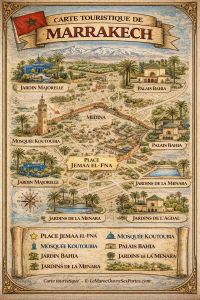
In a semi-arid climate, gardens are inseparable from water management. The Menara and Agdal gardens combine pools, orchards, vistas and irrigation systems. They are not merely green retreats: they bear witness to an organisation of the landscape and a gardening culture linked to the city’s history.
Jardin Majorelle tells a more recent story. Created by the painter Jacques Majorelle and later restored by Yves Saint Laurent and Pierre Bergé, it combines a botanical collection, architecture and colour. Its international fame has made it one of the most visited places in Marrakech, but its story belongs to the 20th century and does not replace that of the historic gardens.
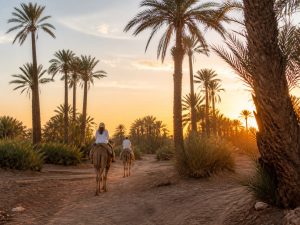
The palm grove, meanwhile, is part of the historic landscape while facing intense urban and environmental pressure. The image of an untouched oasis conceals issues involving water, property development and conservation.
A city of creation, not only conservation
Marrakech attracts artists, filmmakers, fashion designers, architects and designers. This visibility can sometimes produce a standardised aesthetic—ochre walls, zellige, brass and textiles assembled like a global brand. But local creativity is not limited to this image. It is expressed through visual arts, photography, music, gastronomy, craftsmanship and independent spaces.
The city also hosts international events and cultural institutions that connect it to other African and Mediterranean scenes. These initiatives are not separate from its identity: they extend its historic role as a crossroads, while raising questions about access, representation and the place given to local creators.
Marrakech beyond the scenery
The Red City fascinates through its contrasts, but the phrase can become a cliché. The calm of a derb and the bustle of a square, a restored palace and a working fondouk, a historic garden and a design district all belong to the same city. Looking at them together avoids choosing between a postcard Marrakech and a contemporary metropolis.
Its identity lies in this tension: preserving exceptional heritage without emptying it of its residents, welcoming the world without reducing itself to its expectations, and allowing practices to evolve without erasing their history. Marrakech is then discovered not as a collection of hidden treasures, but as a living city whose layers remain in dialogue.
Institutional sources
- UNESCO, “Medina of Marrakesh”, World Heritage Site since 1985: https://whc.unesco.org/fr/list/331
- UNESCO, “Cultural space of Jemaa el-Fna Square”: https://ich.unesco.org/fr/RL/lespace-culturel-de-la-place-jemaa-el-fna-00014
- Moroccan National Tourist Office, Marrakech destination: https://www.visitmorocco.com/fr/voyage/marrakech
- Marrakech-Safi Regional Tourism Council, history and heritage: https://visitmarrakech.com/fr/que-vivre-absolument/histoire-et-patrimoine/