Morocco is a country where history can be read in city walls, in the alleyways of the medinas and in the palaces built by the great dynasties that shaped the kingdom.
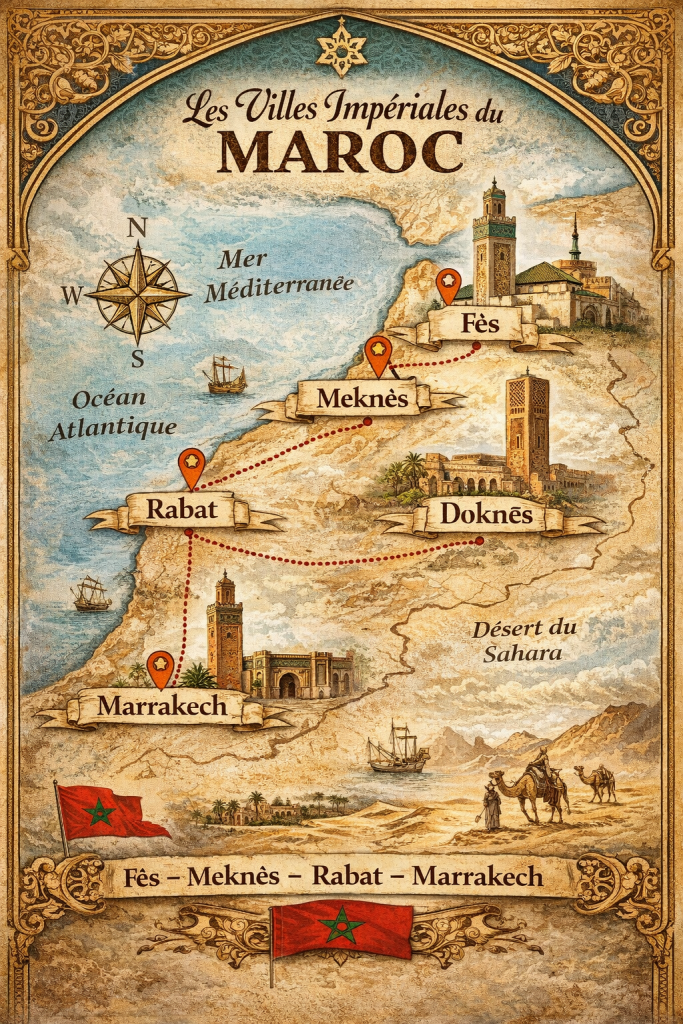
Among all Moroccan cities, four hold a special place in the country’s history: Fez, Marrakech, Meknes and Rabat. They are known as Morocco’s imperial cities.
At different periods in history, these cities were the political and cultural capitals of the kingdom. Each was chosen by a dynasty to become the centre of power.
Today, these cities are genuine historical treasures. Their medinas, palaces, mosques and ramparts recount more than a thousand years of Moroccan history.
In this article, we invite you to discover the fascinating history of Morocco’s four imperial cities and the role they played in building the kingdom.
What is an imperial city?
An imperial city is a city that served as Morocco’s capital under a royal dynasty.
Over the centuries, several dynasties chose different cities as the seats of their power. These cities then became major political, religious and cultural centres.
The rulers had the following built there:
- royal palaces
- monumental mosques
- madrasas (religious schools)
- ramparts and monumental gates
- gardens and public squares
These structures shaped Morocco’s architectural and cultural identity.
Today, the imperial cities are among the country’s most important tourist destinations.
Fez: Morocco’s spiritual capital
Among the imperial cities, Fez holds a special place. Founded in the 9th century by the Idrisid dynasty, it is considered the oldest of Morocco’s imperial cities.
The city was founded by Idris II, who made it the capital of his kingdom.
Thanks to its strategic location and religious importance, Fez quickly became one of the most influential intellectual centres in the Islamic world.
Al Quaraouiyine University
One of Fez’s most famous monuments is Al Quaraouiyine University, founded in 859 by Fatima Al-Fihriya.
This institution is often considered the oldest university still operating in the world.
For centuries, it attracted students and scholars from across the Muslim world.
The medina of Fez
The medina of Fez is now listed as a UNESCO World Heritage Site.
It is one of the largest medinas in the world and includes:
- thousands of alleyways
- traditional souks
- historic madrasas
- famous tanneries
Fez is often called the cultural and spiritual capital of Morocco.
Marrakech: the red city of the dynasties
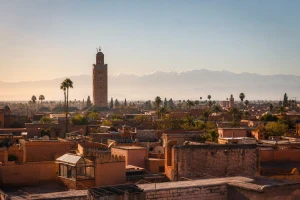
Founded in 1070 by the Almoravids, Marrakech is one of Morocco’s most iconic cities.
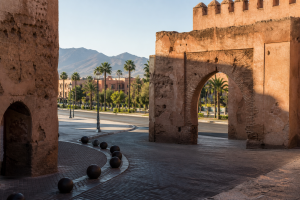
It owes its nickname, the red city, to the ochre colour of its ramparts and buildings.
For several centuries, Marrakech was the capital of powerful Moroccan dynasties.
The Almoravid dynasty
The Almoravids made Marrakech the centre of their empire, which stretched from the Sahara to Andalusia.
They developed an important trade network linking sub-Saharan Africa to Europe.
The Almohads and their monuments
The Almohad dynasty transformed Marrakech into a monumental capital.
Among the most famous monuments built during this period were:
- the Koutoubia Mosque
- the historic gardens
- the city ramparts
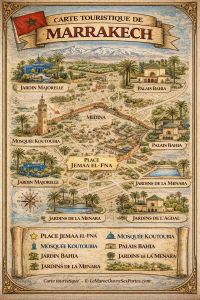
The Koutoubia Mosque remains one of the symbols of Marrakech today.
Jemaa el-Fna square
The famous Jemaa el-Fna square is one of Morocco’s liveliest places.
For centuries, it has welcomed storytellers, musicians, merchants and artists.
It is now inscribed on UNESCO’s Intangible Cultural Heritage list.
Meknes: the capital of Sultan Moulay Ismail
In the 17th century, the city of Meknes became Morocco’s capital during the reign of the Alaouite sultan Moulay Ismail.
This ambitious ruler wanted to build a capital capable of rivalling the great imperial cities of the time.
A monumental imperial city
Moulay Ismail undertook extensive construction work:
- royal palaces
- impressive ramparts
- royal stables
- imperial granaries
The city was surrounded by more than 40 kilometres of ramparts.
Bab Mansour
The monumental Bab Mansour gate is now one of the most famous symbols of Meknes.
It is considered one of Morocco’s most beautiful historic gates.
An exceptional historical heritage
Meknes is now listed as a UNESCO World Heritage Site.
It remains one of the most impressive examples of Moroccan imperial architecture.
Rabat: Morocco’s modern capital
The fourth imperial city is Rabat, which is now the political capital of Morocco.
Its history dates back to the 12th century, when the Almohads built a large fortress there.
Hassan Tower
One of Rabat’s most famous monuments is the Hassan Tower.
This tower was intended to be part of an immense mosque that was never completed.
Today, it remains one of the city’s symbols.
The Mohammed V Mausoleum
Next to the Hassan Tower stands the Mohammed V Mausoleum, the resting place of:
- King Mohammed V
- King Hassan II
This monument is one of the most visited sites in Morocco.
A capital between tradition and modernity
Today, Rabat is a modern city that retains a rich historical heritage.
Its ramparts, medina and Kasbah of the Oudayas still bear witness to its imperial past.
The imperial cities today
Today, Morocco’s imperial cities are among the country’s most visited destinations.
They attract millions of visitors who come to discover:
- Moroccan architecture
- historic medinas
- royal palaces
- craft traditions
These cities offer a genuine journey through Morocco’s history.
They bear witness to the kingdom’s cultural richness and diversity.
Conclusion
Fez, Marrakech, Meknes and Rabat are not merely major Moroccan cities.
They are living witnesses to more than a thousand years of history.
Each dynasty left its mark on these imperial cities, transforming their streets, monuments and traditions.
Visiting these cities means journeying through the pages of Morocco’s history and understanding the deep soul of this thousand-year-old kingdom.
© LeMarocOuvreSesPortes.com