Malhun is not simply another musical genre on a list of traditions. It is popular poetry sung through a shared language of performers, instruments and attentive listening. Its texts can address love, spirituality, celebration, nature, imaginary journeys and social questions.
UNESCO inscribed Malhun on the Representative List of the Intangible Cultural Heritage of Humanity in 2023. The inscription recognises a living practice and its transmission. It does not make every performance offered to visitors an authenticated cultural experience. These MOP guideposts help explain what an audience is hearing.
Poetry created to be sung
The poem is at the centre of Malhun. Verses are primarily sung in Moroccan dialectal Arabic and may also be performed in Hebrew. Music is not background decoration: it gives the text rhythm, breathing space and a relationship with the audience.
Even without understanding every word, a listener can follow the structure of the performance, recurring lines, exchanges between voice and ensemble and changes in intensity.
Themes drawn from life
UNESCO’s record mentions love, the joys of life, beauty, nature, prayer, food, celebration, imaginary travel, politics and social issues. This range explains why Malhun cannot be reduced either to religious expression or to entertainment.
Poems may carry moral messages or respond to their own period. They form an emotional record of society, although they should not be treated as literal historical documents without context.
Recognising the instruments
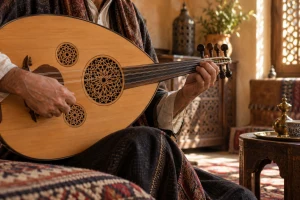
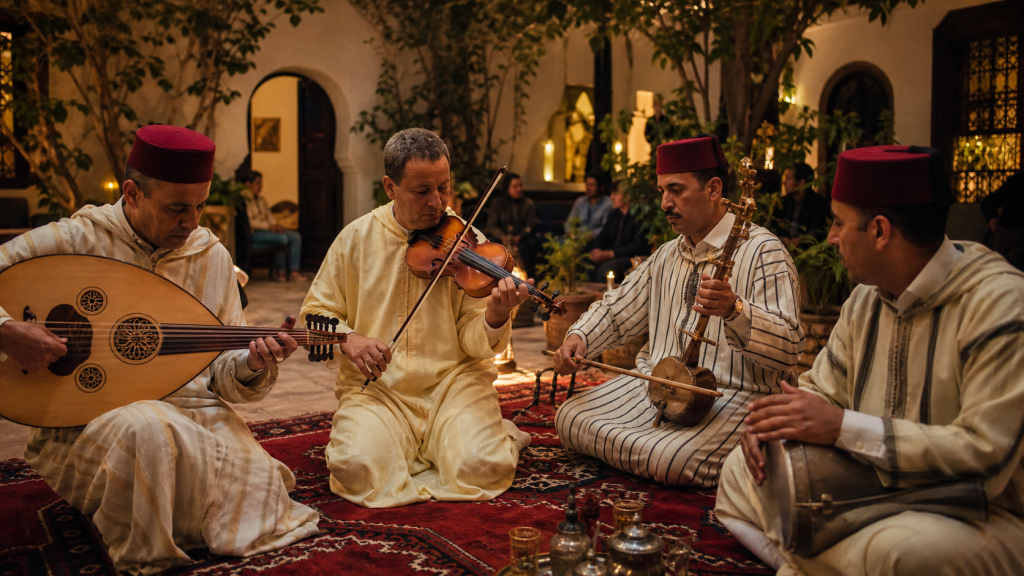
An ensemble may include the oud, violin, rebab and small drums. The exact formation varies with performers and circumstances. Instruments support diction, mark rhythmic cycles and answer the voice.
During a performance, notice how the musicians prepare the singer’s entrance, repeat a phrase or leave room for the words. Silence and anticipation are also part of the musical experience.
A practice connected with several cities
UNESCO’s page points to related heritage places including the medinas of Fez and Marrakech, historic Meknes and Rabat. It would nevertheless be misleading to confine the art to one city or one type of tourist venue.
Malhun can be performed at family gatherings, festivals, conservatoires and major venues. Context changes the encounter: a large stage may offer an accessible introduction, while a smaller setting can bring the words and interaction forward.
How knowledge is transmitted
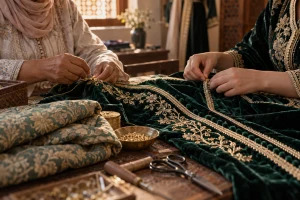
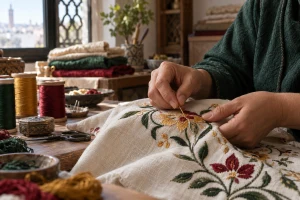
Malhun was traditionally passed on through apprenticeships with singers, musicians, transcribers, poets and makers of instruments and traditional clothing. It is now also taught through associations and music conservatoires and preserved in publications of established texts.
The coexistence matters. Oral learning carries the nuances of performance, while teaching and documentation help new generations approach a demanding repertoire.
What UNESCO inscription means
The 2023 inscription recognises Malhun as an element of intangible cultural heritage. It draws attention to the communities, skills and conditions that keep the practice viable.
It is not a commercial label for a venue or an automatic certification of a show. Using UNESCO’s name in advertising does not by itself prove quality, provenance or a relationship with practising communities.
Listening without turning culture into scenery
Where possible, choose programmes that name the ensemble, performers and repertoire. Arrive on time, avoid conversation during sung passages and ask before recording. A musician is not a decorative subject available for unrestricted filming.
If a workshop or meeting is offered, check who leads it, what is genuinely taught and how artists are compensated. A responsible cultural experience makes space for explanation rather than promising instant “authenticity”.
Building a coherent cultural stop
Malhun can deepen a stay in Fez, Meknes, Marrakech or Rabat when it is connected to a wider understanding of the city: language, craft, architecture, history and contemporary music.
Start with our Destinations catalogue and then consult institutional or cultural programmes for the exact travel dates. MOP does not reproduce unverified schedules or ticket availability that may change.
A living art, not a frozen image
Malhun has crossed centuries because people continue to perform, discuss and transmit it. Its value lies not only in age but in its ability to bring together poetry, music and observation of society.
Listening carefully, identifying artists and respecting the setting are the best ways for a traveller to move from consuming a show to encountering a living cultural practice.
Sources consulted
- UNESCO, “Malhun, a popular poetic and musical art”, file 01592, inscribed in 2023: https://ich.unesco.org/en/RL/malhun-a-popular-poetic-and-musical-art-01592
- UNESCO, Moroccan elements on the Intangible Cultural Heritage lists, accessed 24 August 2026: https://ich.unesco.org/en/state/morocco-MA?info=elements-on-the-lists