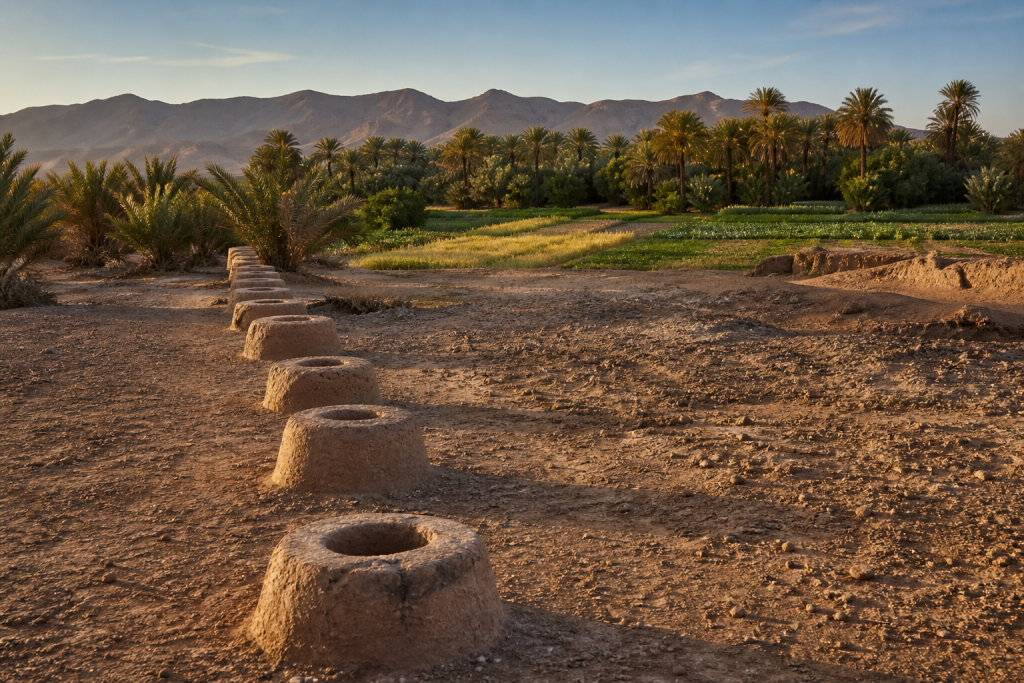
In several Moroccan oases, a line of small shafts across dry ground reveals a structure that is largely underground. A khettara taps an aquifer and carries water through a gently sloping gallery towards inhabited and cultivated land. The visible landscape depends on discreet engineering and collective maintenance.
In 2026, UNESCO granted preparatory assistance to a Moroccan project devoted to the knowledge and skills associated with khettaras. The stated objective is to support documentation and prepare a nomination to the List of Intangible Cultural Heritage in Need of Urgent Safeguarding. This is not yet an inscription on that list.
A gallery, maintenance shafts and a controlled slope
The horizontal gallery transports water by gravity. Vertical shafts help with excavation, ventilation and maintenance. Their succession allows part of the invisible route to be followed from the surface.
That general description does not erase local forms. Depth, length, materials and organisation vary with the ground and the community. A serious visit should begin with the specific place rather than treat one diagram as universal.
Collective knowledge, not an isolated object
A khettara does not keep working simply because it was once built. People must understand the ground, allocate water, clear the gallery, repair collapses and pass on the rules governing use.
The heritage lies as much in those skills and decisions as in the structure. Photographing a shaft without explaining water sharing gives an incomplete account of the oasis.
Why safeguarding has become urgent
The UNESCO assistance page identifies several threats: depletion of groundwater, loss of transmission, damage associated with alternating floods and severe droughts, and migration of skilled labour.
Those pressures can reinforce one another. A gallery that receives less maintenance deteriorates, while a scarcer resource makes the work harder. Safeguarding cannot mean repairing a visible opening alone; it must consider water, skills and social organisation.
What the 2026 project sets out to do
The approved assistance concerns documentation, an updated inventory and preparation of a nomination file. The page also refers to a film about the techniques involved, including excavation and underground drainage.
The announced assistance is USD 10,000, with implementation scheduled from 5 August 2026 to 30 April 2027. These details describe an approved project; they do not prove that a specific restoration has already been completed.
Visit without weakening the structure
A maintenance shaft can be deep and dangerous. Do not approach an unprotected opening, stand on its edge or enter a gallery without an authorised professional safety system.
Remain on routes indicated by residents or a guide. Channels and fields are working infrastructure, often connected to rights of use. A photograph is not a reason to cross a boundary.
Choose honest interpretation
Ask who is presenting the khettara, how the visit contributes to its maintenance and which elements can genuinely be observed. Be cautious about any promise of underground exploration that does not explain safety.
Good interpretation separates historic operation, present condition and proposed safeguarding. It does not turn a UNESCO project into a tourism label that has already been awarded.
Connect water, agriculture and settlement
The khettara becomes meaningful when visitors see the palm grove, crops, secondary channels and settlement that it helped make possible. Water is not separate from architecture or food; it structures the territory.
This reading encourages a slower visit. Instead of collecting several oases in one day, choose a place where the history and present use of water can be explained precisely.
Responsible habits
- Never enter a gallery alone.
- Respect barriers, paths and water-use rights.
- Ask before photographing people at work.
- Distinguish a safeguarding project from an effective UNESCO inscription.
- Check how a visit or donation is managed.
- Avoid wasting water where it conditions local life.
The MOP Destinations catalogue places this knowledge within the valleys and oases of southern Morocco. The khettara shows that a spectacular landscape may depend on an almost invisible system—and on people who continue to maintain it.