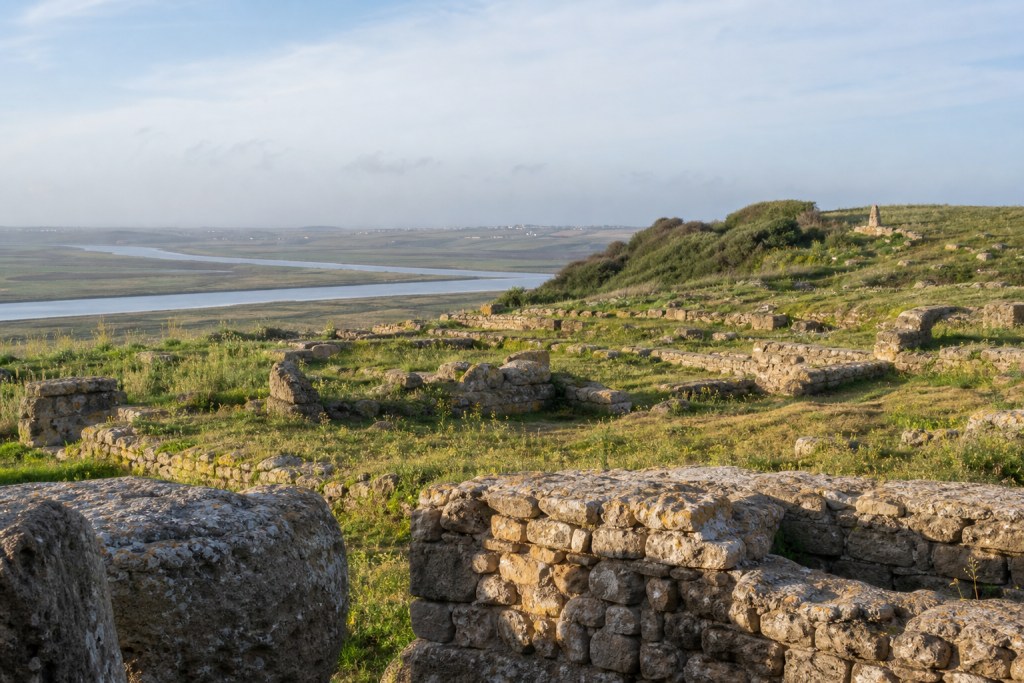
A few kilometres from Larache, Lixus stands on high ground near the mouth of the Loukkos. It does not tell the story of a single period: its long occupation requires visitors to separate the layers and resist overly simple narratives.
Morocco’s official entry on UNESCO’s Tentative List describes Phoenician, Punic, Mauretanian, Roman, post-Roman and Islamic phases. MOP starts with that documented framework, then asks travellers to verify the practical conditions immediately before visiting.
Place Lixus in the Larache landscape
Lixus lies near Larache in a landscape shaped by the Loukkos and the Atlantic. Its position helps explain relationships with movement and coastal resources. It does not, however, allow us to reconstruct the exact ancient landscape simply from today’s view.
A coherent day can connect the archaeological site with Larache, but both deserve time. Avoid packing Lixus, Asilah and Tangier into one short half-day: transfers and contingency margins would replace meaningful observation.
Read several periods, not one civilisation
UNESCO’s notice places occupation between the eighth century BCE and the fourteenth century. It distinguishes successive phases. This chronology is a reading framework, not a promise that an untrained visitor can immediately date every visible structure.
Use the interpretation available on site and follow guidance from staff. When an identification is uncertain, describe a visible sector or structure rather than assigning it a dramatic function without evidence.
Understand the maritime economy
The official record notes an important fish-salting complex. This is a reminder that Lixus is not understood through monumental buildings alone: productive activity and the site’s relationship to the coast also matter.
Do not label every installation as a specific workshop unless the interpretation confirms it. Archaeology relies on context, comparison and dating; one photograph cannot reconstruct a complete industry.
Check access instead of copying old schedules
Opening hours, charges, access and temporary restrictions can change. Confirm them through an official or local source shortly before departure. An old article, however careful, is not an opening guarantee.
Carry water, sun protection and stable footwear. Wind, heat and rain can change the comfort of the route. If you need step-free access or another accommodation, ask which sectors are accessible before arranging transport.
Photograph without damaging the record
The remains are a fragile archive, not a set. Stay on authorised routes, do not climb on masonry and never remove a fragment. Even an ordinary-looking stone belongs to a context that only archaeological work can document.
Do not assume that ordinary admission covers professional equipment, a drone or a large setup. Check the site’s rules and, for drones, complete Morocco’s national formalities before travelling.
Continue the reading in Larache
Larache extends the territorial story through its urban fabric, its relationship with the Loukkos and its maritime outlook. The connection must remain editorial: the contemporary town does not preserve every key to the ancient site.
Leave a pause between both visits. It prevents heritage from becoming a stream of images and makes it easier to distinguish periods, uses and the lives of today’s residents.
What UNESCO Tentative List status means
Lixus has appeared on Morocco’s Tentative List since 1 July 1995 in the cultural category. A Tentative List identifies properties a state may consider nominating; it is not the same as inscription on the World Heritage List.
This distinction prevents an inflated claim about the site’s status. Its importance rests on documentation and conservation, not an imprecise promotional label.
Checks to make before leaving
- Opening, access and visiting conditions recently confirmed.
- Outbound and return transport planned with a realistic margin.
- Water, sun protection and suitable footwear packed.
- Photography and circulation instructions followed.
- No touching, moving or removing archaeological material.
- Separate time reserved for Larache and Lixus.
For a wider regional framework, MOP’s destination catalogue helps place northern travel corridors without turning every town into a rushed excursion.
Sources consulted
- UNESCO World Heritage Centre, “Lixus”, Morocco’s official Tentative List entry: file 456